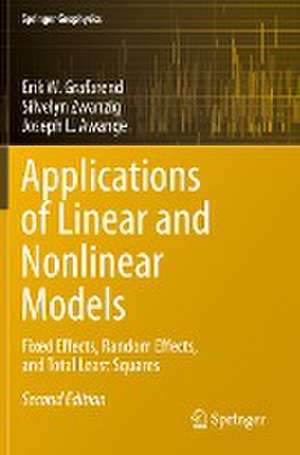
Applications of Linear and Nonlinear Models: Fixed Effects, Random Effects, and Total Least Squares: Springer Geophysics
Autor Erik W. Grafarend, Silvelyn Zwanzig, Joseph L. Awangeen Limba Engleză Paperback – 3 oct 2023
În această a doua ediție a lucrării Applications of Linear and Nonlinear Models, remarcăm o extindere substanțială a cadrului teoretic și aplicativ necesar în geofizică și geodezie, prin adăugarea a trei capitole fundamentale ce vizează metodele Bayes, modelele Error-in-variables (EIV) și algoritmii pentru minime pătrate întregi. Descoperim aici o abordare duală riguroasă, care armonizează viziunea algebrică (precum soluțiile LESS) cu cea stocastică (estimările BLUUE), oferind o imagine completă asupra regresiei liniare și slab neliniare în primele opt capitole. Față de literatura existentă, volumul se distinge prin tratarea sistemelor de ecuații neliniare pe varietăți curbe, utilizând soluții hibride numeric-simbolice, o necesitate în contextul datelor sferice sau hipersferice actuale.
Observăm o progresie logică a conținutului, de la problemele de bază ale regresiei algebrice și probabilistice, până la complexitatea modelelor Gauss-Markov cu efecte aleatorii. Comparativ cu Linear Model Theory de Dale L. Zimmerman, care se concentrează masiv pe exerciții și teoria clasică ANOVA, lucrarea de față este mult mai orientată către aplicațiile complexe din științele pământului, integrând concepte avansate precum coordonatele Grassmann–Plucker și mulțimile FUZZY. De asemenea, deși acoperă teme similare cu Total Least Squares and Errors-in-Variables Modeling de S. van Huffel, volumul de față oferă o perspectivă mai integrată în contextul geodeziei algebrice, beneficiind de expertiza autorilor în modelarea rețelelor geodetice.
Această ediție consolidează direcțiile explorate de Erik W. Grafarend în lucrări anterioare precum Algebraic Geodesy and Geoinformatics, rafinând tranziția de la fundamentele algebrice la aplicațiile practice de înaltă precizie. Cele patru anexe, care totalizează o parte semnificativă din cele peste 1100 de pagini, transformă volumul într-o resursă enciclopedică, acoperind de la algebra tensorială la algoritmul Buchberger.
Din seria Springer Geophysics
- 18%
 Preț: 985.58 lei
 - 18%
 Preț: 1488.75 lei
 - 24%
 Preț: 1163.85 lei
 - 18%
 Preț: 997.97 lei
 - 15%
 Preț: 673.09 lei
 - 15%
 Preț: 680.99 lei
 - 18%
 Preț: 997.76 lei
 - 15%
 Preț: 670.93 lei
 - 18%
 Preț: 998.19 lei
 - 18%
 Preț: 998.19 lei
 - 24%
 Preț: 886.24 lei
 - 18%
 Preț: 1167.85 lei
 - 15%
 Preț: 516.94 lei
 - 18%
 Preț: 815.01 lei
 - 18%
 Preț: 759.56 lei
 - 18%
 Preț: 807.81 lei
 - 18%
 Preț: 920.59 lei
 - 19%
 Preț: 524.97 lei
 - 15%
 Preț: 501.24 lei
 - 24%
 Preț: 977.52 lei
 - 15%
 Preț: 655.14 lei
 - 18%
 Preț: 807.38 lei
 - 18%
 Preț: 895.14 lei
 - 18%
 Preț: 1020.39 lei
 - 24%
 Preț: 972.62 lei
 - 24%
 Preț: 970.26 lei
Preț: 1346.47 lei
Preț vechi: 1771.68 lei
-24%
Carte tipărită la comandă
Livrare economică 04-10 decembrie
Specificații
ISBN-10: 3030946002
Pagini: 1113
Ilustrații: XXV, 1113 p. 131 illus.
Dimensiuni: 155 x 235 mm
Ediția:2nd ed. 2022
Editura: Springer International Publishing
Colecția Springer
Seria Springer Geophysics
Locul publicării:Cham, Switzerland
De ce să citești această carte
Recomandăm această lucrare cercetătorilor și studenților avansați în geofizică și geodezie care necesită un fundament matematic solid pentru modelarea datelor. Cititorul câștigă acces la tehnici moderne de estimare, inclusiv metode Bayes și algoritmi LLL pentru baze reduse, esențiale în poziționarea de precizie. Este o resursă indispensabilă pentru înțelegerea riguroasă a modelelor de regresie aplicate în studiul formei și dinamicii Pământului.
Despre autor
Echipa de autori reunește experți de renume în domeniul geodeziei și matematicii aplicate. Erik W. Grafarend a fost o figură centrală în geodezia teoretică, cunoscut pentru integrarea algebrei liniare și a geometriei diferențiale în studiul rețelelor geodetice, așa cum demonstrează și lucrarea sa Map Projections. Silvelyn Zwanzig aduce expertiza în statistică matematică, în timp ce Joseph L. Awange contribuie cu o vastă experiență în geoinformatică și aplicații de mediu, colaborând anterior cu Grafarend pentru a umple lacunele educaționale din literatura de specialitate dedicată studenților de la inginerie și științele pământului.
Cuprins
Notă biografică
Textul de pe ultima copertă
(1) Chapter on integer least squares that covers (i) model for positioning as a mixed integer linear model which includes integer parameters. (ii) The general integer least squares problem is formulated, and the optimality of the least squares solution is shown. (iii) The relation to the closest vector problem is considered, and the notion of reduced lattice basis is introduced. (iv) The famous LLL algorithm for generating a Lovasz reduced basis is explained.
(2) Bayes methods that covers (i) general principle of Bayesian modeling. Explain the notion of prior distribution and posterior distribution. Choose the pragmatic approach for exploring the advantages of iterative Bayesian calculations and hierarchical modeling. (ii) Present the Bayes methods for linear models with normal distributed errors, including noninformative priors, conjugate priors, normal gamma distributions and (iii) short outview to modern application of Bayesian modeling. Useful in case of nonlinear models or linear models with no normal distribution: Monte Carlo (MC), Markov chain Monte Carlo (MCMC), approximative Bayesian computation (ABC) methods.
(3) Error-in-variables models, which cover: (i) Introduce the error-in-variables (EIV) model, discuss the difference to least squares estimators (LSE), (ii) calculate the total least squares (TLS) estimator. Summarize the properties of TLS, (iii) explain the idea of simulation extrapolation (SIMEX) estimators, (iv) introduce the symmetrized SIMEX (SYMEX) estimator and its relation to TLS, and (v) short outview to nonlinear EIV models.
The chapter on algebraic solution of nonlinear system of equations has also been updated in line with the new emerging field of hybrid numeric-symbolic solutions to systems of nonlinear equations, ermined system of nonlinear equations on curved manifolds. The von Mises–Fisher distribution is characteristic for circular or (hyper) spherical data. Our last chapter is devoted to probabilistic regression, the special Gauss–Markov model with random effects leading to estimators of type BLIP and VIP including Bayesian estimation.
A great part of the work is presented in four appendices. Appendix A is a treatment, of tensor algebra, namely linear algebra, matrix algebra, and multilinear algebra. Appendix B is devoted to sampling distributions and their use in terms of confidence intervals and confidence regions. Appendix C reviews the elementary notions of statistics, namely random events and stochastic processes. Appendix D introduces the basics of Groebner basis algebra, its careful definition, the Buchberger algorithm, especially the C. F. Gauss combinatorial algorithm.