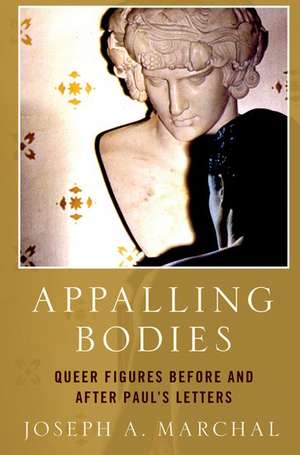
Appalling Bodies: Queer Figures Before and After Paul's Letters
Autor Joseph A. Marchalen Limba Engleză Paperback – 21 dec 2022
Recomandăm volumul Appalling Bodies ca o resursă esențială pentru studenții în teologie, cercetătorii în studii de gen și practicienii interesați de intersecția dintre religie și sociologie. Joseph A. Marchal propune o schimbare de paradigmă în exegeza biblică: în loc să se concentreze exclusiv pe figura lui Pavel, autorul direcționează atenția către „corpurile îngrozitoare” — acele prezențe marginalizate precum femeile, eunucii sau sclavii, care apar în și pe lângă scrisorile pauline. Suntem de părere că forța acestui studiu rezidă în utilizarea riguroasă a teoriei queer pentru a chestiona stereotipurile imperiale romane integrate în canonul creștin.
Din punct de vedere metodologic, Appalling Bodies se distinge prin tehnica juxtapunerii anacronice, un procedeu care aduce față în față figurile antice cu identitățile sexuale contemporane. Această abordare extinde cadrul propus de Contextualizing Gender in Early Christian Discourse de Caroline Vander Stichele, integrând date noi despre modul în care stigmatizarea corpurilor non-normative a modelat istoria interpretării. Dacă în lucrarea sa anterioară, The People beside Paul, autorul explora identitatea colectivă a comunităților din Filipi, aici el plonjează mai adânc în mecanismele de excludere, analizând cum corpul devine un câmp de luptă ideologic.
Considerăm că textul oferă o perspectivă critică necesară asupra modului în care textele biblice sunt folosite în disputele culturale actuale. Ritmul argumentației este dens, susținut de o documentare vastă, iar structura facilitează o înțelegere clară a modului în care categoriile de gen și etnie se suprapun în contextul imperial. Este o lucrare care nu doar analizează trecutul, ci provoacă cititorul să reevalueze fundamentele etice ale lecturii biblice moderne.
Preț: 275.22 lei
Preț vechi: 333.18 lei
-17%
Carte disponibilă
Livrare economică 06-11 noiembrie
Specificații
ISBN-10: 0197668968
Pagini: 328
Dimensiuni: 152 x 237 x 20 mm
Greutate: 0.49 kg
Editura: Oxford University Press
Colecția OUP USA
Locul publicării:New York, United States
De ce să citești această carte
Această carte este indispensabilă pentru cei care doresc să înțeleagă rădăcinile istorice și politice ale normativității de gen în creștinismul timpuriu. Cititorul câștigă o perspectivă critică asupra scrisorilor pauline, învățând să identifice vocile marginalizate din text. Este o lectură fundamentală pentru oricine studiază modul în care religia modelează percepția asupra corpului uman și a diversității sexuale, oferind instrumente teoretice moderne pentru o analiză biblică riguroasă.
Despre autor
Joseph A. Marchal este profesor de studii religioase la Grinnell College, fiind o voce recunoscută în domeniul interpretării biblice feministe și postcoloniale. Expertiza sa se concentrează pe analiza contextului social și politic al Noului Testament, cu un interes deosebit pentru figurile marginalizate de istoriografia tradițională. A publicat numeroase articole și volume, printre care se numără și The People beside Paul, lucrări ce reflectă angajamentul său de a aduce la lumină complexitatea identităților din antichitatea greco-romană și relevanța acestora pentru discursul academic contemporan.
Descriere
Recenzii
Marchal reaches across history—with an acknowledged debt to Carolyn Dinshaw's queer historiography (1999, 2012)—not to locate forebears from those distant years, but rather to illustrate the ways that gender and sexuality are constructed and contested in these texts, and to resist the ways they still influence the shape of gender and sexuality in our contemporary moment. In thinking about the androgyne, the eunuch, the slave, and the barbarian, Marchal performs a tour de force of theoretical and exegetical work.
Appalling Bodies is such a rich analysis of lives touched, traumatized, destroyed, and resurrected by sex. Paul's letters are the occasion. History and theory are the modes of inquiry. But joy, sorrow, love, and pain are the true subjects of this work, or that's how it seemed to me.
Simply stunning and exhilarating! Marchal travels back and forth in time to juxtapose fascinating (and often threatening) figures of the first and the twentyfirst century to show us a whole new way of reading Paul's letters without placing Paul at the center. This carefully researched, conspicuously erudite, and compellingly readable book will surprise, delight, and impress you.
Joseph Marchal has emerged as one of today's leading practitioners of queer biblical scholarship, and this volume amply demonstrates why. It will be required reading not only for scholars who are interested in the letters attributed to Paul and the assumptions made by those letters (and by their interpreters) about gender and sexuality, but also for anyone who seeks a model for queer engagement with ancient texts.
Appalling Bodies takes us beyond a kyriarchal focus on Paul to appreciation of the other figures that populate his letters for rhetorical effect- prophetic women, eunuchs, and slaves, whose gender and sexuality do not conform to imperial Roman elite male sexuality. Making partial and contingent touches across time to contemporary LGBTQI communities, Marchal troubles and complicates the sexual regimes Paul's letters are used to enforce. This brilliant book is sure to become a classic in studies of scripturalized sexual norms and queer engagements with the Bible.
This is an immensely exciting book, exceptionally original and stunningly creative, the first to limn out in full the contours of a queer historiography in biblical studies. It amounts to a dizzying defamiliarization of ground that has been endlessly trodden and retrodden by Pauline scholars. But it is not a specialist tome. It richly merits an audience beyond the boundaries of biblical studies, and even beyond religious studies.
Appalling Bodies is a deeply ethical book meant to improve human lives, especially those of the most marginalized among us. Theories can be opaque to general readers, but to show how these theories can make human lives more livable, Marchal explains them clearly. Marchal employs deliberate anachronism to shake up readers' belief that they know what Paul meant, thereby undercutting fundamentalisms. Fundamentalisms are resulting in deaths, whether through hate crimes or suicides, and Marchal understands the urgency of truly alternative biblical interpretation in which marginalized figures become central.
In Appalling Bodies: Queer Figures Before and After Paul's Letters-an excellent, detailed, and thorough study of queer figures in the Greco-Roman environment in which Paul writes his letters-Joseph Marchal engages in intentionally "anachronistic juxtaposition," a queering of time and history to highlight ancient attitudes towards androgynes, eunuchs, slaves, and foreigners. The book rewards the reader with a wealth of insight into both ancient and modern topics and will prove an essential text for any further scholarly engagement with corporeality in Paul.