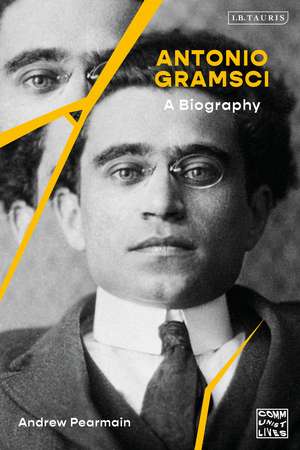
Antonio Gramsci: A Biography: Communist Lives
Autor Andrew Pearmainen Limba Engleză Hardback – 20 aug 2020







Preț: 547.05 lei
Preț vechi: 697.12 lei
-22%
Puncte Express: 821
Carte tipărită la comandă
Livrare economică 23 noiembrie-07 decembrie
Livrare prin curier în România Termenul estimat este afișat lângă disponibilitate.
Transport gratuit pentru acest produs Plată online sau ramburs, în funcție de opțiunile comenzii.
Retur gratuit în 14 zile Comandă securizată și suport în română.
Specificații
ISBN-13: 9781838601607
ISBN-10: 1838601600
Pagini: 248
Dimensiuni: 156 x 234 x 22 mm
Greutate: 0.53 kg
Editura: Bloomsbury Publishing
Colecția I.B.Tauris
Seria Communist Lives
Locul publicării:London, United Kingdom
ISBN-10: 1838601600
Pagini: 248
Dimensiuni: 156 x 234 x 22 mm
Greutate: 0.53 kg
Editura: Bloomsbury Publishing
Colecția I.B.Tauris
Seria Communist Lives
Locul publicării:London, United Kingdom
V-ar putea interesa
-
 Preț: 207.49 lei
 -
 Prison Notebooks - Volume 1Antonio GramsciPreț: 258.34 lei
 -
 Prison NotebooksAntonio GramsciPreț: 262.91 lei
 -
 IndignityLea Ypi-28%Preț: 101.86 lei142.26 lei
 -
 Interesting Times: A Twentieth-Century LifeEric Hobsbawm-26%Preț: 79.52 lei108.03 lei
 -
 Preț: 202.33 lei
 -
 Selections from Political WritingsAntonio GramsciPreț: 260.00 lei
 -
 A Gramsci ReaderAntonio GramsciPreț: 264.60 lei
 -
 Antonio GramsciGiuseppe FioriPreț: 143.15 lei
 -
 New Gramscian PathsGuido LiguoriPreț: 380.35 lei
 -
 Gramsci and the Struggle for Democratic CommunismMichael Wayne-32%Preț: 553.69 lei817.86 lei
 -
 -17%Preț: 134.94 lei163.09 lei
 -
 Young StalinSimon Sebag MontefiorePreț: 81.82 lei
 -
 The Rise and Fall of the Italian Communist PartySilvio PonsPreț: 541.56 lei
 -
 A Political Life: 1937 - 1985Alain BadiouPreț: 192.97 lei
 -
 The ProphetKahlil GibranPreț: 27.21 lei
 -
 Antonio GramsciAntonio A. SantucciPreț: 113.11 lei
 -
 Karl Marx and the Birth of Modern SocietyMichael HeinrichPreț: 248.26 lei
 -
 Gramsci's FallNora BossongPreț: 148.28 lei
 -
 A Rebels Guide To GramsciChris Bambery-20%Preț: 22.62 lei28.36 lei
Cuprins
A. Infancy and Childhood in Rural Sardinia, effects of Gramsci's father's prosecution and imprisonment.
B. School study at home and in Cagliari.
C. Scholarship and study at the University of Turin, and early involvement in radical politics.
D. Early journalism and activism in the Socialist Party.
E. Italian responses to the First World War and the Soviet revolution, and schisms within the Socialist Party.
F. The journal Ordine Nuovo and the Turin Factory Councils movement.
G. The foundation of the Italian Communist Party, and the reaction of Fascism.
H. The early life of the PCd'I, Gramsci's then minor role, and his time in Russia at the Communist International, including his acquaintance with the Schucht family, his complicated courtship of Julia and the birth of their sons.
I. Return to Italy as a Communist MP, then (with the arrest of most of the party leadership) as Party Secretary, culminating in arrest in November 1926.
J. Early prison years, with court appearances and frequent relocations, with growing reliance on Tatiana and estrangement from Julia and the rest of the Schucht family.
K. Settlement at the penitentiary in Turi di Bari, and a serious start on the prison notebooks.
L. The inner-party feuds of the early 1930s and their ramifications for Gramsci.
M. The onset of serious ill health, and death in 1937.
N. The several 'after-lives' of Antonio Gramsci, and the continuing relevance of his thought.
B. School study at home and in Cagliari.
C. Scholarship and study at the University of Turin, and early involvement in radical politics.
D. Early journalism and activism in the Socialist Party.
E. Italian responses to the First World War and the Soviet revolution, and schisms within the Socialist Party.
F. The journal Ordine Nuovo and the Turin Factory Councils movement.
G. The foundation of the Italian Communist Party, and the reaction of Fascism.
H. The early life of the PCd'I, Gramsci's then minor role, and his time in Russia at the Communist International, including his acquaintance with the Schucht family, his complicated courtship of Julia and the birth of their sons.
I. Return to Italy as a Communist MP, then (with the arrest of most of the party leadership) as Party Secretary, culminating in arrest in November 1926.
J. Early prison years, with court appearances and frequent relocations, with growing reliance on Tatiana and estrangement from Julia and the rest of the Schucht family.
K. Settlement at the penitentiary in Turi di Bari, and a serious start on the prison notebooks.
L. The inner-party feuds of the early 1930s and their ramifications for Gramsci.
M. The onset of serious ill health, and death in 1937.
N. The several 'after-lives' of Antonio Gramsci, and the continuing relevance of his thought.
Recenzii
A compelling narrative of Gramsci's life and times with a lucid exposition of his intellectual achievements ... It is beautifully and sensitively written, sober in tone, wise in judgment and full of striking aperçus.
Gramsci is probably the most brilliant of all Marx's intellectual followers. He was also a real historical actor, secret leader of the Italian Communist Party under Fascism. Pearmain's biography places the first fact in the context of the second: he has written a book that, just as he aimed to do, re-places Gramsci from merely academic treatments back into "politics and history". This biography enables one to understand how this extraordinary organic intellectual can have so much to say that speaks to us still today. His difficult existence - in ill-health, as beleaguered political prisoner, and in a world that gradually seemed to forget all that he holds dear - casts real light on how his thought became increasingly 'revisionist' during the course of his (too-short) life, and on how the Gramscian net of concepts such as 'subaltern' and 'hegemony' is far more relevant to our times than most more-dogmatically Marxian theory. Pearmain's account is simultaneously humble and authoritative, grounded sharply in Gramsci's time and yet dripping with relevances to our own. It is faithful and therefore poignant. It deserves to be read.
Gramsci is probably the most brilliant of all Marx's intellectual followers. He was also a real historical actor, secret leader of the Italian Communist Party under Fascism. Pearmain's biography places the first fact in the context of the second: he has written a book that, just as he aimed to do, re-places Gramsci from merely academic treatments back into "politics and history". This biography enables one to understand how this extraordinary organic intellectual can have so much to say that speaks to us still today. His difficult existence - in ill-health, as beleaguered political prisoner, and in a world that gradually seemed to forget all that he holds dear - casts real light on how his thought became increasingly 'revisionist' during the course of his (too-short) life, and on how the Gramscian net of concepts such as 'subaltern' and 'hegemony' is far more relevant to our times than most more-dogmatically Marxian theory. Pearmain's account is simultaneously humble and authoritative, grounded sharply in Gramsci's time and yet dripping with relevances to our own. It is faithful and therefore poignant. It deserves to be read.