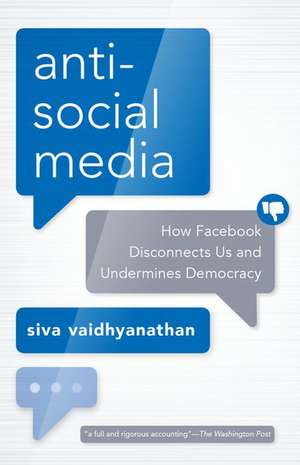
Antisocial Media: How Facebook Disconnects Us and Undermines Democracy
Autor Siva Vaidhyanathanen Limba Engleză Paperback – 13 ian 2022
Destinată studenților la științe politice, cercetătorilor în media și practicienilor din domeniul comunicării digitale, lucrarea Antisocial Media oferă o perspectivă critică esențială asupra modului în care conectivitatea globală a devenit o vulnerabilitate sistemică. Siva Vaidhyanathan demonstrează cum algoritmul Facebook, deși conceput cu bune intenții de către studenți de la Harvard, a degenerat într-o mașinărie care amplifică propaganda, ura și neîncrederea în știință.
Subliniem faptul că autorul nu se limitează la o critică tehnologică, ci atacă ideologia „soluționismului” prin cod, care ignoră complexitatea deliberării democratice. Ne-a atras atenția analiza detaliată a modului în care platforma a facilitat ingerințele rusești în alegerile americane și a fost exploatată de regimuri autoritare în Asia. Spre deosebire de Facebook, the Media and Democracy de Leighton Andrews, care se concentrează pe reglementările legislative și interviuri cu utilizatori, Antisocial Media adoptă o abordare mai teoretică și culturală, examinând hubris-ul din spatele misiunii Facebook.
Această lucrare reprezintă o continuare firească a preocupărilor autorului pentru libertatea informației și proprietatea intelectuală, teme explorate anterior în The Anarchist in the Library și Copyrights and Copywrongs. Dacă în lucrările trecute Siva Vaidhyanathan analiza lupta pentru accesul la date, aici el avertizează asupra pericolului pe care îl reprezintă colectarea masivă de date și supravegherea sub paravanul interacțiunii sociale. Apreciem stilul narativ clar, care reușește să explice mecanisme complexe de erodare a spațiului public fără a recurge la un limbaj excesiv de tehnic.
Preț: 100.24 lei
Preț vechi: 122.02 lei
-18%
Carte disponibilă
Livrare economică 06-17 noiembrie
Livrare express 23-29 octombrie pentru 54.08 lei
Specificații
ISBN-10: 0190056541
Pagini: 336
Dimensiuni: 156 x 235 x 23 mm
Greutate: 0.49 kg
Editura: Oxford University Press
Colecția OUP USA
Locul publicării:New York, United States
V-ar putea interesa
-
 The Net DelusionEvgeny MorozovPreț: 136.00 lei
 -
 FacebookSteven Levy-48%Preț: 78.52 lei150.64 lei
 -
 Like, Comment, SubscribeMark Bergen-17%Preț: 92.78 lei111.12 lei
 -
 An Ugly Truth: Inside Facebook's Battle for DominationSheera Frenkel-26%Preț: 58.46 lei78.90 lei
 -
 -26%Preț: 68.84 lei92.76 lei
 -
 The Hype MachineSinan AralPreț: 90.28 lei
 -
 How to Stand Up to a DictatorMaria Ressa-29%Preț: 75.58 lei107.13 lei
 -
 Social WarmingCharles ArthurPreț: 78.82 lei
 -
 Preț: 122.01 lei
 -
 AntisocialAndrew Marantz-32%Preț: 49.54 lei73.03 lei
 -
 -26%Preț: 69.60 lei93.84 lei
 -
 The People Vs TechJamie Bartlett-20%Preț: 73.48 lei91.41 lei
 -
 The New CensorshipAyala PanievskyPreț: 141.53 lei
 -
 Broken CodeJeff HorwitzPreț: 79.33 lei
 -
 EnshittificationCory DoctorowPreț: 170.65 lei
 -
 Fake News: A pocket primerChris Stokel-Walker-19%Preț: 51.50 lei63.89 lei
 -
 Media War: Dark Tech and Populists are Seizing PowerMartin AndreePreț: 213.16 lei
De ce să citești această carte
Recomandăm această carte oricărui cetățean preocupat de sănătatea democrației în era digitală. Cititorul va înțelege mecanismele prin care rețelele sociale distorsionează realitatea și de ce simpla conectivitate nu duce neapărat la progres social. Este un ghid indispensabil pentru a naviga critic un peisaj media dominat de algoritmi care prioritizează angajamentul emoțional în detrimentul adevărului factural.
Despre autor
Siva Vaidhyanathan este profesor de studii media la University of Virginia (Robertson Family Professor). Este un intelectual public recunoscut, cu intervenții frecvente la CNN, BBC și în publicații de prestigiu precum The New York Times și The Washington Post. Expertiza sa acoperă istoria tehnologiei, proprietatea intelectuală și impactul mediului digital asupra societății. Prin lucrări precum Intellectual Property sau The Anarchist in the Library, el s-a impus ca unul dintre cei mai lucizi critici ai modului în care tehnologia modelează politica și cultura contemporană.
Descriere
Recenzii
Hello, reader. Do you use Facebook? Do you see it more times in a given day than you, say, drink a glass of water? If so, I suggest you find out from Siva Vaidhyanathan to what it is that you've given not only yourself, but also your crucial little portion of our world. He's the one who can tell you." -Jonathan Lethem, author of Motherless Brooklyn and Fortress of Solitude
As a San Franciscan, I've had a front-row seat for the rise of Silicon Valley as a global power, and what the glossy new oligarchs have brought us terrifies me, as has the widespread obliviousness to the consequences of their new systems of information control. It's made me enormously grateful for Siva Vaidhyanathan, who set out after the election to dissect exactly how Facebook had helped corrupt our minds, our culture, our elections, and our governments. His scathing conclusions here should both chill you and equip you to face the perils the new information megacorporations pose to each and all of us." -Rebecca Solnit, author of Hope in the Dark
An eye -opening and provocative examination of the unintended consequences that this tech giant inflicted on the global community it created.
Facebook's plan to connect the world has backfired. Democratic societies are unraveling everywhere. Conflict is trumping community, suspicion is undermining trust. Antisocial Media is the best account of how and why the world's leading tech firms have contributed to this crisis, here and across the globe. Vaidhyanathan's message is not merely necessary; it's urgent.
Vaidhyanathan does have some solutions in mind, but they are not the simple tweaks Facebook proposes. There's no way at this point to reengineer a platform that rewards hasty, emotional, shallow engagement or moderates content to ensure two billion people behave themselves. We need to work across borders to make these steps multinational if not global. And we need to do it soon. The lamps are going out all over Europe again, and far beyond.
In "Antisocial Media," University of Virginia professor Siva Vaidhyanathan gives a full and rigorous accounting of Facebook's sins. Much of the criticism will be familiar to anyone who has been following the news about the company. What distinguishes the book is Vaidhyanathan's skill in putting the social media phenomenon into a broader context - legal, historical and political.
In a post-Cambridge Analytica, post-Donald Trump election world, Vaidhyanathan's book [Antisocial Media] is a critique of the "Facebook machine" and the ways it operates on users in terms of "pleasure, surveillance, attention, protest, politics, and disinformation." - Express Newspaper Service, The Indian Express
Vaidhyanathan has written a structured response to the behemoth that is Facebook. He acknowledges all the rhetorically valid ways in which Facebook might offer emotionally fulfilling interactions (the author himself is a user), but he buttresses these emotive motivations with close readings of the filter bubble, monetization of all transactions on the platform, and even the inherent vice of "good" business... Verdict: Ideal for readers who live in the world of social media who want to put these platforms into context.
An excellent critique of the social media giant underlines the threat it poses to us all - and suggests how it can be tamed.
With 30 per cent of the world's population on Facebook, Vaidhyanathan contends that the platform could become the operating system of our lives. And while it's fun to catch up with old school friends, its "mediated cacophony" is a powerful tool for the vocal minority to quickly subvert silent majorities. Zuckerberg himself is curiously complacent. Facebook, he says, "is just too big to govern. We are victims of its success.
This thoroughly researched and persuasively argued account of social media's noxious effects on the very fabric of society is the first study of its kind: a trenchant analysis of Facebook's unwholesome side effects. It needed saying, and it's supremely well said." - Juanita Coulson, The Lady
From propagating fake news to violating our privacy, from empowering authoritarian regimes to enabling anti-Semitic advertising, Facebook has become the social network everyone loves to hate. Vaidhyanathan, whose previous books include "The Googlization of Everything" - and "Why We Should Worry", has produced a valuable guide, written in clear, non-academic prose, to the monstrous force Facebook has become. And if his overview of what's gone wrong with Facebook will seem familiar to those of us who obsess about these things, it nevertheless serves as a worthwhile introduction to the Zuckerborg and all that it has wrought. If only Vaidhyanathan had some compelling ideas on what to do about it. If only any of us did." - Dan Kennedy, The Arts Fuse
Vaidhyanathan has been a strenuous critic of the technology industry, and the book is best described by his own pithy summary: "The problem with Facebook is Facebook." He's spent the past several years reading and thinking with scholarly depth about not just how Facebook works, but why it was built the way that it was." - Alexis C. Madrigal, The Atlantic
Vaidhyanathan writes with conviction and a deep sense of history. His research is sharp and diverse and his long association with media studies and readings on the philosophy of modern technology is vividly reflected in his writing. Personally, it was a pleasure to know that Vaidhyanathan had worked with the New York University where legendary social commentator and a critic of technology, Neil Postman, taught, and his anecdotes on Postman's ideas are a social media student's delight." - Jinoy Jose P, The Hindu
I think your book has to be, in my mind, one of the most important nonfiction books of this year, if not in the last decade... It's extremely important for the users especially to look at the mechanics of this monster that's been created over the last decade or so." - Juan González, Daily Show Co-Host, Democracy Now!
14/01/2019
Notă biografică
Cuprins
- Introduction
- Chapter 1: The Pleasure Machine
- Chapter 2: The Surveillance Machine
- Chapter 3: The Attention Machine
- Chapter 4: The Benevolence Machine
- Chapter 5: The Protest Machine
- Chapter 6: The Politics Machine
- Chapter 7: The Disinformation Machine
- Conclusion: The Nonsense Machine
- Acknowledgements