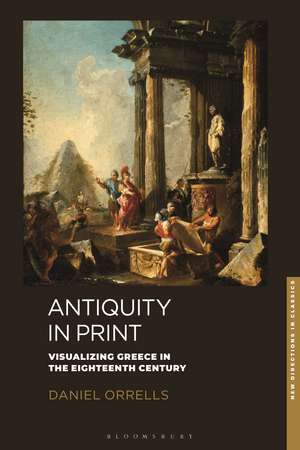
Antiquity in Print: Visualizing Greece in the Eighteenth Century: New Directions in Classics
Autor Daniel Orrellsen Limba Engleză Paperback – 13 iun 2024
With the explosion of the Quarrel between the Ancients and the Moderns, eighteenth-century intellectuals, antiquarians and artists such as Giambattista Vico, Johann Joachim Winckelmann, the Comte de Caylus, James Stuart, Julien-David Leroy, Giovanni Battista Piranesi and Pierre-François Hugues d'Hancarville all became interested in how printed engravings of ancient art and archaeology could visualize a historical narrative. These figures theorized the relationship between ancient text and ancient material and visual culture - theorizations which would pave the way to foundational questions at the heart of the discipline of classical studies and neoclassical aesthetics.
Preț: 171.54 lei
Preț vechi: 189.71 lei
-10%
Puncte Express: 257
Carte disponibilă
Livrare economică 30 octombrie-13 noiembrie
Livrare express 16-22 octombrie pentru 57.06 lei
Livrare prin curier în România Termenul estimat este afișat lângă disponibilitate.
Transport gratuit de la 400.00 lei Plată online sau ramburs, în funcție de opțiunile comenzii.
Retur gratuit în 14 zile Comandă securizată și suport în română.
Specificații
ISBN-13: 9781350407770
ISBN-10: 1350407771
Pagini: 368
Ilustrații: 89 bw illus
Dimensiuni: 156 x 234 x 18 mm
Greutate: 0.63 kg
Editura: Bloomsbury Publishing
Colecția Bloomsbury Academic
Seria New Directions in Classics
Locul publicării:London, United Kingdom
ISBN-10: 1350407771
Pagini: 368
Ilustrații: 89 bw illus
Dimensiuni: 156 x 234 x 18 mm
Greutate: 0.63 kg
Editura: Bloomsbury Publishing
Colecția Bloomsbury Academic
Seria New Directions in Classics
Locul publicării:London, United Kingdom
Cuprins
List of Figures
Acknowledgements
Introduction: Historicity, Disciplinarity and Materiality
Chapter 1: Achilles' Shield and Vico's Frontispiece
Chapter 2: Visualising Philhellenism
Chapter 3: Putting Ancient Greece into the Picture
Epilogue: From Lessing to Kauffmann: Awaiting the Return of Ancient Greece
Notes
Bibliography
Index
Acknowledgements
Introduction: Historicity, Disciplinarity and Materiality
Chapter 1: Achilles' Shield and Vico's Frontispiece
Chapter 2: Visualising Philhellenism
Chapter 3: Putting Ancient Greece into the Picture
Epilogue: From Lessing to Kauffmann: Awaiting the Return of Ancient Greece
Notes
Bibliography
Index
Recenzii
In this learned and wide-ranging book, Daniel Orrells provides a fascinating study of eighteenth-century representations of Greek art in print.
While traditionally considered a discipline driven by philological exactitude, Antiquity in Print highlights just how much the emergence of Classics was conditioned by the use of images and a sophisticated visual rhetoric. Written with verve and erudition, Orrells presents an important reframing of the historiography of Classical scholarship.
There is much to admire in this book, starting with its large number of high-quality engravings and their placement in close proximity to the author's discussion of them. Orrells offers intelligent and creative readings of these images, thanks particularly to his classical training, which allows him to identify the authors' ancient points of reference, and their philological, chronological, and archaeological mistakes.
Antiquity in Print is an ambitious and attractive monograph [that] offers a vast survey of Enlightenment art history . [The author's] expertise in classical literature and knowledge of the ancient sources provide a unique perspective.
While traditionally considered a discipline driven by philological exactitude, Antiquity in Print highlights just how much the emergence of Classics was conditioned by the use of images and a sophisticated visual rhetoric. Written with verve and erudition, Orrells presents an important reframing of the historiography of Classical scholarship.
There is much to admire in this book, starting with its large number of high-quality engravings and their placement in close proximity to the author's discussion of them. Orrells offers intelligent and creative readings of these images, thanks particularly to his classical training, which allows him to identify the authors' ancient points of reference, and their philological, chronological, and archaeological mistakes.
Antiquity in Print is an ambitious and attractive monograph [that] offers a vast survey of Enlightenment art history . [The author's] expertise in classical literature and knowledge of the ancient sources provide a unique perspective.