
Antiplane Elastic Systems: Ergebnisse der angewandten Mathematik, cartea 8
Autor Louis M. Milne-Thomsonen Limba Engleză Paperback – 1962
Din seria Ergebnisse der angewandten Mathematik
-
 Preț: 437.95 lei
 -
 Preț: 396.46 lei
 - 15%
 Preț: 419.08 lei
 -
 Preț: 396.09 lei
 -
 Preț: 335.59 lei
 -
 Preț: 371.00 lei
 -
 Preț: 383.79 lei
Preț: 371.57 lei
Puncte Express: 557
Carte tipărită la comandă
Livrare economică 14-28 noiembrie
Livrare prin curier în România Termenul estimat este afișat lângă disponibilitate.
Transport gratuit de la 400.00 lei Plată online sau ramburs, în funcție de opțiunile comenzii.
Retur gratuit în 14 zile Comandă securizată și suport în română.
Specificații
ISBN-13: 9783540028055
ISBN-10: 3540028056
Pagini: 276
Ilustrații: VIII, 266 p.
Dimensiuni: 152 x 229 x 14 mm
Greutate: 0.37 kg
Ediția:Softcover reprint of the original 1st ed. 1962
Editura: Springer Berlin, Heidelberg
Colecția Springer
Seria Ergebnisse der angewandten Mathematik
Locul publicării:Berlin, Heidelberg, Germany
ISBN-10: 3540028056
Pagini: 276
Ilustrații: VIII, 266 p.
Dimensiuni: 152 x 229 x 14 mm
Greutate: 0.37 kg
Ediția:Softcover reprint of the original 1st ed. 1962
Editura: Springer Berlin, Heidelberg
Colecția Springer
Seria Ergebnisse der angewandten Mathematik
Locul publicării:Berlin, Heidelberg, Germany
V-ar putea interesa
-
 -22%Preț: 519.99 lei670.41 lei
 -
 Fundamentals of Weather and ClimateRobin McIlveen-20%Preț: 490.84 lei613.71 lei
 -
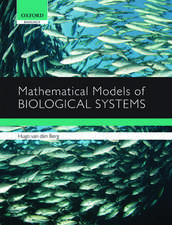 Mathematical Models of Biological SystemsHugo van den Berg-22%Preț: 480.97 lei619.62 lei
 -
 Model Selection and Multimodel InferenceDavid R. Anderson-23%Preț: 1059.74 lei1376.28 lei
 -
 Empirical Model BuildingJames R Thompson-9%Preț: 915.82 lei1006.39 lei
 -
 Handbook of Neural Activity MeasurementRomain Brette-5%Preț: 778.81 lei819.80 lei
 -
 -8%Preț: 472.02 lei513.06 lei
 -
 Waves in Neural MediaPaul C. Bressloff-15%Preț: 709.30 lei834.48 lei
 -
 Reduced Order Methods for Modeling and Computational ReductionAlfio Quarteroni-15%Preț: 621.49 lei731.16 lei
 -
 Optimization with PDE ConstraintsRonald Hoppe-15%Preț: 625.32 lei735.66 lei
 -
 Network Models in Economics and FinanceValery A. Kalyagin-15%Preț: 636.35 lei748.65 lei
 -
 Mathematical ModellingMatti HeiliöPreț: 461.86 lei
 -
 Dispersal, Individual Movement and Spatial EcologyMark A. LewisPreț: 397.70 lei
Public țintă
ResearchCuprins
I. The Law of Elasticity.- 1.1. Continued dyadic products.- 1.2. The stress tensor.- 1.3. The deformation tensor.- 1.4. The equation of motion.- 1.5. Internal energy.- 1.6. Elastic deformation.- 1.7. Hooke’s law.- 1.8. Anisotropy.- 1.9. Elastic symmetry.- Examples I.- II. Stress functions and complex stresses.- 2.0. Introductory notions.- 2.1. Stress functions and fundamental stress combinations.- 2.3. The displacement.- 2.4. The strain-energy function.- 2.5. The elimination of the displacements.- 2.6. The complex stresses.- 2.7. Expression of the fundamental stress combinations in terms of the complex stresses.- 2.8. Effective stress functions.- 2.9. The shear function.- Examples II.- III. Isotropic beams.- 3.1. The boundary conditions for a prismatic beam.- 3.2. The isotropic beam.- 3.3. Classification of certain antiplane problems.- 3.4. The equations which give the displacement in pure antiplane stress.- 3.5. The boundary condition for the pure antiplane problem for isotropic beams.- 3.6. Simple extension.- 3.7. Bending by terminal couples.- 3.8. Circular cylinder pushed into a hole.- Examples III.- IV. The torsion of isotropic beams.- 4.1. The torsion problem.- 4.2. Lines of shearing stress.- 4.3. The twisting moment.- 4.4. Solution by conformal mapping.- 4.5. The $$ z\bar z $$method.- 4.6. Boundary conditions.- 4.7. A uniqueness theorem.- 4.8. The principle of virtual stresses.- 4.9. Torsion of a compound bar of isotropic materials.- Examples IV.- V. The flexure of isotropic beams.- 5.1. The flexure problem.- 5.2. The centre of flexure.- 5.3. Half-sections.- 5.4. Shear stress functions.- 5.5. de St. Venant’s flexure function.- Examples V.- VI. Antiplane of elastic symmetry.- 6.1. Bending by couples.- 6.2. Boundary conditions.- 6.3. A device for transformingintegrals.- 6.4. Simplifying assumptions.- 6.5. Antiplane of elastic symmetry.- 6.6. The striess component zz.- 6.7. Orthotropic material.- 6.8. Methods of approximation.- Examples VI.- VII. General linear and cylindrical anisotropy.- 7.1. Generalized plane deformation.- 7.2. Line force applied to an elastic half-plane.- 7.3. Induced mappings for the region exterior to an ellipse.- 7.4. Bending of a cantilever by a transverse force at the free end.- 7.5. Cylindrical anisotropy.- 7.6. Equations satisfied by the stress functions.- 7.7. Circular tube under pressure.- Examples VII.- References.