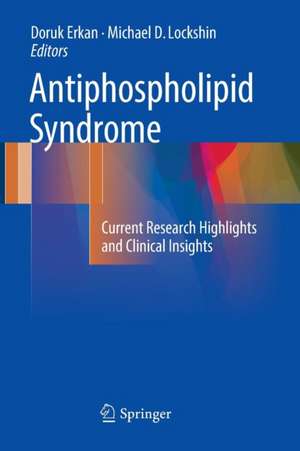
Antiphospholipid Syndrome
Editat de Doruk Erkan, Michael D. Lockshinen Limba Engleză Paperback – 12 aug 2018
Notăm cu interes apariția acestui volum de referință care sintetizează concluziile celui de-al 15-lea Congres Internațional privind Anticorpii Antifosfolipidici. Această ediție aduce o abordare metodologică riguroasă, bazată pe dovezi, prin care echipe multidisciplinare de experți au răspuns unor întrebări clinice predefinite, oferind astfel protocoale actualizate pentru o afecțiune autoimună complexă. Descoperim aici o extindere necesară a spectrului clinic: dacă în mod tradițional sindromul era asociat cu evenimente trombotice recurente și morbiditate gestațională, lucrarea de față aprofundează manifestările „non-criteriu”, precum leziunile cutanate, bolile renale și tulburările neurologice care mimează scleroza multiplă. Remarcăm organizarea logică a conținutului, care ghidează cititorul de la mecanismele moleculare și genetice către provocările terapeutice actuale. Secțiunile dedicate patogenezei explică modul în care anticorpii antifosfolipidici interacționează cu membranele celulare, în timp ce capitolele clinice oferă instrumente de măsurare a riscului și criterii de diagnostic rafinate. Acolo unde Antiphospholipid Syndrome in Systemic Autoimmune Diseases oferă o privire de ansamblu asupra contextului autoimun larg, volumul editat de Doruk Erkan și Michael D. Lockshin se distinge prin rigoarea consensului științific și prin integrarea perspectivelor din hematologie, cardiologie și neurologie sub o singură cupolă editorială. Un element de noutate absolută în acest format academic este includerea secțiunilor dedicate pacienților, facilitând astfel o mai bună înțelegere a managementului bolii pe termen lung.
Preț: 725.07 lei
Preț vechi: 763.24 lei
-5%
Carte tipărită la comandă
Livrare economică 30 noiembrie-14 decembrie
Specificații
ISBN-10: 3319856626
Pagini: 392
Ilustrații: XX, 372 p. 18 illus., 16 illus. in color.
Dimensiuni: 155 x 235 x 22 mm
Greutate: 0.59 kg
Ediția:Softcover reprint of the original 1st ed. 2017
Editura: Springer
Locul publicării:Cham, Switzerland
V-ar putea interesa
-
 GoutNicola Dalbeth-19%Preț: 247.75 lei304.92 lei
 -
 Adamantiades-Behçet's DiseaseChristos Zouboulis-5%Preț: 1496.21 lei1574.96 lei
 -
 The Skin in Rheumatic DiseaseC. R. Lovell-5%Preț: 352.76 lei371.33 lei
 -
 -5%Preț: 1420.84 lei1495.63 lei
 -
 Geriatric RheumatologyYuri Nakasato-5%Preț: 1479.61 lei1557.49 lei
 -
 Perioperative Management of Patients with Rheumatic DiseaseBrian F Mandell-5%Preț: 1156.60 lei1217.47 lei
 -
 Antiphospholipid SyndromeDoruk Erkan-5%Preț: 784.79 lei826.10 lei
 -
 Sjögren's SyndromeRobert I. Fox-5%Preț: 1632.80 lei1718.74 lei
 -
 Gamut Index of Skeletal DysplasiasKazimierz Kozlowski-5%Preț: 356.79 lei375.57 lei
 -
 Bone FormationFelix Bronner-5%Preț: 1398.59 lei1472.19 lei
 -
 Bone ResorptionFelix Bronner-5%Preț: 1467.49 lei1544.72 lei
 -
 Atlas of Rheumatoid ArthritisPaul Emery-5%Preț: 445.38 lei468.82 lei
 -
 Clinician's Manual on LupusGraham Hughes-5%Preț: 359.55 lei378.48 lei
 -
 Morbus BechterewAlbrecht Falkenbach-5%Preț: 984.36 lei1036.16 lei
 -
 OsteoarthritisMohit Kapoor-5%Preț: 609.20 lei641.27 lei
 -
 Advanced Handbook of Systemic Lupus ErythematosusLaurent Arnaud-5%Preț: 471.78 lei496.61 lei
 -
 -5%Preț: 448.13 lei471.72 lei
 -
 -5%Preț: 1388.57 lei1461.65 lei
 -
 Systemic Lupus Erythematosus: Clinical and Experimental AspectsJosef S. Smolen-5%Preț: 695.14 lei731.72 lei
 -
 The Hereditary Basis of Rheumatic DiseasesRikard Holmdahl-5%Preț: 1137.25 lei1197.10 lei
 -
 -5%Preț: 375.09 lei394.84 lei
 -
 Arthritis und Spondylitis psoriaticaF. Schilling-5%Preț: 388.21 lei408.65 lei
 -
 -5%Preț: 534.28 lei562.39 lei
 -
 VaskulitisEva Reinhold-Keller-5%Preț: 195.17 lei205.44 lei
De ce să citești această carte
Această lucrare este esențială pentru medicii reumatologi, hematologi și obstetricieni care gestionează cazuri complexe de autoimunitate. Cititorul câștigă acces la cele mai recente ghiduri de tratament și diagnostic stabilite de experți internaționali. Este o resursă clinică indispensabilă pentru a înțelege nu doar mecanismele „sângelui lipicios”, ci și manifestările sistemice mai puțin evidente care pot afecta prognosticul pacientului.
Despre autor
Editorii volumului, Doruk Erkan și Michael D. Lockshin, sunt figuri proeminente în comunitatea științifică internațională, fiind afiliați unor centre de excelență în cercetarea reumatologică. Michael D. Lockshin este recunoscut pentru deceniile de activitate dedicate studiului lupusului și al sindromului antifosfolipidic, contribuind fundamental la definirea criteriilor clinice moderne. Împreună cu Doruk Erkan, aceștia au coordonat Comitetul de Planificare Științifică al Congresului Internațional, asigurând o rigoare academică de excepție în transformarea discuțiilor de specialitate în capitole de referință pentru literatura medicală contemporană.