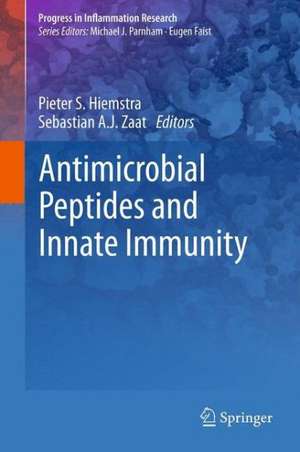
Antimicrobial Peptides and Innate Immunity: Progress in Inflammation Research
Editat de Pieter S. Hiemstra, Sebastian A. J. Zaaten Limba Engleză Hardback – 7 feb 2013
The book starts with an overview of the evolution of cysteine-containing antimicrobial peptides (including defensins), and the role of these peptides in host defense in plants and micro-organisms. The realization that antimicrobial peptides also display functions distinct from their direct antimicrobial action is the focus of the next chapters, and puts these peptides center stage in immunity and wound repair. Further chapters discuss the role of antimicrobial peptides in disease, by providing an overview of mechanisms in bacterial resistance to antimicrobial peptides and a discussion of their role in inflammatory bowel disease, cystic fibrosis lung disease and chronic obstructive pulmonary disease. Finally, the book shows how knowledge of the function of antimicrobial peptides and their regulation can be used to design new therapies for inflammatory and infectious disorders. This is a very important area of research because of the increase in resistance of micro-organisms to conventional antibiotics. Therefore the use of synthetic or recombinant peptides, or agents that stimulate the endogenous production of antimicrobial peptides, provides an attractive alternative for conventional antibiotics.
Din seria Progress in Inflammation Research
- 5%
 Preț: 1363.18 lei
 - 5%
 Preț: 1613.84 lei
 - 5%
 Preț: 719.17 lei
 - 15%
 Preț: 651.09 lei
 - 18%
 Preț: 953.70 lei
 - 5%
 Preț: 691.11 lei
 - 5%
 Preț: 1246.34 lei
 - 5%
 Preț: 687.74 lei
 - 5%
 Preț: 1055.99 lei
 - 5%
 Preț: 632.57 lei
 - 5%
 Preț: 1072.53 lei
 - 5%
 Preț: 690.22 lei
 - 5%
 Preț: 1107.17 lei
 - 5%
 Preț: 1353.92 lei
 - 5%
 Preț: 1059.67 lei
 - 5%
 Preț: 1070.57 lei
 - 5%
 Preț: 1103.68 lei
 - 5%
 Preț: 1536.83 lei
 - 5%
 Preț: 692.12 lei
 - 5%
 Preț: 629.03 lei
 - 5%
 Preț: 1359.58 lei
 - 5%
 Preț: 627.65 lei
 - 5%
 Preț: 1057.23 lei
 - 5%
 Preț: 1784.18 lei
 - 15%
 Preț: 620.07 lei
 - 24%
 Preț: 859.53 lei
 - 5%
 Preț: 1065.68 lei
 - 5%
 Preț: 633.11 lei
 - 5%
 Preț: 1065.47 lei
 - 5%
 Preț: 1365.22 lei
 - 5%
 Preț: 720.13 lei
 - 5%
 Preț: 687.60 lei
 - 5%
 Preț: 1724.11 lei
 - 5%
 Preț: 1104.61 lei
 - 5%
 Preț: 692.85 lei
 - 5%
 Preț: 1061.46 lei
 - 15%
 Preț: 555.62 lei
 - 5%
 Preț: 627.65 lei
 - 5%
 Preț: 628.19 lei
 - 5%
 Preț: 625.22 lei
 - 5%
 Preț: 1073.37 lei
 - 5%
 Preț: 1054.40 lei
 - 5%
 Preț: 1354.39 lei
 - 5%
 Preț: 1059.31 lei
 - 5%
 Preț: 1105.18 lei
 - 5%
 Preț: 1054.94 lei
Preț: 1060.69 lei
Preț vechi: 1116.52 lei
-5%
Puncte Express: 1591
Carte tipărită la comandă
Livrare economică 11-25 noiembrie
Livrare prin curier în România Termenul estimat este afișat lângă disponibilitate.
Transport gratuit pentru acest produs Plată online sau ramburs, în funcție de opțiunile comenzii.
Retur gratuit în 14 zile Comandă securizată și suport în română.
Specificații
ISBN-13: 9783034805407
ISBN-10: 3034805403
Pagini: 396
Ilustrații: XI, 384 p. 43 illus., 20 illus. in color.
Dimensiuni: 160 x 241 x 26 mm
Greutate: 0.76 kg
Ediția:2013
Editura: Springer
Colecția Progress in Inflammation Research
Seria Progress in Inflammation Research
Locul publicării:Basel, Switzerland
ISBN-10: 3034805403
Pagini: 396
Ilustrații: XI, 384 p. 43 illus., 20 illus. in color.
Dimensiuni: 160 x 241 x 26 mm
Greutate: 0.76 kg
Ediția:2013
Editura: Springer
Colecția Progress in Inflammation Research
Seria Progress in Inflammation Research
Locul publicării:Basel, Switzerland
V-ar putea interesa
-
 Major Histocompatibility Complex: Biology, Functions & Roles in DiseaseNatalya V Semiletova-23%Preț: 1305.34 lei1703.12 lei
 -
 Visualizing ImmunityDorian McGavern-5%Preț: 1370.30 lei1442.41 lei
 -
 Allergy in PracticeJohannes Ring-5%Preț: 842.26 lei886.59 lei
 -
 Biotechnology of Hairy Root SystemsPauline M Doran-5%Preț: 1414.14 lei1488.57 lei
 -
 Systemic Lupus Erythematosus: Clinical and Experimental AspectsJosef S. Smolen-5%Preț: 695.14 lei731.72 lei
 -
 Allergy Frontiers:Future PerspectivesRuby Pawankar-5%Preț: 786.11 lei827.48 lei
Public țintă
ResearchCuprins
Evolution of Antimicrobial Peptides: a View From the Cystine Chapel.- Innate immunity in plants: the role of antimicrobial peptides.- Antimicrobial peptides produced by microorganisms.- LL-37: an immunomodulatory antimicrobial host defence peptide.- Wound Repair and Antimicrobial Peptides.- WAPing out pathogens and disease in the mucosa-roles for SLPI and trappin-2.- Histatins: multifunctional salivary antimicrobial peptides.- Structure-function relationships of antimicrobial chemokines.- Mechanisms and Significance of Bacterial Resistance to Human Cationic Antimicrobial Peptides.- Antimicrobial peptides and inflammatory bowel disease.- Cystic Fibrosis and Defective Airway Innate Immunity.- Antimicrobial peptides in chronic obstructive pulmonary disease.- Host defense peptides: Immune modulation and antimicrobial activity in vivo.- Helping the host – induction of antimicrobial peptides as a novel therapeutic strategy against infections.
Textul de pe ultima copertă
Antimicrobial peptides have been the subject of intense research in the past decades, and are now considered as an essential part of the defense system in bacteria, plants, animals and humans. This book provides an update on these effector molecules of the innate immune system both for researchers who are already actively involved in the area, and for those with a general interest in the topic.
The book starts with an overview of the evolution of cysteine-containing antimicrobial peptides (including defensins), and the role of these peptides in host defense in plants and micro-organisms. The realization that antimicrobial peptides also display functions distinct from their direct antimicrobial action is the focus of the next chapters, and puts these peptides center stage in immunity and wound repair. Further chapters discuss the role of antimicrobial peptides in disease, by providing an overview of mechanisms in bacterial resistance to antimicrobial peptides and a discussion of their role in inflammatory bowel disease, cystic fibrosis lung disease and chronic obstructive pulmonary disease. Finally, the book shows how knowledge of the function of antimicrobial peptides and their regulation can be used to design new therapies for inflammatory and infectious disorders. This is a very important area of research because of the increase in resistance of micro-organisms to conventional antibiotics. Therefore the use of synthetic or recombinant peptides, or agents that stimulate the endogenous production of antimicrobial peptides, provides an attractive alternative for conventional antibiotics.
The book starts with an overview of the evolution of cysteine-containing antimicrobial peptides (including defensins), and the role of these peptides in host defense in plants and micro-organisms. The realization that antimicrobial peptides also display functions distinct from their direct antimicrobial action is the focus of the next chapters, and puts these peptides center stage in immunity and wound repair. Further chapters discuss the role of antimicrobial peptides in disease, by providing an overview of mechanisms in bacterial resistance to antimicrobial peptides and a discussion of their role in inflammatory bowel disease, cystic fibrosis lung disease and chronic obstructive pulmonary disease. Finally, the book shows how knowledge of the function of antimicrobial peptides and their regulation can be used to design new therapies for inflammatory and infectious disorders. This is a very important area of research because of the increase in resistance of micro-organisms to conventional antibiotics. Therefore the use of synthetic or recombinant peptides, or agents that stimulate the endogenous production of antimicrobial peptides, provides an attractive alternative for conventional antibiotics.
Caracteristici
Provides a comprehensive overview on these endogenous antibiotics Includes information on role in inflammatory diseases and gives an outlook on new therapeutic options Written by experts in the field of antimicrobial/host defense peptide research Includes supplementary material: sn.pub/extras