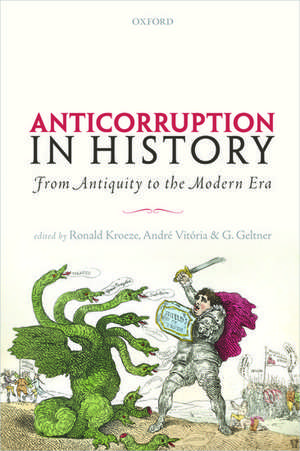
Anticorruption in History: From Antiquity to the Modern Era
Editat de Ronald Kroeze, André Vitória, Guy Geltneren Limba Engleză Paperback – 20 feb 2020
Evoluția studiilor despre guvernare a demonstrat că fenomenul corupției nu poate fi înțeles doar prin prisma indicatorilor statistici contemporani, ci necesită o perspectivă diacronică profundă. În Anticorruption in History, descoperim o lucrare esențială care mută accentul de pe simpla cuantificare a mitei spre o analiză a modului în care societățile au definit, identificat și combătut abuzurile de putere de-a lungul secolelor. Considerăm că forța acestui volum rezidă în capacitatea sa de a arăta că „calea spre Danemarca” — modelul statului stabil și integru — este pavată cu experimente istorice diverse, de la mecanismele de control din Atena antică până la reformele administrative din România secolului al XIX-lea sau din Imperiul Otoman.
Această lucrare completează perspectiva oferită de Political Corruption de Michael Johnston, adăugând o dimensiune istorică și culturală acolo unde Johnston se concentrează pe dezbateri conceptuale și date comparate recente. Structura volumului permite o analiză comparativă rară, punând față în față eurasia medievală cu birocrația modernă a Germaniei de Est. În contextul operei editorilor, în special al lucrărilor semnate de Ronald Kroeze, precum Corruption, Empire and Colonialism in the Modern Era, acest titlu consolidează o direcție de cercetare care refuză „naționalismul metodologic”. Dacă lucrările anterioare investigau legătura dintre corupție și dominația imperială, volumul de față extinde cadrul, demonstrând cum anticorupția a fost, istoric, un instrument de legitimare politică și de modelare a ordinii sociale. Ritmul este academic, dar accesibil, oferind o rigoare documentară care lipsește adesea din discursul public actual despre integritate.
Preț: 264.61 lei
Preț vechi: 339.37 lei
-22%
Carte disponibilă
Livrare economică 15-26 mai
Specificații
ISBN-10: 0198858078
Pagini: 464
Dimensiuni: 55 x 30 x 25 mm
Greutate: 0.7 kg
Editura: OUP OXFORD
Colecția OUP Oxford
Locul publicării:Oxford, United Kingdom
V-ar putea interesa
-
 Good Economics for Hard TimesAbhijit V. Banerjee-31%Preț: 61.92 lei89.64 lei
 -
 How Literature WorksJohn SutherlandPreț: 161.16 lei
 -
 RHS Encyclopedia Of Plants and FlowersChristopher Brickell-14%Preț: 342.00 lei398.12 lei
 -
 The Body: A Guide for OccupantsBill BrysonPreț: 69.94 lei
 -
 The World According to PhysicsJim Al–khaliliPreț: 108.90 lei
 -
 Narrative EconomicsRobert J. ShillerPreț: 117.87 lei
 -
 PantheonJörg RüpkePreț: 248.23 lei
 -
 The Psychology of Fatigue: Work, Effort and ControlRobert HockeyPreț: 270.82 lei
 -
 The Physics of Rock Failure and EarthquakesMitiyasu OhnakaPreț: 327.55 lei
 -
 -5%Preț: 326.52 lei343.70 lei
 -
 -15%Preț: 491.72 lei578.50 lei
 -
 Eastern Europe and the Challenges of Modernity, 1800-2000Stefano Bianchini-15%Preț: 402.13 lei473.09 lei
 -
 -15%Preț: 641.68 lei754.92 lei
 -
 Preț: 399.52 lei
 -
 VideocracyKevin Allocca-26%Preț: 66.97 lei90.56 lei
 -
 The Language of FashionRoland Barthes-22%Preț: 135.65 lei174.44 lei
 -
 BookshelfLydia Pyne-38%Preț: 48.56 lei78.26 lei
 -
 Materializing Memories: Dispositifs, Generations, AmateursProfessor Susan Aasman-26%Preț: 231.59 lei312.72 lei
 -
 -34%Preț: 78.63 lei118.37 lei
 -
 Debt: The First 5,000 Years, Updated and ExpandedDavid GraeberPreț: 132.09 lei
 -
 Critique of Everyday LifeHenri LefebvrePreț: 213.86 lei
 -
 Black Sea: Coasts and Conquests: From Pericles to PutinNeal Ascherson-32%Preț: 60.75 lei88.93 lei
 -
 The Lost Gutenberg: Obsession and Ruin in Pursuit of the World's Rarest BooksMargaret Leslie Davis-20%Preț: 61.25 lei76.16 lei
 -
 -21%Preț: 101.31 lei128.39 lei
De ce să citești această carte
Această lucrare este adresată cercetătorilor, studenților la științe politice și istorie, dar și factorilor de decizie interesați de rădăcinile profunde ale bunei guvernări. Cititorul câștigă o înțelegere nuanțată a modului în care integritatea publică a fost construită istoric. Este un instrument valoros pentru a înțelege de ce anumite politici de anticorupție eșuează astăzi, oferind contextul cultural și social pe care indicii de percepție a corupției îl omit adesea.
Despre autor
Editorii volumului sunt specialiști recunoscuți în istoria politică și socială. Ronald Kroeze este expert în istoria corupției și a democrației moderne, publicând anterior studii despre legătura dintre imperii și practicile ilicite. André Vitória și Guy Geltner aduc expertiză în perioada medievală și pre-modernă, Geltner fiind cunoscut pentru cercetările sale asupra ordinii sociale și a pedepsei. Împreună, aceștia au coordonat proiecte internaționale care redefinesc istoria corupției ca pe o istorie a valorilor politice în schimbare, integrând studii de caz din diverse spații geografice, de la Portugalia la Țările de Jos.
Descriere
Anticorruption in History is a timely and urgent volume: corruption is widely seen today as a major problem we face as a global society, undermining trust in government and financial institutions, economic efficiency, the principle of equality before the law and human wellbeing in general. Corruption, in short, is a major hurdle on the "path to Denmark" a feted blueprint for stable and successful statebuilding. The resonance of this view explains why effortsto promote anticorruption policies have proliferated in recent years.
But while the subject of corruption and anticorruption has captured the attention of politicians, scholars, NGOs and the global media, scant attention has been paid to the link between corruption and the change of anticorruption policiesover time and place, with the attendant diversity in how to define, identify and address corruption. Economists, political scientists and policy-makers in particular have been generally content with tracing the differences between low-corruption and high-corruption countries in the present and enshrining them in all manner of rankings and indices. The long-term trends-social, political, economic, cultural-potentially undergirding the position of various countries plays a very small role.
Such a historical approach could help explain major moments of change in the past as well asreasons for the success and failure of specific anticorruption policies and their relation to a country's image (of itself or as construed from outside) as being more or less corrupt. It is precisely this scholarly lacuna that the present volume intends to begin to fill. The volume addresses a wide range of historical contexts: Ancient Greece and Rome, Medieval Eurasia, Italy, France, Great Britain and Portugal as well as studies on anticorruption in the Early Modern and Modern era in Romania, the Ottoman Empire, the Netherlands, Germany, Denmark, Sweden, and the former German Democratic Republic.
Recenzii
It is a cohesive and stimulating investigation of the shifting perceptions of corruption in moral, civic and political terms and the strategies and alternative modes of public behaviour that have been attempted to deal with this ongoing problem of modern societies of all political hues.