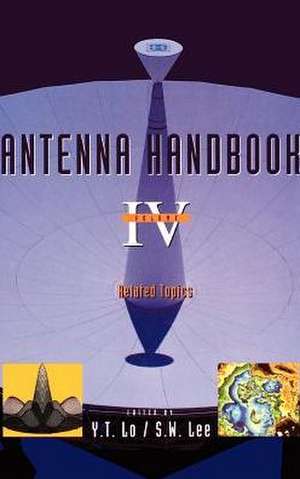
Antenna Handbook
Autor S. W. Lee, Y. T. Loen Limba Engleză Hardback – 31 oct 1993
Preț: 986.17 lei
Preț vechi: 1202.64 lei
-18%
Puncte Express: 1479
Carte tipărită la comandă
Livrare economică 28 noiembrie-12 decembrie
Livrare prin curier în România Termenul estimat este afișat lângă disponibilitate.
Transport gratuit pentru acest produs Plată online sau ramburs, în funcție de opțiunile comenzii.
Retur gratuit în 14 zile Comandă securizată și suport în română.
Specificații
ISBN-13: 9780442015961
ISBN-10: 0442015968
Pagini: 416
Ilustrații: X, 402 p.
Dimensiuni: 160 x 241 x 27 mm
Greutate: 0.74 kg
Ediția:1994
Editura: Springer Us
Locul publicării:New York, NY, United States
ISBN-10: 0442015968
Pagini: 416
Ilustrații: X, 402 p.
Dimensiuni: 160 x 241 x 27 mm
Greutate: 0.74 kg
Ediția:1994
Editura: Springer Us
Locul publicării:New York, NY, United States
V-ar putea interesa
-
 Radar Handbook, Third EditionMerrill Skolnik-23%Preț: 1292.51 lei1678.59 lei
 -
 Elements of ElectromagneticsMatthew Sadiku-25%Preț: 1585.02 lei2125.72 lei
 -
 Perspectives in Antenna TechnologyAlan J. Fenn-20%Preț: 840.46 lei1050.57 lei
 -
 Radar Techniques Using Array AntennasWulf-Dieter Wirth-18%Preț: 851.31 lei1038.19 lei
 -
 Antenna TheoryConstantine A. Balanis-23%Preț: 1096.94 lei1424.59 lei
 -
 Antenna Engineering HandbookJohn Volakis-37%Preț: 1009.92 lei1605.19 lei
 -
 Practical Antenna Handbook, Sixth EditionJoseph Carr-28%Preț: 310.03 lei427.64 lei
 -
 -23%Preț: 857.36 lei1113.46 lei
 -
 Ew 101David L Adamy-15%Preț: 706.38 lei831.03 lei
 -
 The VNA Applications HandbookGregory Bonaguide-18%Preț: 814.17 lei992.90 lei
 -
 Sparse Phased Array Antennas: Theory and ApplicationsAshutosh Kedar-14%Preț: 814.09 lei946.61 lei
 -
 Developments in Antenna Analysis and DesignRaj Mittra-18%Preț: 862.44 lei1051.76 lei
 -
 HF Antennas for All LocationsL. A. MoxonPreț: 143.81 lei
 -
 Preț: 117.94 lei
 -
 RF Antenna Beam FormingShun-Ping ChenPreț: 444.98 lei
 -
 Millimeter Wave RadarChristian WaldschmidtPreț: 357.18 lei
 -
 -20%Preț: 600.19 lei750.24 lei
 -
 Practical Models of Antenna SystemsAmur B. Khashimov-24%Preț: 751.64 lei989.00 lei
 -
 -18%Preț: 1020.86 lei1244.94 lei
Public țintă
ResearchCuprins
Transmission lines and waveguides; Propagation; Antenna response to electromagnetic pulses; Random electromagnetic design; Measurement of antenna radiation characteristics on far-field ranges; Near-field far-field antenna measurements; Appendices; Index
Descriere
Descriere de la o altă ediție sau format:
Techniques based on the method of modal expansions, the Rayleigh-Stevenson expansion in inverse powers of the wavelength, and also the method of moments solution of integral equations are essentially restricted to the analysis of electromagnetic radiating structures which are small in terms of the wavelength. It therefore becomes necessary to employ approximations based on "high-frequency techniques" for performing an efficient analysis of electromagnetic radiating systems that are large in terms of the wavelength. One of the most versatile and useful high-frequency techniques is the geometrical theory of diffraction (GTD), which was developed around 1951 by J. B. Keller [1,2,3]. A class of diffracted rays are introduced systematically in the GTD via a generalization of the concepts of classical geometrical optics (GO). According to the GTD these diffracted rays exist in addition to the usual incident, reflected, and transmitted rays of GO. The diffracted rays in the GTD originate from certain "localized" regions on the surface of a radiating structure, such as at discontinuities in the geometrical and electrical properties of a surface, and at points of grazing incidence on a smooth convex surface as illustrated in Fig. 1. In particular, the diffracted rays can enter into the GO shadow as well as the lit regions. Consequently, the diffracted rays entirely account for the fields in the shadow region where the GO rays cannot exist.
Techniques based on the method of modal expansions, the Rayleigh-Stevenson expansion in inverse powers of the wavelength, and also the method of moments solution of integral equations are essentially restricted to the analysis of electromagnetic radiating structures which are small in terms of the wavelength. It therefore becomes necessary to employ approximations based on "high-frequency techniques" for performing an efficient analysis of electromagnetic radiating systems that are large in terms of the wavelength. One of the most versatile and useful high-frequency techniques is the geometrical theory of diffraction (GTD), which was developed around 1951 by J. B. Keller [1,2,3]. A class of diffracted rays are introduced systematically in the GTD via a generalization of the concepts of classical geometrical optics (GO). According to the GTD these diffracted rays exist in addition to the usual incident, reflected, and transmitted rays of GO. The diffracted rays in the GTD originate from certain "localized" regions on the surface of a radiating structure, such as at discontinuities in the geometrical and electrical properties of a surface, and at points of grazing incidence on a smooth convex surface as illustrated in Fig. 1. In particular, the diffracted rays can enter into the GO shadow as well as the lit regions. Consequently, the diffracted rays entirely account for the fields in the shadow region where the GO rays cannot exist.