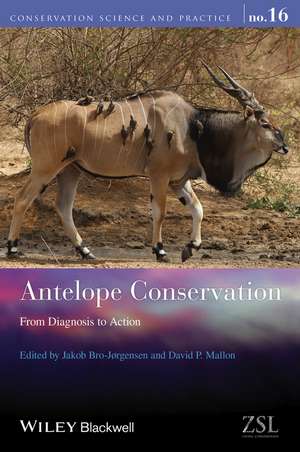
Antelope Conservation
Editat de Jakob Bro-Jorgensen, David P Mallonen Limba Engleză Paperback – 8 aug 2016
As the first book dedicated to antelope conservation, this volume sets out to diagnose the causes of the drastic declines in antelope biodiversity and on this basis identify the most effective points of action. In doing so, the book covers central issues in the current conservation debate, especially related to the management of overexploitation, habitat fragmentation, disease transmission, climate change, population genetics, and reintroductions. The contributions are authored by world-leading experts in the field, and the book is a useful resource to conservation scientists and practitioners, researchers, and students in related disciplines as well as interested lay people.
Preț: 359.77 lei
Preț vechi: 512.74 lei
-30%
Puncte Express: 540
Preț estimativ în valută:
63.57€ • 73.28$ • 55.50£
63.57€ • 73.28$ • 55.50£
Carte indisponibilă temporar
Doresc să fiu notificat când acest titlu va fi disponibil:
Se trimite...
Specificații
ISBN-13: 9781118409633
ISBN-10: 1118409639
Pagini: 384
Dimensiuni: 155 x 226 x 20 mm
Greutate: 0.7 kg
Editura: Wiley
Locul publicării:Chichester, United Kingdom
ISBN-10: 1118409639
Pagini: 384
Dimensiuni: 155 x 226 x 20 mm
Greutate: 0.7 kg
Editura: Wiley
Locul publicării:Chichester, United Kingdom
Public țintă
Graduate students of conservation science and researchers. Also wildlife conservation professionals and decision makers
Notă biografică
Jakob Bro-Jorgensen, Department of Evolution, Ecology and Behaviour, University of Liverpool, United Kingdom.
David P. Mallon, Division of Biology and Conservation Ecology, Manchester, Metropolitan University, United Kingdom.
David P. Mallon, Division of Biology and Conservation Ecology, Manchester, Metropolitan University, United Kingdom.
Descriere
Antelopes constitute a fundamental part of ecosystems throughout Africa and Asia where they act as habitat architects, dispersers of seeds, and prey for large carnivores. The fascication they hold in the human mind is evident from prehistoric rock paintings and ancient Egyptian art to today's wildlife documentaries and popularity in zoos.