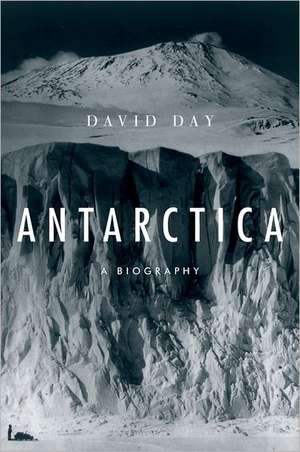
Antarctica
Autor David Dayen Limba Engleză Hardback – 20 iun 2013
Drawing from archives from around the world, Day provides a sweeping, large-scale history of Antarctica. Focusing on the dynamic personalities drawn to this unconquered land, the book offers an engaging collective biography of explorers and scientists battling the elements in the most hostile place on earth. We see intrepid sea captains picking their way past icebergs and pushing to the edge of the shifting pack ice, sanguinary sealers and whalers drawn south to exploit "the Penguin El Dorado," famed nineteenth-century explorers like Scott and Amundson in their highly publicized race to the South Pole, and aviators like Clarence Ellsworth and Richard Byrd, flying over great stretches of undiscovered land. Yet Antarctica is also the story of nations seeking to incorporate the Antarctic into their national narratives and to claim its frozen wastes as their own. As Day shows, in a place as remote as Antarctica, claiming land was not just about seeing a place for the first time, or raising a flag over it; it was about mapping and naming and, more generally, knowing its geographic and natural features. And ultimately, after a little-known decision by FDR to colonize Antarctica, claiming territory meant establishing full-time bases on the White Continent.
The end of the Second World War would see one last scramble for polar territory, but the onset of the International Geophysical Year in 1957 would launch a cooperative effort to establish scientific bases across the continent. And with the Antarctic Treaty, science was in the ascendant, and cooperation rather than competition was the new watchword on the ice. Tracing history from the first sighting of land up to the present day, Antarctica is a fascinating exploration of this deeply alluring land and man's struggle to claim it.
Preț: 278.24 lei
Puncte Express: 417
Carte disponibilă
Livrare economică 16-30 noiembrie
Livrare prin curier în România Termenul estimat este afișat lângă disponibilitate.
Transport gratuit de la 400.00 lei Plată online sau ramburs, în funcție de opțiunile comenzii.
Retur gratuit în 14 zile Comandă securizată și suport în română.
Specificații
ISBN-13: 9780199861453
ISBN-10: 0199861455
Pagini: 642
Dimensiuni: 161 x 240 x 39 mm
Greutate: 0.98 kg
Editura: OXFORD UNIV PR
ISBN-10: 0199861455
Pagini: 642
Dimensiuni: 161 x 240 x 39 mm
Greutate: 0.98 kg
Editura: OXFORD UNIV PR
V-ar putea interesa
-
 Collins Complete Woodworker's ManualAlbert JacksonPreț: 285.57 lei
 -
 Collins Complete DIY ManualAlbert JacksonPreț: 298.43 lei
 -
 Monsters to Destroy: Understanding the War on TerrorNavin A. Bapat-11%Preț: 242.59 lei273.32 lei
 -
 China and the WorldDavid Shambaugh-16%Preț: 212.07 lei251.94 lei
 -
 -22%Preț: 220.46 lei281.39 lei
 -
 Age of Iron: On Conservative NationalismColin Dueck-21%Preț: 258.71 lei328.99 lei
 -
 -15%Preț: 224.81 lei264.29 lei
 -
 China's Western Horizon: Beijing and the New Geopolitics of EurasiaDaniel S. Markey-14%Preț: 211.64 lei246.63 lei
 -
 Truth to Power: A History of the U.S. National Intelligence CouncilRobert Hutchings-23%Preț: 312.08 lei405.65 lei
 -
 -13%Preț: 185.48 lei213.63 lei
 -
 Comparative Grand Strategy: A Framework and CasesThierry Balzacq-12%Preț: 300.17 lei341.03 lei
 -
 Bosnia Remade: Ethnic Cleansing and Its ReversalGerard Toal-28%Preț: 446.58 lei617.32 lei
 -
 -31%Preț: 1654.91 lei2411.54 lei
 -
 The Complete Manual of WoodworkingAlbert JacksonPreț: 238.45 lei
 -
 Christ Our LifeDavid DayPreț: 80.38 lei
 -
 The Virtual American Empire: On War, Faith and PowerEdward N. LuttwakPreț: 473.71 lei
 -
 Making Political GeographyJohn Agnew-15%Preț: 439.20 lei516.72 lei
 -
 Halford MackinderBrian W. BlouetPreț: 140.77 lei
 -
 Space, Time and the Construction of IdentityRita Salvi-19%Preț: 457.89 lei565.29 lei
 -
 China and India in Asia Power PoliticsRohit SinghPreț: 355.70 lei
 -
 China's Quest for Global DominanceP J S Sandhu (Retd)Preț: 367.78 lei
 -
 Preț: 365.58 lei
 -
 Role of Pakistan in India's Energy SecurityA K Chaturvedi (Retd)Preț: 101.88 lei
Descriere
Descriere de la o altă ediție sau format:
Part of the What Everyone Needs to Know® series, David Day's book on Antarctica examines the most forbidding and formidably inaccessible continent on Earth. Antarctica was first discovered by European explorers in 1820, and for over a century following this, countries competed for the frozen land's vast marine resources--namely, the skins and oil of seals and whales. Soon the entire territory played host to competing claims by rival nations. The Antarctic Treaty of 1959 was meant to end this contention, but countries have found other means of extending control over the land, with scientific bases establishing at least symbolic claims. Exploration and drilling by the United States, Great Britain, Russia, Japan, and others has led to discoveries about the world's climate in centuries past--and in the process intimations of its alarming future.Delving into the history of the continent, Antarctic wildlife, arguments over governance, underwater mountain rangers, and the continent's use in predicting coming global change, Day's work sheds new light on a territory that, despite being the coldest, driest, and windiest continent in the world, will continue to be the object of intense speculation and competition.
Part of the What Everyone Needs to Know® series, David Day's book on Antarctica examines the most forbidding and formidably inaccessible continent on Earth. Antarctica was first discovered by European explorers in 1820, and for over a century following this, countries competed for the frozen land's vast marine resources--namely, the skins and oil of seals and whales. Soon the entire territory played host to competing claims by rival nations. The Antarctic Treaty of 1959 was meant to end this contention, but countries have found other means of extending control over the land, with scientific bases establishing at least symbolic claims. Exploration and drilling by the United States, Great Britain, Russia, Japan, and others has led to discoveries about the world's climate in centuries past--and in the process intimations of its alarming future.Delving into the history of the continent, Antarctic wildlife, arguments over governance, underwater mountain rangers, and the continent's use in predicting coming global change, Day's work sheds new light on a territory that, despite being the coldest, driest, and windiest continent in the world, will continue to be the object of intense speculation and competition.
Notă biografică
David Day has been a research fellow at Clare College in Cambridge and a Visiting Professor at University College Dublin, he University of Aberdeen, and the Center for Pacific and American Studies at the University of Tokyo. He is currently a research associate at La Trobe University in Melbourne. He is the author of many books, including Conquest: How Societies Overwhelm Others and the award-winning Claiming a Continent: A History of Australia.