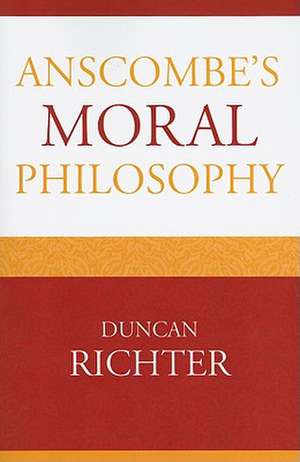
Anscombe's Moral Philosophy
Autor Duncan Richteren Limba Engleză Paperback – 29 noi 2010
Anscombe's Moral Philosophy clarifies what Anscombe thought about ethics, showing how her different ideas connect and how she supported them. It also evaluates her reasoning, showing that it is stronger in some parts than in others. The five main chapters of the book deal in turn with her work on military ethics (including the so-called doctrine of double effect), her rejection of consequentialism, her attack on the modern, atheist notion of moral obligation, her analysis of intention and its relevance for ethics, an
Preț: 319.50 lei
Preț vechi: 421.71 lei
-24%
Puncte Express: 479
Carte tipărită la comandă
Livrare economică 08-22 iunie
Specificații
ISBN-13: 9780739138854
ISBN-10: 0739138855
Pagini: 181
Dimensiuni: 157 x 232 x 11 mm
Greutate: 0.29 kg
Editura: Bloomsbury Publishing
Colecția Lexington Books
Locul publicării:New York, United States
ISBN-10: 0739138855
Pagini: 181
Dimensiuni: 157 x 232 x 11 mm
Greutate: 0.29 kg
Editura: Bloomsbury Publishing
Colecția Lexington Books
Locul publicării:New York, United States
Cuprins
Chapter 1 Introduction
Chapter 2 Chapter 1. War
Chapter 3 Chapter 2. Consequentialism
Chapter 4 Chapter 3. Obligation
Chapter 5 Chapter 4. Intention
Chapter 6 Chapter 5. Sex
Chapter 7 Chapter 6. Conclusion
Chapter 2 Chapter 1. War
Chapter 3 Chapter 2. Consequentialism
Chapter 4 Chapter 3. Obligation
Chapter 5 Chapter 4. Intention
Chapter 6 Chapter 5. Sex
Chapter 7 Chapter 6. Conclusion
Recenzii
A splendid book on a remarkable thinker, whose writings on ethics are deeply controversial. Richter makes clear the power and enduring interest of Anscombe's ideas. His reading is distinguished by sympathetic insight and sharp critical intelligence, making the book essential reading for anyone interested in ethics.
Richter provides a helpful guide to the moral philosophy of G.E.M. Anscombe, a leading 20th-century philosopher. His exposition of Anscombe's moral viewpoint develops through a thoughtful, accessible attempt to clarify and defend it against many leading critics. Throughout, Richter's development of Anscombe's views are sympathetic without being insensitive to Anscombe's often-shallow treatment of the history of philosophy. Accordingly, Richter succeeds in bringing out the manner in which Anscombe's though is important-not for its penetrating insight into the history of ideas, but for its novel contribution to that history. Chapters are generally organized around the development of concepts; e.g. chapter 1, "War," focuses primarily on the articulation and defense of the doctrine of double effect. Here Richter is less concerned with defending Anscombe's views on war's morality than with clarifying the doctrine and situating it in Anscombe's philosophy. Similarly, chapter 3, "Obligation," is concerned less with the concept and more with the manner in which a conception of the intelligibility of concepts informed Anscombe's views. Ultimately, this volume is not only an importnat supplement to the Anscombe literature, but also one that, in the process of clarifying the philosopher's views, makes an important contribution to contemporary moral philosophy.
Richter provides a helpful guide to the moral philosophy of G.E.M. Anscombe, a leading 20th-century philosopher. His exposition of Anscombe's moral viewpoint develops through a thoughtful, accessible attempt to clarify and defend it against many leading critics. Throughout, Richter's development of Anscombe's views are sympathetic without being insensitive to Anscombe's often-shallow treatment of the history of philosophy. Accordingly, Richter succeeds in bringing out the manner in which Anscombe's though is important-not for its penetrating insight into the history of ideas, but for its novel contribution to that history. Chapters are generally organized around the development of concepts; e.g. chapter 1, "War," focuses primarily on the articulation and defense of the doctrine of double effect. Here Richter is less concerned with defending Anscombe's views on war's morality than with clarifying the doctrine and situating it in Anscombe's philosophy. Similarly, chapter 3, "Obligation," is concerned less with the concept and more with the manner in which a conception of the intelligibility of concepts informed Anscombe's views. Ultimately, this volume is not only an importnat supplement to the Anscombe literature, but also one that, in the process of clarifying the philosopher's views, makes an important contribution to contemporary moral philosophy.