
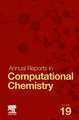
Annual Reports in Computational Chemistry: Annual Reports in Computational Chemistry, cartea 7
Editat de Ralph A. Wheeleren Limba Engleză Paperback – 25 noi 2011
- Broad coverage of computational chemistry and up-to-date information
- Each chapter reviews the most recent literature on a specific topic of interest to computational chemists





Preț: 1186.38 lei
Preț vechi: 1725.27 lei
-31%
Puncte Express: 1780
Carte tipărită la comandă
Livrare economică 13-27 noiembrie
Livrare prin curier în România Termenul estimat este afișat lângă disponibilitate.
Transport gratuit pentru acest produs Plată online sau ramburs, în funcție de opțiunile comenzii.
Retur gratuit în 14 zile Comandă securizată și suport în română.
Specificații
ISBN-13: 9780444538352
ISBN-10: 0444538356
Pagini: 288
Ilustrații: 1
Dimensiuni: 152 x 229 x 20 mm
Greutate: 0.46 kg
Editura: ELSEVIER SCIENCE
Seria Annual Reports in Computational Chemistry
ISBN-10: 0444538356
Pagini: 288
Ilustrații: 1
Dimensiuni: 152 x 229 x 20 mm
Greutate: 0.46 kg
Editura: ELSEVIER SCIENCE
Seria Annual Reports in Computational Chemistry
V-ar putea interesa
-
 Novel Carbon AdsorbentsJuan M.D. Tascón-31%Preț: 1052.46 lei1516.35 lei
 -
 Gas ChromatographyColin Poole-31%Preț: 884.69 lei1277.82 lei
 -
 Green Analytical Chemistry: Theory and PracticeMiguel de la Guardia-26%Preț: 1249.99 lei1696.58 lei
 -
 -26%Preț: 876.56 lei1184.44 lei
 -
 Hazard Analysis Techniques for System Safety 2eClifton A. Ericson-23%Preț: 773.71 lei1004.83 lei
 -
 Guidelines for Asset Integrity ManagementCcps (Center for Chemical Process Saf-9%Preț: 930.04 lei1022.02 lei
 -
 -9%Preț: 923.06 lei1014.36 lei
 -
 Preț: 52.10 lei
 -
 OrganikumKlaus Schwetlick-8%Preț: 500.94 lei544.50 lei
 -
 -9%Preț: 1067.68 lei1173.27 lei
 -
 Röntgenfluoreszenzanalyse in der LaborpraxisMichael Haschke-8%Preț: 562.70 lei611.63 lei
Public țintă
Researchers and students interested in computational chemistryCuprins
Contributors
Section 1: Bioinformatics
Preface Potential Landscape and Flux Framework of Nonequilibrium Biological Networks
1. Introduction
2. Biochemical Oscillation
3. Stem-Cell Differentiation and Development: Arrows of Time
Acknowledgments
Section 2: Simulation Methodologies
Predicting Structural and Functional Properties of Membrane Proteins from Protein Sequence 1. Topologies and 3D Structures of Integral Membrane Proteins
2. Predicting TM Helices from Sequence
3. Predicting Structural Features of Helical TM Proteins
4. Predicting the Exposure Status of TM Residues
5. Topology and Exposure Status Prediction of TMB
6. Functional Classification of GPCRs and Membrane Transporters
7. Outlook
A Review of Coarse-Grained Molecular Dynamics Techniques to Access Extended Spatial and Temporal Scales in Biomolecular Simulations
1. Introduction
2. Energy-Based Approach to Coarse-Graining
3. Force-Matching Approach to Coarse-Graining
4. Mixed Resolution Dynamics
5. Prospective Utilization
6. Outlook and Summary
An Overview of String-Based Path Sampling Methods
1. Introduction
2. Elastic Band Derived Methods
3. Applications
4. Conclusions and Outlook
Constructing and Evaluating Predictive Models for Protein Biophysical Characteristics
1. Introduction
2. Characterizing the Error Distribution
3. Outliers
4. Accurate Model Parameters
5. Conclusion
Supplementary Data
Section 3: Biological Modeling
Extracting Experimental Measurables from Molecular Dynamics Simulations of Membranes 1. Introduction
2. Bilayer Structure
3. Bilayer Dynamics
4. Future Direction: Escaping the Timescale Limits of All-Atom MD
Acknowledgment
Advances in Scalable Computational Chemistry
1. Introduction
2. Software Design
3. Hartree–Fock and Density Functional Theory
4. Gaussian Basis Set HF and DFT
5. Plane-Wave Basis Set DFT
6. CC Methods
7. Perturbation Methods
8. Electron Transfer Methods
9. Relativistic Methods
10. Classical MD Simulation
11. Combined QM/MM
12. Conclusions
Acknowledgments
Section 4: Quantum Chemistry
The Super Instruction Architecture 1. Introduction
2. Productivity for Electronic Structure Science and Engineering
3. Productivity for Method Developers
4. Outlook
Acknowledgments
Section 5: Chemical Education
Electronically Excited States in Interstellar Chemistry 1. Introduction
2. Theoretical Details of Coupled Cluster Excited States
3. Excited States in the ISM: Radicals, Cations, and Anions, Oh My!
4. Conclusions
Acknowledgments
Computational Chemistry of Vision in Vertebrates and Invertebrates
1. Introduction
2. Retinal Proteins
3. Theoretical Framework
4. Spectral Tuning
5. Conclusion
Acknowledgments
A Class Project Combining Organic Chemistry, Quantum Chemistry, and Statistics
1. Background
2. Results and Discussion
3. Conclusions
Notes and Acknowledgment
Section 1: Bioinformatics
Preface Potential Landscape and Flux Framework of Nonequilibrium Biological Networks
1. Introduction
2. Biochemical Oscillation
3. Stem-Cell Differentiation and Development: Arrows of Time
Acknowledgments
Section 2: Simulation Methodologies
Predicting Structural and Functional Properties of Membrane Proteins from Protein Sequence 1. Topologies and 3D Structures of Integral Membrane Proteins
2. Predicting TM Helices from Sequence
3. Predicting Structural Features of Helical TM Proteins
4. Predicting the Exposure Status of TM Residues
5. Topology and Exposure Status Prediction of TMB
6. Functional Classification of GPCRs and Membrane Transporters
7. Outlook
A Review of Coarse-Grained Molecular Dynamics Techniques to Access Extended Spatial and Temporal Scales in Biomolecular Simulations
1. Introduction
2. Energy-Based Approach to Coarse-Graining
3. Force-Matching Approach to Coarse-Graining
4. Mixed Resolution Dynamics
5. Prospective Utilization
6. Outlook and Summary
An Overview of String-Based Path Sampling Methods
1. Introduction
2. Elastic Band Derived Methods
3. Applications
4. Conclusions and Outlook
Constructing and Evaluating Predictive Models for Protein Biophysical Characteristics
1. Introduction
2. Characterizing the Error Distribution
3. Outliers
4. Accurate Model Parameters
5. Conclusion
Supplementary Data
Section 3: Biological Modeling
Extracting Experimental Measurables from Molecular Dynamics Simulations of Membranes 1. Introduction
2. Bilayer Structure
3. Bilayer Dynamics
4. Future Direction: Escaping the Timescale Limits of All-Atom MD
Acknowledgment
Advances in Scalable Computational Chemistry
1. Introduction
2. Software Design
3. Hartree–Fock and Density Functional Theory
4. Gaussian Basis Set HF and DFT
5. Plane-Wave Basis Set DFT
6. CC Methods
7. Perturbation Methods
8. Electron Transfer Methods
9. Relativistic Methods
10. Classical MD Simulation
11. Combined QM/MM
12. Conclusions
Acknowledgments
Section 4: Quantum Chemistry
The Super Instruction Architecture 1. Introduction
2. Productivity for Electronic Structure Science and Engineering
3. Productivity for Method Developers
4. Outlook
Acknowledgments
Section 5: Chemical Education
Electronically Excited States in Interstellar Chemistry 1. Introduction
2. Theoretical Details of Coupled Cluster Excited States
3. Excited States in the ISM: Radicals, Cations, and Anions, Oh My!
4. Conclusions
Acknowledgments
Computational Chemistry of Vision in Vertebrates and Invertebrates
1. Introduction
2. Retinal Proteins
3. Theoretical Framework
4. Spectral Tuning
5. Conclusion
Acknowledgments
A Class Project Combining Organic Chemistry, Quantum Chemistry, and Statistics
1. Background
2. Results and Discussion
3. Conclusions
Notes and Acknowledgment
Descriere
Descriere de la o altă ediție sau format:
Presents critical reviews of important topics in computational chemistry as applied to various chemical disciplines. This title covers such topics as quantum chemistry, molecular mechanics, force fields, chemical education, and applications in academic and industrial settings, focusing on the advances in the field.
Presents critical reviews of important topics in computational chemistry as applied to various chemical disciplines. This title covers such topics as quantum chemistry, molecular mechanics, force fields, chemical education, and applications in academic and industrial settings, focusing on the advances in the field.