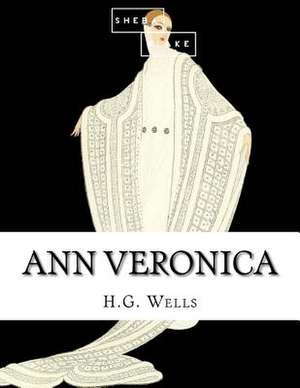
Ann Veronica
Autor H. G. Wellsen Limba Engleză Paperback
Preț: 104.24 lei
Puncte Express: 156
Carte disponibilă
Livrare economică 27 octombrie-10 noiembrie
Livrare prin curier în România Termenul estimat este afișat lângă disponibilitate.
Transport gratuit de la 400.00 lei Plată online sau ramburs, în funcție de opțiunile comenzii.
Retur gratuit în 14 zile Comandă securizată și suport în română.
Specificații
ISBN-13: 9781548137830
ISBN-10: 1548137839
Pagini: 238
Dimensiuni: 216 x 279 x 13 mm
Greutate: 0.56 kg
ISBN-10: 1548137839
Pagini: 238
Dimensiuni: 216 x 279 x 13 mm
Greutate: 0.56 kg
V-ar putea interesa
-
 The Island of Doctor MoreauH. G. WellsPreț: 28.01 lei
 -
 A Vindication of the Rights of WomanMary Wollstonecraft-28%Preț: 21.37 lei29.58 lei
 -
 Keep the Aspidistra FlyingGeorge Orwell-27%Preț: 52.19 lei71.53 lei
 -
 SinnersElizabeth FremantlePreț: 108.65 lei
 -
 Mary AnneDaphne du Maurier-26%Preț: 58.93 lei79.19 lei
 -
 The First Men in the MoonH. G. WellsPreț: 53.36 lei
 -
 AnthemAyn RandPreț: 52.26 lei
 -
 FatherElizabeth von Arnim-5%Preț: 68.64 lei71.89 lei
 -
 A Modern UtopiaH. G. WellsPreț: 51.18 lei
 -
 The BostoniansHenry JamesPreț: 56.71 lei
 -
 The Book of RevelationsJuliet NicolsonPreț: 156.28 lei
 -
 Preț: 50.57 lei
 -
 The Nine Lives of Annie BesantClare PatersonPreț: 156.51 lei
 -
 Preț: 69.13 lei
 -
 The Open HeartEmelyne Godfrey-10%Preț: 111.12 lei123.14 lei
 -
 A Vindication of the Rights of Woman (Hero Classics)Mary WollstonecraftPreț: 70.51 lei
 -
 Preț: 34.20 lei
 -
 The Time MachineH. G. WellsPreț: 33.23 lei
Notă biografică
H.G. Wells was a professional writer and journalist who published more than a hundred books, including pioneering science fiction novels, histories, essays and programmes for world regeneration. He was a founding member of numerous movements including Liberty and PEN International - the world's oldest human rights organization - and his Rights of Man laid the groundwork for the 1948 Universal Declaration of Human Rights. Wells' controversial and progressive views on equality and the shape of a truly developed nation remain directly relevant to our world today. He was, in Bertrand Russell's words, 'an important liberator of thought and action'.
Descriere
Descriere de la o altă ediție sau format:
H.G. Wells’s 1909 novel centres on the coming of age of the spirited Ann Veronica, who runs away from her sheltered suburban home to live in London. There she mingles with feminists, studies biology, learns jiu jitsu, and even participates in a suffragette raid on the House of Commons that lands her in jail. When originally published, the novel was deemed “poisonous” for its bold treatment of an adulterous romance that only lightly veiled Wells’s extramarital affairs. While critics debate whether the shift to romance undermines the novel’s feminist themes, readers continue to be engaged by its vividly realized heroine and its rich portrayal of the tumultuous social movements of Edwardian London.
Historical documents expand on the novel’s autobiographical dimension with letters between Wells and Amber Reeves, the model for Ann Veronica; also included are materials on the suffrage movement, attempts to censor the novel, and the New Woman.
H.G. Wells’s 1909 novel centres on the coming of age of the spirited Ann Veronica, who runs away from her sheltered suburban home to live in London. There she mingles with feminists, studies biology, learns jiu jitsu, and even participates in a suffragette raid on the House of Commons that lands her in jail. When originally published, the novel was deemed “poisonous” for its bold treatment of an adulterous romance that only lightly veiled Wells’s extramarital affairs. While critics debate whether the shift to romance undermines the novel’s feminist themes, readers continue to be engaged by its vividly realized heroine and its rich portrayal of the tumultuous social movements of Edwardian London.
Historical documents expand on the novel’s autobiographical dimension with letters between Wells and Amber Reeves, the model for Ann Veronica; also included are materials on the suffrage movement, attempts to censor the novel, and the New Woman.
Recenzii
H.G. Wells’s 1909 novel centres on the coming of age of the spirited Ann Veronica, who runs away from her sheltered suburban home to live in London. There she mingles with feminists, studies biology, learns jiu jitsu, and even participates in a suffragette raid on the House of Commons that lands her in jail. When originally published, the novel was deemed “poisonous” for its bold treatment of an adulterous romance that only lightly veiled Wells’s extramarital affairs. While critics debate whether the shift to romance undermines the novel’s feminist themes, readers continue to be engaged by its vividly realized heroine and its rich portrayal of the tumultuous social movements of Edwardian London.
Historical documents expand on the novel’s autobiographical dimension with letters between Wells and Amber Reeves, the model for Ann Veronica; also included are materials on the suffrage movement, attempts to censor the novel, and the New Woman.
“A fitting representation of Wells’s series of social romances, in this new edition Ann Veronica assumes enhanced value as an examination of the ‘Woman Question’ at the turn of the twentieth century. Carey Snyder’s fine introduction and her selection of texts for the appendices encourage readers to join in the sort of debate that Wells strove to inspire in his fiction. Notably Snyder appreciates the lifelong accomplishments of Amber Reeves, whose youthful affair with Wells was the inspiration for the lively central character. There are also some well-selected primary texts recording the views of Wells on his own work, the arguments of would-be censors, the Fabians, the suffrage movement, modernist reviewers, and Beatrice Hastings of The New Age.” — Bonnie Kime Scott, Professor Emerita, San Diego State University and the University of Delaware
“Carey Snyder has produced a splendid new edition of H.G. Wells’s under-read take on the social and literary phenomenon of the New Woman. The novel itself, like most of Wells’s work, is a great read, and Snyder supplies a first-rate introduction that locates Ann Veronica in its moment—the woman’s suffrage movement, debates about marriage, chastity, sexual candor, and socialism—as well a rich selection of appendices reproducing a wide range of contextual documents, from John Ruskin on separate spheres for men and women to selections of letters to Wells from Amber Reeves, one of the historical/autobiographical models for his eponymous heroine. By situating Ann Veronica so deftly in its own moment, Snyder lets it speak to ours.” — Mark Wollaeger, Vanderbilt University
“Snyder’s terrific edition does justice to Ann Veronica’s experiments in the modern and to the implications of the ‘modern romance’ of its subtitle. Its introduction and notes assist readers with understanding contemporary contexts and debates, while its appendices provide readers with tools to extend their analyses of the novel’s engagement with, among other topics, feminism, theories of modern fiction, socialism, censorship, evolutionary biology, urban life, and contrary notions of ‘modernity.’” — Elizabeth F. Evans, Modernism/modernity
Historical documents expand on the novel’s autobiographical dimension with letters between Wells and Amber Reeves, the model for Ann Veronica; also included are materials on the suffrage movement, attempts to censor the novel, and the New Woman.
“A fitting representation of Wells’s series of social romances, in this new edition Ann Veronica assumes enhanced value as an examination of the ‘Woman Question’ at the turn of the twentieth century. Carey Snyder’s fine introduction and her selection of texts for the appendices encourage readers to join in the sort of debate that Wells strove to inspire in his fiction. Notably Snyder appreciates the lifelong accomplishments of Amber Reeves, whose youthful affair with Wells was the inspiration for the lively central character. There are also some well-selected primary texts recording the views of Wells on his own work, the arguments of would-be censors, the Fabians, the suffrage movement, modernist reviewers, and Beatrice Hastings of The New Age.” — Bonnie Kime Scott, Professor Emerita, San Diego State University and the University of Delaware
“Carey Snyder has produced a splendid new edition of H.G. Wells’s under-read take on the social and literary phenomenon of the New Woman. The novel itself, like most of Wells’s work, is a great read, and Snyder supplies a first-rate introduction that locates Ann Veronica in its moment—the woman’s suffrage movement, debates about marriage, chastity, sexual candor, and socialism—as well a rich selection of appendices reproducing a wide range of contextual documents, from John Ruskin on separate spheres for men and women to selections of letters to Wells from Amber Reeves, one of the historical/autobiographical models for his eponymous heroine. By situating Ann Veronica so deftly in its own moment, Snyder lets it speak to ours.” — Mark Wollaeger, Vanderbilt University
“Snyder’s terrific edition does justice to Ann Veronica’s experiments in the modern and to the implications of the ‘modern romance’ of its subtitle. Its introduction and notes assist readers with understanding contemporary contexts and debates, while its appendices provide readers with tools to extend their analyses of the novel’s engagement with, among other topics, feminism, theories of modern fiction, socialism, censorship, evolutionary biology, urban life, and contrary notions of ‘modernity.’” — Elizabeth F. Evans, Modernism/modernity
Cuprins
Acknowledgements
Introduction
H.G. Wells: A Brief Chronology
A Note on the Text
Ann Veronica
Appendix A: Reception of Ann Veronica
Introduction
H.G. Wells: A Brief Chronology
A Note on the Text
Ann Veronica
Appendix A: Reception of Ann Veronica
- From John O’London, T.P.’s Weekly (22 October 1909)
- From [John St Loe Strachey,] “A Poisonous Book,” Spectator (20 November 1909)
- From H.G. Wells’s reply, Spectator (4 December 1909)
- From Freda Kirchwey, “A Private Letter to H.G. Wells,” Nation (28 November 1928)
- B[eatrice] H[astings] and K[atherine] M[ansfield], A Parody of Ann Veronica, The New Age (25 May 1911)
- From the Preface to the Atlantic Edition of The Works of H.G. Wells (1925)
- From “Writings about Sex,” Experiment in Autobiography (1934)
- John Littlejohns, Front Cover of The New Age (3 February 1910)
- “A Public Librarian,” Spectator (December 1909)
- From Jacob Tonson [Arnold Bennett], “Books and Persons,” The New Age (24 February 1910)
- From H.G. Wells, “The Contemporary Novel,” An Englishman Looks at the World (1914)
- From Henry James, “The Younger Generation,” Times Literary Supplement (2 April 1914)
- From Virginia Woolf, “Modern Fiction,” The Common Reader (1925)
- From John Ruskin, “Of Queens’ Gardens,” Sesame and Lilies (1865)
- From Mona Caird, “Marriage,” Westminster Review (August 1888)
- From Olive Schreiner, Woman and Labour (1911)
- From Dora Marsden, “Bondswomen and Freewomen,” Freewoman (23 November 1911)
- From Fabian Women’s Group, “Three Year’s Work” (1911)
- From M.A. [Mabel Atkinson], “The Economic Foundations of the Women’s Movement” (1914)
- From Socialism and the Family (1906)
- From “Human Evolution, An Artificial Process,” Fortnightly Review (October 1896)
- H.G. Wells, “Dusa” (1936)
- Photograph of Amber Reeves in 1908 Student Group
- From the Diary of Beatrice Webb (1908, 1909)
- From Letters from Amber Reeves to H.G. Wells (1908, 1939)
- Photograph of Amber and Anna Jane Blanco White (1910)
- From Christabel Pankhurst, A Speech Delivered at Queen’s Hall (22 December 1908)
- From Emmeline Pankhurst, A Speech Delivered at Queen’s Hall (2 December 1910)
- From Belfort Bax, “Feminism and Female Suffrage,” The New Age (30 May 1908)
- From Beatrice Tina [Beatrice Hastings], “Woman as State Creditor,” The New Age (27 June 1907)
- From Beatrice Tina [Beatrice Hastings], “Suffragettes in the Making,” The New Age (3 December 1908)
- From D. Triformis [Beatrice Hastings], “The Failure of Militancy,” The New Age (20 January 1911)
- From Millicent Garrett Fawcett, Women’s Suffrage: A Short History of a Great Movement (1912)
- From Teresa Billington-Grieg, “Emancipation in a Hurry,” The New Age (12 January 1911)
- H.G. Wells, “Reply to Symposium on Women’s Suffrage,” The New Age (2 February 1911)
- M.C. Rock, “[And the Words]” (1914)
- “The Suffragettes and Their Trojan Horse,” Auckland Star (28 March 1908)
- Arthur Wallis Mills, “The Suffragette that Knew Jiu-Jitsu,” Punch (6 July 1910)
- Suffragettes Selling Votes for Women at Oval Cricket Ground Entrance (1908)