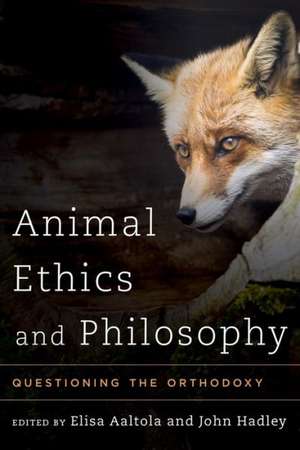
Animal Ethics and Philosophy: Questioning the Orthodoxy
Editat de Elisa Aaltola, John Hadleyen Limba Engleză Paperback – 24 noi 2014
This timely collection of essays brings together new theory and critical perspectives on key topics in animal ethics, foregrounding questions relating to moral status, moral epistemology and moral psychology. Is an individualistic approach based upon capacities the best way to ground the moral status of non-human animals or should philosophers pursue relational perspectives? What does it mean to "know" animals and "speak" for them? What is the role of emotions such as disgust, empathy, and love, in animal ethics and how does emotion inform the rationalism inherent in analytic animal ethics theory?
The collection aims to broaden the scope of animal ethics, rendering it more inclusive of important contemporary philosophical themes and pushing the discipline in new directions.
Preț: 328.01 lei
Preț vechi: 468.39 lei
-30%
Puncte Express: 492
Carte tipărită la comandă
Livrare economică 08-22 iunie
Specificații
ISBN-13: 9781783481828
ISBN-10: 178348182X
Pagini: 236
Dimensiuni: 157 x 229 x 17 mm
Greutate: 0.36 kg
Editura: Bloomsbury Publishing
Colecția Rowman & Littlefield
Locul publicării:New York, United States
ISBN-10: 178348182X
Pagini: 236
Dimensiuni: 157 x 229 x 17 mm
Greutate: 0.36 kg
Editura: Bloomsbury Publishing
Colecția Rowman & Littlefield
Locul publicării:New York, United States
V-ar putea interesa
-
 When Elephants WeepJeffrey MassonPreț: 108.16 lei
 -
 Biology, Ethics, and AnimalsRosemary Rodd-26%Preț: 132.59 lei178.55 lei
 -
 -14%Preț: 356.68 lei415.04 lei
 -
 Animals, Equality and DemocracyS. O'Sullivan-15%Preț: 674.25 lei793.23 lei
 -
 Animal Suffering: Philosophy and CultureE. Aaltola-15%Preț: 620.20 lei729.65 lei
 -
 Ethics, Humans and Other Animals: An Introduction with ReadingsRosalind HursthousePreț: 423.64 lei
 -
 The Case for Animal RightsTom ReganPreț: 245.92 lei
 -
 The Lives of AnimalsJ M CoetzeePreț: 84.20 lei
 -
 Preț: 217.75 lei
 -
 Animal Rights and WrongsRoger Scruton-43%Preț: 117.35 lei205.79 lei
 -
 Zoo Story: Life in the Garden of CaptivesThomas French-44%Preț: 60.58 lei108.69 lei
 -
 Ethics of Animal UsePeter Sandøe-5%Preț: 491.00 lei516.84 lei
 -
 My Rescue Dog Rescued Me: Amazing True Stories of Adopted Canine HeroesSharon Ward Keeble-20%Preț: 49.40 lei61.75 lei
 -
 Animals Like UsMark RowlandsPreț: 101.54 lei
 -
 DonkeyJill Bough-11%Preț: 91.76 lei102.99 lei
 -
 The No-Nonsense Guide To Animal RightsCatherine Grant-31%Preț: 38.42 lei55.36 lei
Cuprins
Notes on Contributors / Introduction: Questioning the Orthodoxy, John Hadley and Elisa Aaltola/ Part I: Intrinsic Value and Moral Status: Rethinking Sentience/ 1. A Meta-level Problem for Animal Rights Theory, John Hadley / 2. Against Moral Intrinsicalism, Nicolas Delon / 3. Beyond Sentience: Biosemiotics as Foundation for Animal and Environmental Ethics, Morton Tonnesen and Jonathan Beever / 4. Animal Agency: What It Is, What It Isn't, and How It Can be Realized, Zipporah Weisberg / Part II: Epistemology: Knowing and Speaking for Nonhuman Animals / 5. Enchanted Worlds and Animal Others, Wayne Williams / 6. 'The Flesh of My Flesh': Animality, Difference, and 'Radical' Community in Merleau-Ponty's Late Philosophy, Jonathan D. Singer / 7.The Problem of Speaking for Animals, Jason Wyckoff / 8. Doing Away with Rights, Elizabeth Foreman / Part III: Moral Psychology: Emotions and Metaethics / 9. Disgust and the Collection of Bovine Foetal Blood, Robert Fischer / Hume on Animals and the Rest of Nature, Angela Coventry and Avram Hiller / 11.The Politicization of Animal Love, Tony Milligan / 12. The Sentimentalism Revival and Animal Philosophy, Elisa Aaltola / Further Reading / Index
Recenzii
Editors Aaltola and Hadley identify the motivation for this collection of essays as the fact that there is very little innovation in the field of animal ethics; much fits the description of 'moral extensionism,' or the extension of existing moral and political theories across species. The editors present works that examine the metaethical and meta-philosophical issues in animal ethics, thereby asking unaddressed questions. In the book's 12 essays, various contributors focus on the assumptions behind the critique of morally relevant relationships; offer an application of biosemiotics, or living organisms' use of signs; and utilize Merleau-Ponty's embodied subjects to discuss intersubjectivity with non-human animals. Authors also examine the epistemological and ethical difficulties regarding speaking for animals, argue there is a shortsightedness in basing animal ethics in rights, and consider the moral role of disgust with animal abuse. Finally, Aaltola ends with a convincing explanation for how and why humans are able to paradoxically love some animals and eat others. . . .Readers will find original additions to the animal ethics discussion. Summing Up: Recommended. Upper-division undergraduates through researchers and faculty.
This is a very original book which examines new paths for studies in nonhuman animals and moral philosophy. Addressing issues concerning animal ethics in metaethics, metaphilosophy, epistemology and moral psychology, it offers a previously unexplored approach.
Aaltola and Hadley have rounded up some of their most gifted contemporaries to push the boundaries and rejuvenate some of the old debates. An exciting read for all those who care about ethics and animals.
The essays that constitute Animal Ethics and Philosophy: Questioning the Orthodoxy accomplish at least two things: first, they provide a long-overdue critical reconceptualization and sharp meta-analysis of assumptions foundational to contemporary animal ethics; second and most importantly, they construct fresh, original, innovative paradigms for future research in animal ethics.
This is a very original book which examines new paths for studies in nonhuman animals and moral philosophy. Addressing issues concerning animal ethics in metaethics, metaphilosophy, epistemology and moral psychology, it offers a previously unexplored approach.
Aaltola and Hadley have rounded up some of their most gifted contemporaries to push the boundaries and rejuvenate some of the old debates. An exciting read for all those who care about ethics and animals.
The essays that constitute Animal Ethics and Philosophy: Questioning the Orthodoxy accomplish at least two things: first, they provide a long-overdue critical reconceptualization and sharp meta-analysis of assumptions foundational to contemporary animal ethics; second and most importantly, they construct fresh, original, innovative paradigms for future research in animal ethics.