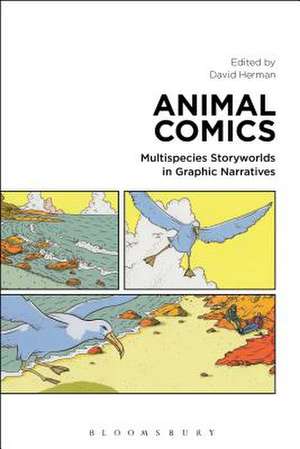
Animal Comics: Multispecies Storyworlds in Graphic Narratives
David Hermanen Limba Engleză Paperback – 27 iun 2019
Preț: 254.61 lei
Preț vechi: 337.48 lei
-25%
Puncte Express: 382
Carte tipărită la comandă
Livrare economică 02-16 decembrie
Livrare prin curier în România Termenul estimat este afișat lângă disponibilitate.
Transport gratuit de la 400.00 lei Plată online sau ramburs, în funcție de opțiunile comenzii.
Retur gratuit în 14 zile Comandă securizată și suport în română.
Specificații
ISBN-13: 9781350116955
ISBN-10: 1350116955
Pagini: 280
Ilustrații: 24 bw illus
Dimensiuni: 156 x 234 x 20 mm
Greutate: 0.4 kg
Editura: Bloomsbury Publishing
Colecția Bloomsbury Academic
Locul publicării:London, United Kingdom
ISBN-10: 1350116955
Pagini: 280
Ilustrații: 24 bw illus
Dimensiuni: 156 x 234 x 20 mm
Greutate: 0.4 kg
Editura: Bloomsbury Publishing
Colecția Bloomsbury Academic
Locul publicării:London, United Kingdom
V-ar putea interesa
-
 -31%Preț: 824.01 lei1194.77 lei
 -
 Storytelling and the Sciences of MindDavid HermanPreț: 322.10 lei
 -
 Routledge Encyclopedia of Narrative TheoryDavid Herman-15%Preț: 553.05 lei650.64 lei
 -
 Thinking with the Eye's MindDavid HermanPreț: 78.12 lei
 -
 The Cambridge Companion to NarrativeDavid HermanPreț: 384.76 lei
 -
 Davis, J: Garfield Fat CatJim DavisPreț: 252.94 lei
 -
 Muriel SparkDavid HermanPreț: 252.95 lei
 -
 Children's and Young Adult ComicsProfessor Gwen Athene Tarbox-20%Preț: 174.75 lei217.68 lei
 -
 Basic Elements NarrativeHermanPreț: 390.09 lei
 -
 The MatchRussell Ayto-27%Preț: 39.87 lei54.98 lei
 -
 Black AFKwanza OsajyefoPreț: 57.42 lei
 -
 A Guinea Pig Christmas CarolCharles DickensPreț: 88.34 lei
 -
 A Guinea Pig NutcrackerAlex GoodwinPreț: 77.42 lei
 -
 Preț: 391.08 lei
Cuprins
List of Figures
Acknowledgments
Notes on Contributors
Introduction: More-than-Human Worlds in Graphic Storytelling
David Herman
Part I. Animal Agency in the History and Theory of Comics
1. Lions and Tigers and Fears: A Natural History of the Sequential Animal
Daniel F. Yezbick, St Louis Community College, USA
2. The Animalized Character and Style
Glenn Willmott, Queen's University, Canada
Part II. Species of Difference: Functions of Animal Alterity in Graphic Narratives
3. The Politics and Poetics of Alterity in Adam Hines's Duncan the Wonder Dog
Alex Link, Alberta College of Art & Design, Canada
4. The Saga of the Animal as Visual Metaphor for Mixed-Race Identity in Comics
Michael A. Chaney, Dartmouth College, USA
5. Curly Tails and Flying Dogs: Structures of Affect in Nick Abadzi's Laika
Carrie Rohman, Lafayette College, USA
6. Invasive Species: Manga's Insect-Human Worlds
Mary A. Knighton, Aoyama Gakuin University, Japan
Part III. Critical Frameworks for Multispecies Comics
7. Resituating the Animal Comic: Environmentalist Aesthetics in Matt Dembicki's Xoc: The Journey of a Great White
Laura Pearson, University of Leeds, UK
8. Interspecies Relationships in Graphic Micronarratives: From Olivier Deprez to Avril-Deprez
Jan Baetens, University of Leuven, Belgium
9. Animal Minds in Nonfiction Comics
David Herman
Part IV. Graphic Animality in the Classroom and Beyond
10. Can We Be Part of the Pride? Reading Animals through Comics in the Undergraduate Classroom
Andrew Smyth and Charles E. Baraw, Southern Connecticut State University, USA
11. This is Home
Bridget Brewer and Thalia Field, Brown University, USA
Index
Acknowledgments
Notes on Contributors
Introduction: More-than-Human Worlds in Graphic Storytelling
David Herman
Part I. Animal Agency in the History and Theory of Comics
1. Lions and Tigers and Fears: A Natural History of the Sequential Animal
Daniel F. Yezbick, St Louis Community College, USA
2. The Animalized Character and Style
Glenn Willmott, Queen's University, Canada
Part II. Species of Difference: Functions of Animal Alterity in Graphic Narratives
3. The Politics and Poetics of Alterity in Adam Hines's Duncan the Wonder Dog
Alex Link, Alberta College of Art & Design, Canada
4. The Saga of the Animal as Visual Metaphor for Mixed-Race Identity in Comics
Michael A. Chaney, Dartmouth College, USA
5. Curly Tails and Flying Dogs: Structures of Affect in Nick Abadzi's Laika
Carrie Rohman, Lafayette College, USA
6. Invasive Species: Manga's Insect-Human Worlds
Mary A. Knighton, Aoyama Gakuin University, Japan
Part III. Critical Frameworks for Multispecies Comics
7. Resituating the Animal Comic: Environmentalist Aesthetics in Matt Dembicki's Xoc: The Journey of a Great White
Laura Pearson, University of Leeds, UK
8. Interspecies Relationships in Graphic Micronarratives: From Olivier Deprez to Avril-Deprez
Jan Baetens, University of Leuven, Belgium
9. Animal Minds in Nonfiction Comics
David Herman
Part IV. Graphic Animality in the Classroom and Beyond
10. Can We Be Part of the Pride? Reading Animals through Comics in the Undergraduate Classroom
Andrew Smyth and Charles E. Baraw, Southern Connecticut State University, USA
11. This is Home
Bridget Brewer and Thalia Field, Brown University, USA
Index
Recenzii
With its international and interdisciplinary sweep, this ground-breaking volume examines the ways that comics activate animals as icons and symbols in ways that no other art form possibly can.
If animals cannot speak, they have found in the authors of this fascinating volume the best advocates and interpreters. Animal comics are not a genre but a continent, of which the cartography is delivered here for the first time, in a truly cross-disciplinary perspective.
The essays offer a variety of critical frameworks for examining these comics; e.g., one essay provides a historical overview, with plenty of illustrative examples. Other contributors use a variety of theoretical lenses as they analyze these comics and even discuss animals in nonfiction comics. The final section (of four) should prove extremely helpful for teachers and future teachers: it offers strategies for using animal comics in various classroom settings, from a general education course to a young adult literature class. The variety of topics and texts represented here makes this collection useful across disciplines and interests . The collection is a worthy complement to other books about graphic novels. Summing Up: Recommended.
If animals cannot speak, they have found in the authors of this fascinating volume the best advocates and interpreters. Animal comics are not a genre but a continent, of which the cartography is delivered here for the first time, in a truly cross-disciplinary perspective.
The essays offer a variety of critical frameworks for examining these comics; e.g., one essay provides a historical overview, with plenty of illustrative examples. Other contributors use a variety of theoretical lenses as they analyze these comics and even discuss animals in nonfiction comics. The final section (of four) should prove extremely helpful for teachers and future teachers: it offers strategies for using animal comics in various classroom settings, from a general education course to a young adult literature class. The variety of topics and texts represented here makes this collection useful across disciplines and interests . The collection is a worthy complement to other books about graphic novels. Summing Up: Recommended.