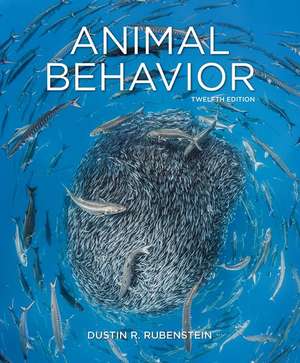
Animal Behavior
Autor Dustin Rubensteinen Limba Engleză Paperback – 12 sep 2023
Nivel de studiu: licență și master în biologie, zoologie sau psihologie comparată. Ajuns la ediția a 12-a sub egida Oxford University Press, acest volum reprezintă textul fundamental în studiul etologiei moderne. Observăm cum Dustin Rubenstein menține rigoarea academică prin integrarea logicii științifice în analiza mecanismelor care guvernează comportamentul animal, punând un accent deosebit pe fundamentul evoluționist ca element unificator. Structura cursului facilitează înțelegerea modului în care genele, sistemul endocrin și neurobiologia interacționează cu mediul ecologic pentru a produce răspunsuri comportamentale complexe.
Apreciem în mod deosebit utilizarea figurilor bazate pe date reale și menținerea unei bibliografii vaste, care ancorează afirmațiile teoretice în cercetări empirice recente. Spre deosebire de abordarea introductivă din Behaviour and Evolution de Marion Hall, care se concentrează pe o prezentare ușor de parcurs a relației cauză-efect, Animal Behavior extinde acest cadru prin analize comparative profunde între specii diverse, de la nevertebrate la primate. De asemenea, dacă The Behavior of Animals de Jerry A. Hogan pune accent pe contribuțiile experților internaționali în capitole tematice despre individualitate, lucrarea lui Rubenstein oferă o viziune mai integrativă, demonstrând cum teoria selecției naturale explică atât supraviețuirea, cât și interacțiunile sociale complexe. Tonul este unul academic precis, oferind studenților instrumentele metodologice necesare pentru a interpreta critic investigațiile științifice din domeniu.
Preț: 964.79 lei
Preț vechi: 1321.63 lei
-27%
Carte disponibilă
Livrare economică 04-18 noiembrie
Specificații
ISBN-10: 0197564917
Pagini: 608
Greutate: 1.71 kg
Ediția:12
Editura: Oxford University Press
Colecția OUP USA
Locul publicării:New York, United States
De ce să citești această carte
Recomandăm această ediție pentru rigoarea cu care tratează etologia ca știință exactă. Cititorul câștigă o înțelegere sistemică a modului în care evoluția modelează acțiunile animalelor, beneficiind de o bibliotecă de studii de caz și date experimentale fără egal. Este resursa definitivă pentru cei care doresc să treacă dincolo de observația descriptivă către analiza mecanismelor biologice și genetice ale comportamentului.
Despre autor
Dustin Rubenstein este un cercetător recunoscut în domeniul biologiei evoluționiste și profesor la Universitatea Columbia. Expertiza sa se concentrează pe studiul mecanismelor fiziologice și moleculare care stau la baza comportamentului social și a adaptării la medii variabile. Prin munca sa de editor și autor pentru Animal Behavior, Rubenstein continuă tradiția excelenței în educația biologică, integrând cele mai noi descoperiri din genetică și neuroștiințe în cadrul clasic al etologiei, oferind astfel o perspectivă modernă și interdisciplinară asupra lumii animale.
Descriere
Recenzii
[The new edition of Animal Behavior] integrates learning objectives and multimedia files to supplement the theory and research findings of the neural physiology behind animal behavior." -Christine Brodsky, Pittsburg State University
Rubenstein's Animal Behavior provides a comprehensive introduction to the study of animal behavior from every conceivable angle. It provides specific examples to contextualize the science behind particular behaviors, while remaining interesting and easy to understand." -Amanda A. Rollins, Wilmington College
The data-driven figures are priceless. The focus on scientific investigations is magnificent. And the maintenance of the rich tradition of having an extensive bibliography of peer-reviewed studies is without equal." -Arshad Khan, University of Texas at El Paso
Notă biografică
Cuprins
- 1 An Introduction to Animal Behavior
- 1.1 Natural Selection and the Evolution of Behavior
- --1.1.1 The Cost-Benefit Approach
- --1.1.2 The Levels of Analysis
- --1.1.3 The Integrative Study of Animal Behavior
- 1.2 Approaches to Studying Behavior
- 1.2.1 Examining the Adaptive Basis of Behavior
- 1.2.2 Inferring the Evolutionary History of Behavior
- 2 The Integrative Study of Behavior
- 2.1 The Development of Song Learning
- --2.1.1 Intraspecific Variation and Dialects
- --2.1.2 Social Experience and Song Development
- 2: Mechanisms of Song Learning
- --2.2.1 The Genetics of Song Learning
- --2.2.2 The Avian Song Control System
- 2.3 The Evolution of Song Learning
- --2.3.1 An Evolutionary History of Bird Song
- --2.3.2 Song Learning: A Comparative Approach
- 2.4 The Adaptive Value of Song Learning
- --2.4.1 Ecological and Social Correlates of Song Learning
- --2.4.2 Social Competition and Mate Choice
- 3 The Developmental and Molecular Bases of Behavior
- 3: Behavior Requires Genes and the Environment
- --3.1.1 Behavioral Ontogeny
- --3.1.2 Gene Regulation Influences Behavior
- 3.2 The Evolutionary Development of Behavior
- --3.2.1 The Evo-Devo Approach to Understanding Behavior
- --3.2.2 Molecular Toolkits and the Development of Behavior
- 3.3 The Development of Behavioral Variation
- --3.3.1 Early Life Developmental Conditions
- --3.3.2 Alternative Behavioral Phenotypes
- 4 The Neural Basis of Behavior
- 4: Responding to Stimuli
- --4.1.1 Complex Behavioral Responses to Simple Stimuli
- --4.1.2 How Moths Avoid Bats
- 4.2 Sensory Stimuli and Nervous System Control
- --4.2.1 Decision Making in the Brain
- --4.2.2 Alternative Sensory Modalities 105
- 4.3 Translating Sensory Stimuli into Behavior
- --4.3.1 Neural Mechanisms of Information Transfer
- --4.3.2 Stimulus Filtering
- 5 The Physiological and Endocrine Bases of Behavior
- 5: Endogenous Rhythms and Changing Behavioral Priorities
- --5.1.1 Endogenous versus Exogenous Control of Behavioral Priorities
- --5.1.2 Mechanisms of Changing Behavioral Priorities
- 5.2 Cues that Entrain Cycles of Behavior
- --5.2.1 Predictable Environmental Cues
- --5.2.2 Unpredictable Environmental Cues
- 5.3 Hormones and Behavior
- --5.3.1 Activational Effects of Hormones
- --5.3.2 Hormonal Causes and Consequences of Behavior
- 6 Avoiding Predators and Finding Food
- 6: Antipredator Behavior
- --6.1.1 Blending In
- --6.1.2 Standing Out
- --6.1.3 Social Defenses
- --6.1.4 Optimality Theory and Antipredator Behavior
- 6.2 Foraging Behavior
- --6.2.1 Optimal Foraging Theory
- --6.2.2 Landscapes of Fear
- --6.2.3 Cognition and Finding Food
- --6.2.4 Frequency Dependence and Foraging Behavior
- 7 Territoriality and Movement
- 7: Where to Live
- --7.1.1 Habitat
- --7.1.2 Selection
- --7.1.3 Territoriality
- 7.2 To Stay or Go
- --7.2.1 Dispersal
- --7.2.2 Variation in Migratory Behavior and Connectivity 225
- 8 Principles of Communication
- 8: Communication and Animal Signals
- --8.1.1 A Communication Framework
- --8.1.2 Functionally Referent Signals
- 8.2 The Evolution of Animal Signals
- --8.2.1 Preexisting Traits
- --8.2.2 Preexisting Biases
- --8.2.3 Preexisting Traits versus Preexisting Biases
- 8.3 The Function of Animal Signals
- --8.3.1 Honest Signaling
- --8.3.2 Deceitful Signaling
- --8.3.3 Eavesdropping on Others
- 9 Reproductive Behavior
- 9: Sexual Selection and the Evolution of Sex Differences
- --9.1.1 Sex Differences in Behavior and Investment
- --9.1.2 A Reversal in Sex Differences
- 9.2 Intrasexual Selection and Competition for Mates
- --9.2.1 Competition and Access to Mates
- --9.2.2 Conditional Mating Tactics versus Alternative Mating Strategies
- --9.2.3 Sperm Competition
- --9.2.4 Paternity Assurance
- 9.3 Intersexual Selection and Mate Choice
- --9.3.1 Female Mate Choice: Direct versus Indirect Benefits
- --9.3.2 Cryptic Female Choice
- --9.3.3 Signal Evolution: Runaway versus Chase-Away Sexual Selection
- 9.4 Sexual Conflict
- --9.4.1 The Manipulation of Female Choice
- --9.4.2 Sexual Arms Races
- 10 Mating Systems
- 10: Monogamy: A Lack of Multiple Mating
- --10.1.1 Why Be Monogamous? 10.1.2 Monogamy and Biparental Care
- 10.2 Polyandry: Multiple Mating by Females
- --10.2.1 Female versus Male Control of Mating
- --10.2.2 Indirect versus Direct Benefits 327
- 10.3 Polygyny: Multiple Mating by Males
- --10.3.1 Female Defense Polygyny
- --10.3.2 Resource Defense Polygyny
- --10.3.3 Lek Polygyny
- --10.3.4 Scramble Competition Polygyny
- 10.4 Polygynandry and Promiscuity: Multiple Mating by Both Sexes
- --10.4.1 Polygynandry
- --10.4.2 Promiscuity
- 11 Parental Care
- 11: Offspring Value and Parental Investment
- --11.1.1 Parental Care Decisions
- --11.1.2 Parental Favoritism in Offspring Care and Production
- --11.1.3 Family Conflict
- 11.2 To Care or Not to Care
- --11.2.1 Current versus Future Reproduction
- --11.2.2 Sexual Conflict and Parental Care
- --11.2.2 Maternal versus Paternal Care
- 11.3 (Non-)Discriminating Parental Care
- --11.3.1 Offspring Recognition and Interspecific Brood Parasitism
- --11.3.2 Coevolutionary Arms Races
- --11.3.3 The Evolution of Brood Parasitism
- 12 Principles of Social Evolution
- 12: Altruism and Levels of Selection
- --12.2.1 Individual versus Group Selection
- --12.2.2 Kin Selection
- 12.2 Kin Selection and Inclusive Fitness Theory
- --12.2.1 Haplodiploidy and the Evolution of Eusociality
- --12.2.2 Inclusive Fitness and Monogamy
- --12.2.3 Sterility and Caste Differentiation
- 12.3 Social Conflict in Animal Societies
- --12.3.1 Reproductive Conflict
- --12.3.2 Consequences of Social Conflict
- 13 Social Behavior and Sociality
- 13: Forms of Social Behavior
- --13.1.1 Mutual Benefit
- --13.1.2 Altruism and Reciprocity
- --13.1.3 Selfishness and Spite
- 13.2 The Evolution of Cooperative Breeding
- --13.2.1 Direct versus Indirect Benefits
- --13.2.2 Costs of Breeding Cooperatively
- --13.2.3 Individual Differences in Cooperative Behavior
- 13.3 Reproductive Conflict
- --13.3.1 Social Organization and Reproductive Skew
- --13.3.2 Reproductive Suppression and Senescence