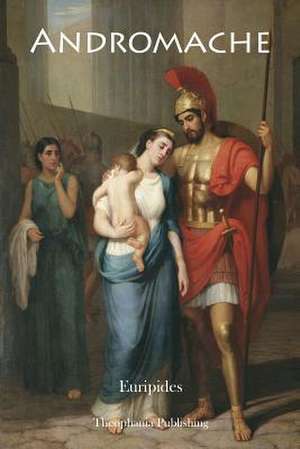
Andromache
Autor Euripidesen Limba Engleză Paperback
Preț: 95.47 lei
Puncte Express: 143
Carte tipărită la comandă
Livrare economică 27 noiembrie-11 decembrie
Livrare prin curier în România Termenul estimat este afișat lângă disponibilitate.
Transport gratuit de la 400.00 lei Plată online sau ramburs, în funcție de opțiunile comenzii.
Retur gratuit în 14 zile Comandă securizată și suport în română.
Specificații
ISBN-13: 9781479140299
ISBN-10: 1479140295
Pagini: 42
Dimensiuni: 152 x 229 x 2 mm
Greutate: 0.07 kg
Editura: CreateSpace Independent Publishing Platform
ISBN-10: 1479140295
Pagini: 42
Dimensiuni: 152 x 229 x 2 mm
Greutate: 0.07 kg
Editura: CreateSpace Independent Publishing Platform
V-ar putea interesa
-
 The Bacchae and Other PlaysEuripides-18%Preț: 77.33 lei94.27 lei
 -
 Essays in IdlenessKamo No Chômei-38%Preț: 57.62 lei92.24 lei
 -
 The Art of the PublisherRoberto Calasso-36%Preț: 45.63 lei70.83 lei
 -
 Sir Leslie Stephen's Mausoleum BookLeslie Stephen-30%Preț: 417.27 lei596.90 lei
 -
 Swift vs. Mainwaring: The Examiner and The MedleyFrank H. Ellis-29%Preț: 528.47 lei746.67 lei
 -
 -19%Preț: 321.94 lei398.60 lei
 -
 -34%Preț: 666.78 lei1006.35 lei
 -
 Coleridge's Notebooks: A SelectionSeamus Perry-12%Preț: 358.24 lei405.12 lei
 -
 Agricola and GermanyTacitus-20%Preț: 63.04 lei78.35 lei
 -
 The Oxford Book of EssaysJohn Gross-17%Preț: 96.79 lei117.27 lei
 -
 The Gifts of ReadingRobert MacFarlane-24%Preț: 17.89 lei23.39 lei
 -
 Love + HateHanif KureishiPreț: 70.84 lei
 -
 Preț: 233.22 lei
 -
 An OresteiaAeschylusPreț: 105.55 lei
 -
 HippolytusEuripides-18%Preț: 87.59 lei106.40 lei
 -
 Euripides - Plays - Vol IIEuripidesPreț: 265.40 lei
 -
 A Literary Tour of ItalyTim ParksPreț: 92.66 lei
Descriere
Descriere de la o altă ediție sau format:
Based on the conviction that only translators who write poetry themselves can properly re-create the celebrated and timeless tragedies of Aeschylus, Sophocles, and Euripides, the Greek Tragedy in New Translations series offers new translations that go beyond the literal meaning of the Greek in order to evoke the poetry of the originals. Under the general editorship of Peter Burian and Alan Shapiro, each volume includes a critical introduction, commentary on the text, full stage directions, and a glossary of the mythical and geographical references in the play. In Andromache, Euripides challenges our concept of tragic character as he transforms our expectations of tragic structure. Through its subtly varied metrics, the play develops an increasingly complex plot and concludes with a simultaneous realization of realism and supernaturalism. The play takes place in the aftermath of the Trojan War. Andromache has become a concubine to Achilles' son, Neoptolemus, bearing him a child, Molossus. The captive Andromache is haunted by memories of her former life and by her love for Hector and their son Astyanax, both slain by the Greeks who are now her masters. As the play opens, Andromache and Molossus are threatened with death by Neoptolemus' young wife, Hermione, who has been unable to conceive a child and is fiercely jealous. The struggle between the two women is mirrored in the conflict between Peleus, who arrives to defend Andromache, and Menelaus, who arrives to help his daughter Hermione complete her bid for power.
Based on the conviction that only translators who write poetry themselves can properly re-create the celebrated and timeless tragedies of Aeschylus, Sophocles, and Euripides, the Greek Tragedy in New Translations series offers new translations that go beyond the literal meaning of the Greek in order to evoke the poetry of the originals. Under the general editorship of Peter Burian and Alan Shapiro, each volume includes a critical introduction, commentary on the text, full stage directions, and a glossary of the mythical and geographical references in the play. In Andromache, Euripides challenges our concept of tragic character as he transforms our expectations of tragic structure. Through its subtly varied metrics, the play develops an increasingly complex plot and concludes with a simultaneous realization of realism and supernaturalism. The play takes place in the aftermath of the Trojan War. Andromache has become a concubine to Achilles' son, Neoptolemus, bearing him a child, Molossus. The captive Andromache is haunted by memories of her former life and by her love for Hector and their son Astyanax, both slain by the Greeks who are now her masters. As the play opens, Andromache and Molossus are threatened with death by Neoptolemus' young wife, Hermione, who has been unable to conceive a child and is fiercely jealous. The struggle between the two women is mirrored in the conflict between Peleus, who arrives to defend Andromache, and Menelaus, who arrives to help his daughter Hermione complete her bid for power.
Notă biografică
Susan Stewart is Regan Professor of English at the University of Pennsylvania. Wesley D. Smith is Professor Emeritus of Classical Studies at the University of Pennsylvania.