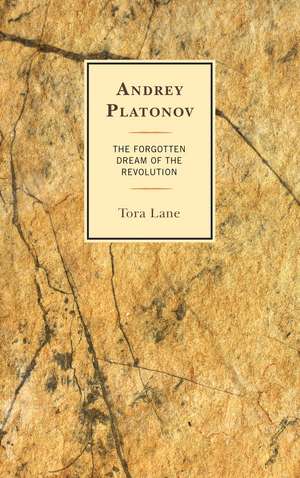
Andrey Platonov: The Forgotten Dream of the Revolution
Autor Tora Laneen Limba Engleză Hardback – 31 mai 2018
Preț: 577.76 lei
Preț vechi: 864.79 lei
-33%
Puncte Express: 867
Carte tipărită la comandă
Livrare economică 17 noiembrie-01 decembrie
Livrare prin curier în România Termenul estimat este afișat lângă disponibilitate.
Transport gratuit pentru acest produs Plată online sau ramburs, în funcție de opțiunile comenzii.
Retur gratuit în 14 zile Comandă securizată și suport în română.
Specificații
ISBN-13: 9781498547758
ISBN-10: 1498547753
Pagini: 176
Dimensiuni: 158 x 232 x 18 mm
Greutate: 0.45 kg
Editura: Bloomsbury Publishing
Colecția Lexington Books
Locul publicării:New York, United States
ISBN-10: 1498547753
Pagini: 176
Dimensiuni: 158 x 232 x 18 mm
Greutate: 0.45 kg
Editura: Bloomsbury Publishing
Colecția Lexington Books
Locul publicării:New York, United States
V-ar putea interesa
-
 Preț: 391.06 lei
 -
 Reading Historical FictionKate MitchellPreț: 393.40 lei
 -
 Preț: 466.27 lei
 -
 The Epic Trickster in American Literature: From Sunjata to So(u)lGregory E. Rutledge-18%Preț: 1259.69 lei1536.22 lei
 -
 Robert Duncan – The Collected Early Poems and PlaysRobert DuncanPreț: 483.05 lei
 -
 Beyond His Dark Materials: Innocence and Experience in the Fiction of Philip PullmanSusan Redington BobbyPreț: 226.18 lei
 -
 The Sister Fidelma MysteriesEdward J. RiellyPreț: 299.49 lei
 -
 -27%Preț: 851.75 lei1163.29 lei
 -
 Lovecraft and InfluenceRobert H. Waugh-33%Preț: 613.04 lei910.31 lei
 -
 Reading Migration and CultureDan OjwangPreț: 388.17 lei
 -
 Surrealism in Latin American LiteratureM. Nicholson-15%Preț: 720.60 lei847.76 lei
 -
 Robert Lowell and the Confessional VoicePaula Hayes-23%Preț: 503.85 lei654.35 lei
 -
 -15%Preț: 111.56 lei131.76 lei
 -
 Reading Richard Matheson: A Critical SurveyCheyenne Mathews-33%Preț: 639.92 lei958.62 lei
 -
 Literary Research and British Postmodernism: Strategies and SourcesBridgit McCafferty-21%Preț: 363.80 lei462.64 lei
 -
 Roth after EightyDavid Gooblar-15%Preț: 606.10 lei713.06 lei
 -
 -23%Preț: 716.90 lei931.05 lei
 -
 Producing Canadian LiteratureKit DobsonPreț: 254.31 lei
 -
 Music in the Works of F. Scott Fitzgerald: Unheard MelodiesAnthony J. Berret-24%Preț: 367.94 lei484.18 lei
 -
 -35%Preț: 531.48 lei815.86 lei
 -
 George Oppen: The Words in ActionRichard Swigg-23%Preț: 330.50 lei426.96 lei
 -
 Words, Bodies, MemoryLars KlebergPreț: 267.70 lei
Cuprins
Introduction
A Proletarian Existentialist RealismChevengur and the Movement of the RevolutionThe Foundation Pit and the Problem of TimeHappy Moscow and Universal Love Dzhan: Retrieving the InnerReka Potudan: Love in Existential PovertyThe Ecstasy of Common Being and the Ecstasy of Existence in Common: "Inspired People" and "The Return" Afterword: The Memory of Utopia and the Utopia of Memory
Bibliography
About the Author
A Proletarian Existentialist RealismChevengur and the Movement of the RevolutionThe Foundation Pit and the Problem of TimeHappy Moscow and Universal Love Dzhan: Retrieving the InnerReka Potudan: Love in Existential PovertyThe Ecstasy of Common Being and the Ecstasy of Existence in Common: "Inspired People" and "The Return" Afterword: The Memory of Utopia and the Utopia of Memory
Bibliography
About the Author
Recenzii
In her often brilliant and insightful critical study, Lane presents a skillful and detailed explication of Platonov's life work, the writer's moral backbone and adherence to his vision, and by so doing exposes the duplicity that constitutes political narrative, while inspiring both respect and admiration for Platonov's lifetime of commitment to the truth.
Lane (Södertörn Univ., Sweden) should be commended for taking on a subject as complex as Andrey Platonov (1899-1951), whose ideas, language, and views of history-whether taken individually or together-have challenged readers for decades. Lane examines Platonov's works to see how he reconciles the disastrous effects of the Russian Revolution with its Utopian promise. . . Accordingly, this welcome exegesis of Platonov's works will appeal to those well-acquainted with Platonov and philosophers such as Heidegger, Blanchot, and Bataille and to less-sophisticated students of Russian literature. Her translations are good as are her notes, which appear at the end of each chapter. The ample list of references will lead anyone interested in Platonov to fertile ground for further study. Lane's study will be invaluable to Russianists, historians of the Russian Revolution, and anyone interested in Utopian ideals and their hidden capacity for tyranny. Summing Up: Recommended. Ambitious upper-division undergraduates, graduate students, researchers, and faculty.
Lane's broader commitment to seeing Platonov through a distinct philosophical prism is productive and perceptive, and may well serve to stimulate further debate.
Lane's idea that what makes Platonov distinctive is his search for revolutionary consciousness in literature as such-as a mode of ironic distance, alienation, or a frustrated alternative to life itself-is interesting and generally consonant with the view prevalent in other scholarship on Platonov. The readings she offers are also eloquently sensitive to Platonov's existential themes. . . . Lane's reading of Platonov on the broader plane of twentieth-century thought is welcome-and deserves to be expanded upon.
Tora Lane does much to bring out the complexity, the subtlety and the hopefulness of Platonov's work, helping the reader to understand why so many Russian writers and critics see Platonov as the greatest Russian prose-writer of the last century.
Andrey Platonov is arguably one of the greatest, aesthetically most original and politically most interesting writers of twentieth century world literature. By stereoscopically examining Platonov's aesthetics as well as the Soviet idea of communism, Tora Lane reveals with brilliance, precision and erudition the originality of Platonov's style and social vision. This is an important book not just for its analysis of Platonov but also for its deep insights into the Russian Revolution and the existential and political energies released by early Soviet communism.
Lane (Södertörn Univ., Sweden) should be commended for taking on a subject as complex as Andrey Platonov (1899-1951), whose ideas, language, and views of history-whether taken individually or together-have challenged readers for decades. Lane examines Platonov's works to see how he reconciles the disastrous effects of the Russian Revolution with its Utopian promise. . . Accordingly, this welcome exegesis of Platonov's works will appeal to those well-acquainted with Platonov and philosophers such as Heidegger, Blanchot, and Bataille and to less-sophisticated students of Russian literature. Her translations are good as are her notes, which appear at the end of each chapter. The ample list of references will lead anyone interested in Platonov to fertile ground for further study. Lane's study will be invaluable to Russianists, historians of the Russian Revolution, and anyone interested in Utopian ideals and their hidden capacity for tyranny. Summing Up: Recommended. Ambitious upper-division undergraduates, graduate students, researchers, and faculty.
Lane's broader commitment to seeing Platonov through a distinct philosophical prism is productive and perceptive, and may well serve to stimulate further debate.
Lane's idea that what makes Platonov distinctive is his search for revolutionary consciousness in literature as such-as a mode of ironic distance, alienation, or a frustrated alternative to life itself-is interesting and generally consonant with the view prevalent in other scholarship on Platonov. The readings she offers are also eloquently sensitive to Platonov's existential themes. . . . Lane's reading of Platonov on the broader plane of twentieth-century thought is welcome-and deserves to be expanded upon.
Tora Lane does much to bring out the complexity, the subtlety and the hopefulness of Platonov's work, helping the reader to understand why so many Russian writers and critics see Platonov as the greatest Russian prose-writer of the last century.
Andrey Platonov is arguably one of the greatest, aesthetically most original and politically most interesting writers of twentieth century world literature. By stereoscopically examining Platonov's aesthetics as well as the Soviet idea of communism, Tora Lane reveals with brilliance, precision and erudition the originality of Platonov's style and social vision. This is an important book not just for its analysis of Platonov but also for its deep insights into the Russian Revolution and the existential and political energies released by early Soviet communism.