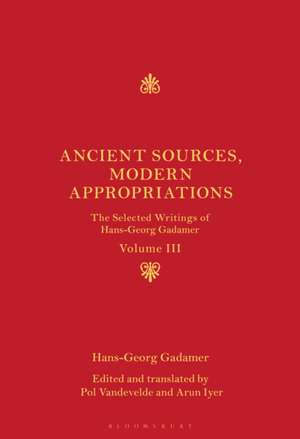
Ancient Sources, Modern Appropriations: The Selected Writings of Hans-Georg Gadamer: Volume III: The Selected Writings of Hans-Georg Gadamer
Autor Hans-Georg Gadamer Traducere de Dr Arun Iyer, Professor Pol Vandeveldeen Limba Engleză Hardback – 6 feb 2025
Ancient Sources, Modern Appropriations is a remarkable demonstration and illustration of how the study of the history of philosophy contributes to the task of doing philosophy by keeping a tradition alive and offering a future to the thinkers of the past. This third volume also includes a substantial critical introduction, a critical apparatus of notes, and several glossaries.
Preț: 543.74 lei
Preț vechi: 1361.16 lei
-60%
Puncte Express: 816
Carte disponibilă
Livrare economică 14-28 noiembrie
Livrare express 03-07 noiembrie pentru 605.51 lei
Livrare prin curier în România Termenul estimat este afișat lângă disponibilitate.
Transport gratuit pentru acest produs Plată online sau ramburs, în funcție de opțiunile comenzii.
Retur gratuit în 14 zile Comandă securizată și suport în română.
Specificații
ISBN-13: 9781441112743
ISBN-10: 144111274X
Pagini: 256
Dimensiuni: 156 x 236 x 20 mm
Greutate: 0.52 kg
Editura: Bloomsbury Publishing
Colecția Bloomsbury Academic
Seria The Selected Writings of Hans-Georg Gadamer
Locul publicării:London, United Kingdom
ISBN-10: 144111274X
Pagini: 256
Dimensiuni: 156 x 236 x 20 mm
Greutate: 0.52 kg
Editura: Bloomsbury Publishing
Colecția Bloomsbury Academic
Seria The Selected Writings of Hans-Georg Gadamer
Locul publicării:London, United Kingdom
V-ar putea interesa
-
 Gadamer in ConversationHans-Georg GadamerPreț: 248.03 lei
 -
 The Practice Turn in Contemporary TheoryKarin Knorr CetinaPreț: 364.26 lei
 -
 Paul RicoeurKarl SimmsPreț: 273.18 lei
 -
 Michel FoucaultSara MillsPreț: 216.62 lei
 -
 Julia KristevaNoelle McAfeePreț: 216.41 lei
 -
 Writing and DifferenceJacques DerridaPreț: 176.18 lei
 -
 The Essential David BohmLee NicholPreț: 376.05 lei
 -
 Preț: 176.63 lei
 -
 The PostmodernSimon MalpasPreț: 225.80 lei
 -
 Unended Quest: An Intellectual AutobiographyKarl PopperPreț: 156.03 lei
 -
 Times of Crisis: What the Financial Crisis Revealed and How to Reinvent our Lives and FutureProfessor Michel Serres-45%Preț: 174.11 lei314.10 lei
 -
 Nature, History, State: 1933-1934Martin Heidegger-48%Preț: 119.14 lei228.46 lei
 -
 Theology After DeleuzeDr Kristien Justaert-15%Preț: 236.65 lei276.99 lei
 -
 Principles of Non-PhilosophyProfessor Francois Laruelle-46%Preț: 276.92 lei517.00 lei
 -
 Rhythmanalysis: Space, Time and Everyday LifeHenri Lefebvre-21%Preț: 158.13 lei199.67 lei
 -
 Time for RevolutionAntonio Negri-20%Preț: 148.72 lei185.28 lei
 -
 Truth and MethodHans-Georg Gadamer-23%Preț: 196.66 lei256.29 lei
 -
 Eclipse of ReasonMax Horkheimer-21%Preț: 144.80 lei182.97 lei
Cuprins
Acknowledgements
Translators' Preface
Translators' Introduction
I What Do We Do When We Interpret? (by Pol Vandevelde)
II On the Art of Reading (by Arun Iyer)
Part I: Ancient Philosophy
1. Parmenides or Why Being Pertains to This World (1988)
2. Plato's Thinking through Utopias: A Lecture Addressed to Philologists (1983)
3. Mathematics and Dialectic in Plato (1982)
4. Dialectic Is not What Sophists Do: What Theaetetus Learns in the Sophist (1990)
Part II: Modern Philosophy
5. Oetinger as Philosopher (1964)
6. Herder and the Historical World (1967)
7. Schleiermacher as Platonist (1969)
8. Hegel and Heraclitus (1990)
9. Hegel and the Historical Spirit (1939)
10. Hegel and Heidelberg Romanticism (1961)
Notes
Appendix: Glossary of German Terms
Glossary of Ancient Greek Terms and Expressions
Glossary of Other Foreign Terms and Expressions
Works Cited by Gadamer
Index of Names
Index of subjects
Translators' Preface
Translators' Introduction
I What Do We Do When We Interpret? (by Pol Vandevelde)
II On the Art of Reading (by Arun Iyer)
Part I: Ancient Philosophy
1. Parmenides or Why Being Pertains to This World (1988)
2. Plato's Thinking through Utopias: A Lecture Addressed to Philologists (1983)
3. Mathematics and Dialectic in Plato (1982)
4. Dialectic Is not What Sophists Do: What Theaetetus Learns in the Sophist (1990)
Part II: Modern Philosophy
5. Oetinger as Philosopher (1964)
6. Herder and the Historical World (1967)
7. Schleiermacher as Platonist (1969)
8. Hegel and Heraclitus (1990)
9. Hegel and the Historical Spirit (1939)
10. Hegel and Heidelberg Romanticism (1961)
Notes
Appendix: Glossary of German Terms
Glossary of Ancient Greek Terms and Expressions
Glossary of Other Foreign Terms and Expressions
Works Cited by Gadamer
Index of Names
Index of subjects
Recenzii
The third in Vandeverlde and Iyer's excellent series, this volume makes accessible in English a selection of essays from the Gesammelte Werke that foreground Gadamer's engagement with the history of philosophy providing new insights into his reading of Plato and Hegel, as well as of Parmenides, Heraclitus, Oetinger, Herder and Schleiermacher. The translated texts are supplemented by a glossary and an extensive introductory essay. Thanks are due to Vandevelde and Iyer for yet another important addition to the growing body of Gadamer's work available in English.
Translated for the first time, these essays on Plato, Hegel, and the Romantics remind us Gadamer still has much to teach us. The introductions by Vandevelde and Ayer to this volume, and to the first two, are some of the most important secondary sources on Gadamer's thought from the last 25 years.
Translated for the first time, these essays on Plato, Hegel, and the Romantics remind us Gadamer still has much to teach us. The introductions by Vandevelde and Ayer to this volume, and to the first two, are some of the most important secondary sources on Gadamer's thought from the last 25 years.
Notă biografică
Hans-Georg Gadamer was born on 11 February 1900 and died on 13 March 2002. He was the author, most notably, of Truth and Method, and, more recently, of The Beginning of Philosophy and The Beginning of Knowledge.