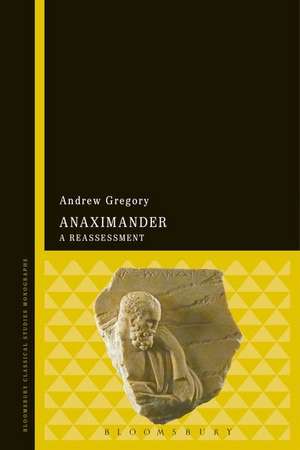
Anaximander: A Re-assessment
Autor Andrew Gregoryen Limba Engleză Hardback – 25 feb 2016
Anaximander: A Re-assessment draws together these wide-ranging threads into a single, coherent picture of the man, his worldview and his legacy to the history of thought. Arguing that Anaximander's statements are both apodeictic and based on observation of the world around him, Andrew Gregory examines how Anaximander's theories can all be construed in such a way that they are consistent with and supportive of each other. This includes the tenet that the philosophical elements of Anaximander's thought (his account of the apeiron, the extant fragment) can be harmonised to support his views on the natural world. The work further explores how these theories relate to early Greek thought and in particular conceptions of theogony and meterology in Hesiod and Homer.
Preț: 837.75 lei
Preț vechi: 1243.99 lei
-33%
Puncte Express: 1257
Carte tipărită la comandă
Livrare economică 27 noiembrie-11 decembrie
Livrare prin curier în România Termenul estimat este afișat lângă disponibilitate.
Transport gratuit pentru acest produs Plată online sau ramburs, în funcție de opțiunile comenzii.
Retur gratuit în 14 zile Comandă securizată și suport în română.
Specificații
ISBN-13: 9781472507792
ISBN-10: 1472507797
Pagini: 312
Dimensiuni: 160 x 236 x 26 mm
Greutate: 0.61 kg
Editura: Bloomsbury Publishing
Colecția Bloomsbury Academic
Locul publicării:London, United Kingdom
ISBN-10: 1472507797
Pagini: 312
Dimensiuni: 160 x 236 x 26 mm
Greutate: 0.61 kg
Editura: Bloomsbury Publishing
Colecția Bloomsbury Academic
Locul publicării:London, United Kingdom
Cuprins
Prologue
Introduction
1. Anaximander and Historiography
2. Anaximander's Zoogony
3. Anaximander and Meteorology
4. The Extant Fragment
5. The Apeiron
6. Cosmogony and Steering
7. Anaximander: One Cosmos or Many?
8. The Stability of the Cosmos
9. Anaximander's Cosmology and Astronomy
10. Anaximander's Numbers
Conclusion
Bibliography
Index
Introduction
1. Anaximander and Historiography
2. Anaximander's Zoogony
3. Anaximander and Meteorology
4. The Extant Fragment
5. The Apeiron
6. Cosmogony and Steering
7. Anaximander: One Cosmos or Many?
8. The Stability of the Cosmos
9. Anaximander's Cosmology and Astronomy
10. Anaximander's Numbers
Conclusion
Bibliography
Index
Recenzii
Andrew Gregory's Anaximander: A Re-assessment is well-argued book that gives us a systematic Anaximander with a network of connecting views on the well-ordered nature of things, including zoogony, meteorology, cosmology, and astronomy. Gregory's careful analysis of ancient texts and modern interpretations is a boon for students and for anyone interested in the beginnings of Greek philosophy and science.
Gregory's Anaximander describes how the first great Greek cosmologist looks back to his poetic predecessors and how later thinkers, particularly Plato, look back to him. By emphasizing the stability, symmetry, and order of Anaximander's system and its integration of natural philosophical and theological principles, Gregory provides a stimulating and welcome contribution to the study of early Greek philosophy.
This book offers a persuasive attempt to show Anaximander as a systematic thinker whose coherent and far-reaching views on cosmology, astronomy, meteorology, and zoogony are based on observation and folk-knowledge. It gives thoughtful attention to those fragments of Anaximander which are frequently overlooked, while also showing the fruitfulness of making explicit the Homeric and Hesiodic background against which Anaximander writes. More generally, this book provides a careful discussion of the particular way in which a Presocratic thinker can be scientifically-minded and yet allow divinity an important place in his account of the world.
Gregory's Anaximander describes how the first great Greek cosmologist looks back to his poetic predecessors and how later thinkers, particularly Plato, look back to him. By emphasizing the stability, symmetry, and order of Anaximander's system and its integration of natural philosophical and theological principles, Gregory provides a stimulating and welcome contribution to the study of early Greek philosophy.
This book offers a persuasive attempt to show Anaximander as a systematic thinker whose coherent and far-reaching views on cosmology, astronomy, meteorology, and zoogony are based on observation and folk-knowledge. It gives thoughtful attention to those fragments of Anaximander which are frequently overlooked, while also showing the fruitfulness of making explicit the Homeric and Hesiodic background against which Anaximander writes. More generally, this book provides a careful discussion of the particular way in which a Presocratic thinker can be scientifically-minded and yet allow divinity an important place in his account of the world.
Notă biografică
Andrew Gregory is Professor of History and Philosophy of Science, University College London, UK. He is the author of many books on the science of the ancient world, including Plato's Philosophy of Science (Bloomsbury, 2000), Eureka! The Birth of Science (2001), Ancient Greek Cosmogony (Bloomsbury, 2008), The Presocratics and the Supernatural (Bloomsbury, 2013), Anaximander: A Re-Assessment (Bloomsbury, 2016) and Early Greek Philosophies of Nature (Bloomsbury, 2020).