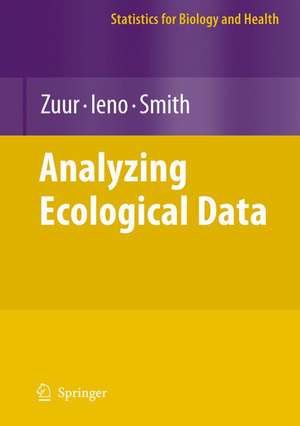
Analyzing Ecological Data
Autor Alain Zuur, Elena N Ieno, Graham M Smithen Limba Engleză Hardback – 3 mai 2007
Găsim în Analyzing Ecological Data un manual de referință fundamental, conceput special pentru cercetătorii care se confruntă cu complexitatea datelor din teren. Publicată de Springer, această ediție din 2007 marchează o schimbare de paradigmă în literatura de specialitate: autorii Alain Zuur, Elena N Ieno și Graham M Smith propun înlocuirea întrebării rigide „ce test ar trebui să aplic?” cu o strategie comprehensivă de analiză și modelare, ancorată în contextul ecologic specific. Structura volumului urmărește o progresie logică, debutând cu explorarea datelor și regresia liniară, continuând cu modele additive (GAM) și modele mixte, pentru a culmina cu analize avansate de multivariate și serii temporale. Apreciem în mod deosebit includerea unor studii de caz reale, precum distribuția peștilor în estuarul Tagus sau polenizarea culturilor în Argentina, care demonstrează aplicabilitatea practică a metodelor teoretice. Comparabil cu Numerical Ecology de P. Legendre în rigoarea tratării datelor multivariante, acest volum se distinge prin abordarea didactică și accentul pus pe validarea modelelor. În contextul operei autorilor, lucrarea reprezintă pilonul central ce face trecerea de la ghidul de bază A Beginner's Guide to R către tehnici avansate, pregătind terenul pentru Mixed Effects Models and Extensions in Ecology with R. Este o resursă care transformă statistica dintr-o barieră matematică într-un instrument de interpretare a lumii vii.
Preț: 1698.47 lei
Preț vechi: 2071.30 lei
-18%
Carte tipărită la comandă
Livrare economică 28 noiembrie-12 decembrie
Specificații
ISBN-10: 0387459677
Pagini: 672
Ilustrații: XXVI, 672 p.
Dimensiuni: 163 x 241 x 48 mm
Greutate: 1.26 kg
Ediția:2007 edition
Editura: Springer
Locul publicării:New York, NY, United States
V-ar putea interesa
-
 -31%Preț: 699.90 lei1010.89 lei
 -
 Plant-Animal CommunicationH. Martin Schaefer-22%Preț: 398.91 lei511.08 lei
 -
 A Dictionary of EcologyMichael Allaby-19%Preț: 98.93 lei121.99 lei
 -
 The Ecology of Snow and Ice EnvironmentsJohanna Laybourn-Parry-21%Preț: 497.70 lei633.82 lei
 -
 Chemical Ecology in Aquatic SystemsChrister Brönmark-28%Preț: 404.67 lei560.17 lei
 -
 -22%Preț: 532.00 lei682.15 lei
 -
 Wytham Woods: Oxford's Ecological LaboratoryPeter Savill-22%Preț: 506.34 lei653.10 lei
 -
 -18%Preț: 940.29 lei1146.70 lei
 -
 -28%Preț: 433.06 lei605.28 lei
 -
 Phase TransitionsRicard SoléPreț: 369.99 lei
 -
 Ecological RestorationSusan M. Galatowitsch-27%Preț: 1167.98 lei1599.97 lei
 -
 Preț: 272.95 lei
 -
 Artificial Reefs in Fisheries ManagementStephen A. Bortone-18%Preț: 1127.03 lei1374.42 lei
 -
 Coral Reef Remote SensingJames A. Goodman-24%Preț: 923.28 lei1214.84 lei
 -
 Bioenergetic Processes of CyanobacteriaGuenter A. Peschek-24%Preț: 1232.81 lei1622.12 lei
Public țintă
ResearchDe ce să citești această carte
Recomandăm această carte cercetătorilor și studenților de la nivel masteral sau doctoral care doresc să depășească utilizarea mecanică a testelor statistice. Cititorul câștigă o înțelegere profundă a modului în care se explorează datele, se verifică ipotezele și se validează modelele complexe. Este un instrument esențial pentru oricine lucrează cu date ecologice reale, oferind soluții concrete pentru gestionarea variabilității și a structurilor de date dificile.
Despre autor
Alain Zuur, împreună cu echipa sa de la Highland Statistics, este o autoritate recunoscută în predarea statisticii aplicate pentru cercetătorii din științele mediului. Experiența sa vastă în consultanță pentru biologi și ecologi se reflectă în stilul clar și aplicat al scrierii sale. Alain Zuur a dezvoltat o întreagă serie de manuale care vizează utilizarea limbajului R în ecologie, concentrându-se pe transformarea metodelor matematice complexe în fluxuri de lucru accesibile pentru cercetătorii care nu au o pregătire matematică avansată.
Descriere scurtă
Cuprins
Recenzii
"I liked the compact style of the book and really enjoyed the case studies. The book would be a suitable companion to statistics courses for both ecologists and statisticians at the introductory graduate level….All in all, I enjoyed reading the book and marvel at the wide range of sophisticated statistical models used in modern ecology."(Biometrics, 64, March 2008)
"Readership: Undergraduates, postgraduates and scientists engaged in areas of the environmental sciences and ecological research. The material presented in this book has been developed and used by the authors in teaching statistics to its intended readership. The text is divided into two parts … . I have no doubt that for undergraduate students the main strength of the book will be the breadth of topics covered by the case studies – ranging from terrestrial ecology to marine biology." (C. M. O’Brien, International Statistical Review, Vol. 75 (3), 2007)
"This is a practical way of analysing ecological data in which methodological approaches are combined with real data sets with the advantages and disadvantages of each strategy discussed. Who is it for? Upper undergraduates, postgraduates and researchers in ecology. Presentation It links ecological data, data analysis and discussion of the approaches. Would you recommend it? If you want an edited volume on different methods of ecological data analysis, then this book is worth looking through." (Times Higher Education, May, 2008)
"The book is aimed at three types of readers: ecologists who wish to develop their own statistical skills, quantitative ecologists who want to use more advanced techniques, and statistical scientists seeking more experience analyzing ecological data. … Enjoyable aspects of the book include good graphical outputs, with interpretations, in the text. … Overall, this book is wroth the purchase price … . No other book combines as many good ecological data sets with suchthoughtfully written analyses. I give this book two enthusiastic thumbs up!" (Loveday Conquest, Journal of the American Statistical Asociation, Vol. 103 (483), September, 2008)
"The book aims to give readers sufficient information to apply statistical methodology in a correct and useful way. … the book meets its aim, covering a wide range of statistical techniques and dealing with many situations that are encountered in ecological statistics. This is an excellent, nicely presented and very readable book. I would highly recommend it to numerate researchers and students interested in environment and ecological data analysis." (Weiqi Luo, Journal of Applied Statistics, Vol. 36 (2), February, 2009)
"Analysing Ecological Data by a group of ecologists-gone-statisticians from Scotland is the latest book in this area and based on years of teaching and consultancy experience. … The book differs from many of its competitors in its structure: it contains a general introduction to several fields of descriptive ecological data analysis (370 pages), which is augmented with 17 chapter-length case studies … . In summary, I can recommend the book primarily as advanced material for ecologists … ." (Carsten F. Dormann, Basic and Applied Ecology, Vol. (10), 2009)
Textul de pe ultima copertă
The first part of the book gives a largely non-mathematical introduction to data exploration, univariate methods (including GAM and mixed modelling techniques), multivariate analysis, time series analysis (e.g. common trends) and spatial statistics. The second part provides 17 case studies, mainly written together with biologists who attended courses given by the first authors. The case studies include topics ranging from terrestrial ecology to marine biology. The case studies can be used as a template for your own data analysis; just try to find a case study that matches your own ecological questions and data structure, and use this as starting point for you own analysis. Data from all case studies are available from www.highstat.com. Guidance on software is provided in Chapter 2.
Alain Zuur is senior statistician and director of Highland Statistics Ltd., a statistical consultancy company based in the UK. He has contributed to a wide range of projects related to marine biology, oceanography, ecology, fisheries, etc. and has extensive experience teaching statistics to ecologists and environmental scientists in the form of academic and non-academic courses. He is honorary research fellow in the School of Biological Sciences, Oceanlab, at the University of Aberdeen, UK.
Elena Ieno is senior marine biologist at Highland Statistics Ltd. In 2004 she left academia to work full time in statistical consultancy. She now teaches statistics to ecologists and has shown she can bridge the gap between the two disciplines and dispel the dread of statistics shown by most biologists. She is also involved in various international statistical consultancy projects, and is honorary research fellow in the School of Biological Sciences, Oceanlab, at the University of Aberdeen, UK.
Graham M. Smith is a Senior Lecturer at Bath Spa University in the UK where he teaches statistics to biology undergraduates. He has a background in ecological consultancy, and continues to provide consultancy on the design and analysis of ecological monitoring programmes and the development of quantitative methods in Ecological Impact Assessment.