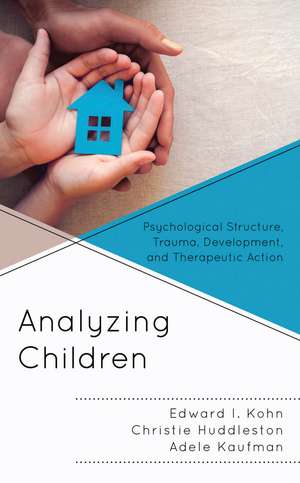
Analyzing Children: Psychological Structure, Trauma, Development, and Therapeutic Action: The Vulnerable Child: Studies in Social Issues and Child Psychoanalysis
Autor Edward I. Kohn, Christie Huddleston, Adele Kaufmanen Limba Engleză Hardback – 5 iun 2019
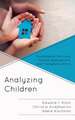
This book closely examines the analyses of two little girls. One began analysis having already achieved the transition to a more enduring and reliable psychic structure, a cohesive self. Because she had several experiences that overwhelmed her emotional capacities prior to entering the oedipal phase of development, her oedipal experience was filled with anxiety and overstimulation. At the start of her analysis , the second child contended with anxiety about loss of the object and abandonment, and she struggled with the process of separation/individuation. Her psychic structure, her self, was not cohesive, and she was vulnerable to fragmentation. During her analysis, her stymied development was freed up, and the authors trace the changes within her as psychic structure consolidated and oedipal material took center stage.
Comparison of these two young girls and their analyses enables the authors to illustrate and describe important mental phenomena and psychoanalytic concepts. These include psychic structure, the self, the similarities and differences between a mind that is vulnerable to fragmentation and one that is not, and the internal states associated with fragmentation and trauma. By looking into the differences (and similarities) in the ways each girl responded to interventions by her analyst, the authors explore psychoanalytic technique and therapeutic action, including the many manifestations of interpretation and insight, the role of the analyst as a developmental object, and the development of psychic structure. The authors show how similar manifest behavior and content have different latent meanings and sources for each child, and they further illustrate the transformations of fantasies, anxieties, preoccupations, and ego structures over the course of their analyses.
Preț: 538.47 lei
Preț vechi: 688.24 lei
-22%
Puncte Express: 808
Carte tipărită la comandă
Livrare economică 28 noiembrie-12 decembrie
Livrare express 24-30 octombrie pentru 152.39 lei
Livrare prin curier în România Termenul estimat este afișat lângă disponibilitate.
Transport gratuit pentru acest produs Plată online sau ramburs, în funcție de opțiunile comenzii.
Retur gratuit în 14 zile Comandă securizată și suport în română.
Specificații
ISBN-13: 9781538121023
ISBN-10: 1538121026
Pagini: 222
Dimensiuni: 150 x 232 x 18 mm
Greutate: 0.47 kg
Editura: Bloomsbury Publishing
Colecția Rowman & Littlefield
Seria The Vulnerable Child: Studies in Social Issues and Child Psychoanalysis
Locul publicării:New York, United States
ISBN-10: 1538121026
Pagini: 222
Dimensiuni: 150 x 232 x 18 mm
Greutate: 0.47 kg
Editura: Bloomsbury Publishing
Colecția Rowman & Littlefield
Seria The Vulnerable Child: Studies in Social Issues and Child Psychoanalysis
Locul publicării:New York, United States
V-ar putea interesa
-
 The Administrative Challenges of (Play) TherapyAllan M. Gonsher-25%Preț: 216.87 lei290.69 lei
 -
 -23%Preț: 264.02 lei344.08 lei
 -
 The Dyadic Developmental Psychotherapy CasebookArthur Becker-Weidman-22%Preț: 540.03 lei689.28 lei
 -
 -5%Preț: 166.34 lei175.10 lei
 -
 -5%Preț: 83.19 lei87.57 lei
 -
 Christian HealingCharles Fillmore-5%Preț: 60.47 lei63.66 lei
 -
 -23%Preț: 256.41 lei334.75 lei
 -
 Contemporary Case Studies in School CounselingMarguerite Ohrtman-25%Preț: 483.35 lei643.62 lei
 -
 Contemporary Case Studies in School CounselingMarguerite Ohrtman-29%Preț: 209.35 lei292.82 lei
 -
 Integrated Care for the Traumatized: A Whole-Person ApproachIlene A. Serlin-22%Preț: 609.80 lei782.35 lei
 -
 Integrated Care for the Traumatized: A Whole-Person ApproachIlene A. Serlin-27%Preț: 270.81 lei370.95 lei
 -
 Hurt FeelingsBogna Szymkiewicz-5%Preț: 117.18 lei123.35 lei
 -
 Das Buch Vom EsGeorg Groddeck-5%Preț: 84.50 lei88.96 lei
 -
 After the ViolenceSophia Grace-5%Preț: 107.88 lei113.55 lei
 -
 This Business of TherapyFay, Jude-5%Preț: 88.06 lei92.70 lei
 -
 Beyond the ImprintO'Connell Lpc, Kate-5%Preț: 101.98 lei107.35 lei
 -
 Die KlangreiseJohannes Oehlmann-5%Preț: 284.83 lei299.81 lei
 -
 -5%Preț: 31.56 lei33.22 lei
 -
 -5%Preț: 112.67 lei118.59 lei
Cuprins
Chapter 1: Isabel, Christie Huddleston
Chapter 2: Discussion of Isabel's Analysis, Edward I. Kohn
Chapter 3: Ella, Adele Kaufman
Chapter 4: Discussion of Ella's Analysis, Edward I. Kohn
Chapter 5: Psychic Structure and Models of the Mind, Edward I. Kohn
Chapter 6: Trauma and Fragile Psychic Structure, Edward I. Kohn
Chapter 7: The Developmental Object, Edward I. Kohn
Chapter 8: Fragmentation to Cohesive Self, Edward I. Kohn
Chapter 9: Therapeutic Action, Edward I. Kohn
Chapter 10: The Play Space, Edward I. Kohn
Chapter 11: Relationship, Action, and Words, Edward I. Kohn
Chapter 12: The Oedipal Phase and its Earlier Determinants, Edward I. Kohn
Chapter 13: Termination, Edward I. Kohn
Chapter 2: Discussion of Isabel's Analysis, Edward I. Kohn
Chapter 3: Ella, Adele Kaufman
Chapter 4: Discussion of Ella's Analysis, Edward I. Kohn
Chapter 5: Psychic Structure and Models of the Mind, Edward I. Kohn
Chapter 6: Trauma and Fragile Psychic Structure, Edward I. Kohn
Chapter 7: The Developmental Object, Edward I. Kohn
Chapter 8: Fragmentation to Cohesive Self, Edward I. Kohn
Chapter 9: Therapeutic Action, Edward I. Kohn
Chapter 10: The Play Space, Edward I. Kohn
Chapter 11: Relationship, Action, and Words, Edward I. Kohn
Chapter 12: The Oedipal Phase and its Earlier Determinants, Edward I. Kohn
Chapter 13: Termination, Edward I. Kohn
Recenzii
In four collaborative chapters, Kohn (Cincinnati Psychoanalytic Institute) explores in detail the case histories of two juvenile subjects to demonstrate the psychoanalytic process of enabling young children to assemble the elements of a traumatized or fragmented psychic structure into a cohesive self. Isabel, through the reported interaction with her therapist (coauthor Huddleston), eventually becomes able to fully express herself without fear of repercussions. Ella at first lacks the ability to verbalize distress stemming from specific family events that were beyond her immediate understanding but gradually learns to express her basic feelings through role-playing with her analyst (coauthor Kaufman), during which she learns to create meaningful maps or drawings representing the related feelings rather than act out aggressive impulses. In the subsequent nine chapters of the book, Kohn provides nuanced explanations of Freudian and post-Freudian concepts and therapeutic processes as illustrated by the two analyses, creating a useful reference for child psychotherapists, students of developmental psychology, and academic researchers.
Summing Up: Highly recommended. Upper-division undergraduates through faculty and practitioners.
In this easily readable yet deeply nuanced work, the brilliant analyses of two girls at different levels of psychic structure are presented. The reader is given a wonderful blend of theory and technique, but most importantly the deep humanity of both therapists and children are never out of the limelight. This is a first-rate book for psychodynamic thinkers and clinicians at all levels.
This thoughtful examination by Edward Kohn of two gifted therapists' analytic work with troubled young girls presenting altogether different levels of psychic structural pathology, his conceptualization of child development and the disorders stemming from the early period of life, and the analysis of this pathology is truly a masterpiece. This volume is a must read for not only child and adolescent analysts but for those who want to better understand their adult analysands.
A tour de force, this book explores the mind of the child and demonstrates how the clinician comprehends it, enters it, and helps it to mend and grow. Huddleston and Kaufman present what appear to be similar children, yet are strikingly different in the ways they are structured and analyzed, bringing the work alive for the reader. Kohn beautifully examines both cases through various lenses and with a depth that adds a significant contribution to our theories of development, relationships, technique, and therapeutic action. This book will appeal to all who work therapeutically with children, as well as adults.
Summing Up: Highly recommended. Upper-division undergraduates through faculty and practitioners.
In this easily readable yet deeply nuanced work, the brilliant analyses of two girls at different levels of psychic structure are presented. The reader is given a wonderful blend of theory and technique, but most importantly the deep humanity of both therapists and children are never out of the limelight. This is a first-rate book for psychodynamic thinkers and clinicians at all levels.
This thoughtful examination by Edward Kohn of two gifted therapists' analytic work with troubled young girls presenting altogether different levels of psychic structural pathology, his conceptualization of child development and the disorders stemming from the early period of life, and the analysis of this pathology is truly a masterpiece. This volume is a must read for not only child and adolescent analysts but for those who want to better understand their adult analysands.
A tour de force, this book explores the mind of the child and demonstrates how the clinician comprehends it, enters it, and helps it to mend and grow. Huddleston and Kaufman present what appear to be similar children, yet are strikingly different in the ways they are structured and analyzed, bringing the work alive for the reader. Kohn beautifully examines both cases through various lenses and with a depth that adds a significant contribution to our theories of development, relationships, technique, and therapeutic action. This book will appeal to all who work therapeutically with children, as well as adults.
Notă biografică
Edward I. Kohn, MD, is on the faculty of the Cincinnati Psychoanalytic Institute (CPI) and the Southeast Consortium for Child and Adolescent Psychoanalysis, serving as a training and supervising analyst at CPI and a child and adolescent supervising analyst at both CPI and the Southeast Consortium.