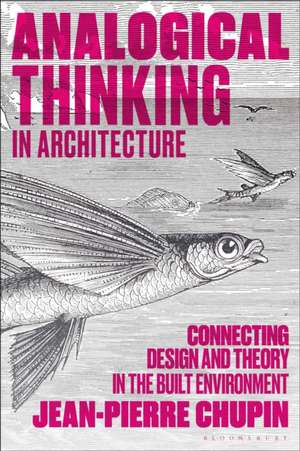
Analogical Thinking in Architecture: Connecting Design and Theory in the Built Environment
Autor Dr Jean-Pierre Chupinen Limba Engleză Paperback – 14 noi 2024
The book is organized into four case studies: the first reviews analogical models that have been at the heart of design thinking representations from the 1960s to the present day; the second investigates the staying power of biological analogies; the third explores the paradoxical imaginary of "analogous cities" as a means of integrating contemporary architecture with heritage contexts; while the fourth unpacks the critical and theoretical potential of linguistic metaphors and visual comparisons in architectural discourse.
Comparing views on the role of analogies and metaphors by prominent voices in architecture and related disciplines from the 17th century to the present, the book shows how the "analogical world of the project" is revealed as a wide-open field of creative and cognitive interactions. Showing how analogy has the power to reconcile design and theory, it is a must-read for both designers and theorists alike.
| Toate formatele și edițiile | Preț | Express |
|---|---|---|
| Paperback (1) | 174.43 lei 22-36 zile | +83.90 lei 5-11 zile |
| Bloomsbury Publishing – 14 noi 2024 | 174.43 lei 22-36 zile | +83.90 lei 5-11 zile |
| Hardback (1) | 526.70 lei 22-36 zile | |
| Bloomsbury Publishing – 24 aug 2023 | 526.70 lei 22-36 zile |
Preț: 174.43 lei
Preț vechi: 235.46 lei
-26%
Puncte Express: 262
Preț estimativ în valută:
30.88€ • 35.96$ • 26.83£
30.88€ • 35.96$ • 26.83£
Carte disponibilă
Livrare economică 02-16 februarie
Livrare express 16-22 ianuarie pentru 93.89 lei
Preluare comenzi: 021 569.72.76
Specificații
ISBN-13: 9781350343665
ISBN-10: 1350343668
Pagini: 256
Ilustrații: 173 bw illus
Dimensiuni: 156 x 230 x 16 mm
Greutate: 0.55 kg
Editura: Bloomsbury Publishing
Colecția Bloomsbury Visual Arts
Locul publicării:London, United Kingdom
ISBN-10: 1350343668
Pagini: 256
Ilustrații: 173 bw illus
Dimensiuni: 156 x 230 x 16 mm
Greutate: 0.55 kg
Editura: Bloomsbury Publishing
Colecția Bloomsbury Visual Arts
Locul publicării:London, United Kingdom
Cuprins
List of Analogical Plates
List of Figures
Acknowledgements
Introduction: Analogy Beyond Resemblance
A Spectrum of Definitions
A Canonical Example
A Paucity of Theories for a Plethora of Facts
Design Process, Repertories, Cities and Theories
1 Reflecting on Design Thinking
The Design Process as an Object of Research
Cybernetic and Methodological Analogues
Analogy as Creative Technique
Toward a Cognitive Approach to Design
The Rise of Design Thinking
2 The Cyclical Case of Biological Analogies
The Intertwined Fates of Architecture and Biology
Peter Collins and the Biological Analogy
Philip Steadman and the Evolutionary Design of Artefacts
George Hersey and the Biological Roots of Architecture
Analogical Reasoning and the Burden of Proof
Life Cycles of Biological Analogies
3 In the Labyrinth of Analogous Cities
The Città Analoga as a Visual Enigma
The Critical Misfortune of a Hypothesis
Climbing the Analogical Mountain
Back to Square One with Aldo Rossi
4 From Linguistic Metaphors to Critical Analogies
Classical Regimes of Resemblance
Post-modern Metaphors of the Column
Critiques of Linguistic Analogy
Colin Rowe's Method of Analogical Pairing
Conclusion: Connecting Design and Theory in the Built Environment
The Analogical World of the Project
Analogy as Inclusive Device
Snakes and Ladders
Digital Analogues and Artificial Imagination
Cognitive Leaps are the Order of Things
Bibliography
Index
List of Figures
Acknowledgements
Introduction: Analogy Beyond Resemblance
A Spectrum of Definitions
A Canonical Example
A Paucity of Theories for a Plethora of Facts
Design Process, Repertories, Cities and Theories
1 Reflecting on Design Thinking
The Design Process as an Object of Research
Cybernetic and Methodological Analogues
Analogy as Creative Technique
Toward a Cognitive Approach to Design
The Rise of Design Thinking
2 The Cyclical Case of Biological Analogies
The Intertwined Fates of Architecture and Biology
Peter Collins and the Biological Analogy
Philip Steadman and the Evolutionary Design of Artefacts
George Hersey and the Biological Roots of Architecture
Analogical Reasoning and the Burden of Proof
Life Cycles of Biological Analogies
3 In the Labyrinth of Analogous Cities
The Città Analoga as a Visual Enigma
The Critical Misfortune of a Hypothesis
Climbing the Analogical Mountain
Back to Square One with Aldo Rossi
4 From Linguistic Metaphors to Critical Analogies
Classical Regimes of Resemblance
Post-modern Metaphors of the Column
Critiques of Linguistic Analogy
Colin Rowe's Method of Analogical Pairing
Conclusion: Connecting Design and Theory in the Built Environment
The Analogical World of the Project
Analogy as Inclusive Device
Snakes and Ladders
Digital Analogues and Artificial Imagination
Cognitive Leaps are the Order of Things
Bibliography
Index
Recenzii
Analogical Thinking in Architecture is careful and timely study of analogy as a powerful tool for connecting design and theory in the built environment. Covering large grounds of theory and practice, Jean-Pierre Chupin makes a compelling argument about the potential of analogical thinking to renew the epistemological horizons of architectural theory and to contribute to a better understanding of contemporary design practice. Eloquently written and filled with insightful examples, it is a must-read for every architecture student, design educator and practitioner.
One of the foremost specialists of analogy, this fundamental dimension of architectural thinking, gives us an expanded English version of his seminal contribution to the study of a topic of interest both to theorists and practitioners. Indeed, analogy is key to the understanding of architectural creativity.
In four chapters, Jean-Pierre Chupin takes us on an intellectual and sensory journey, reviewing key moments in Western architectural theory and history and illuminating modes of thought that remain little explored in the discipline. Chupin argues persuasively that analogical thinking, in all its intellectual and poetic manifestations, needs to be further explored given the powerful capabilities it has always brought to the field. Building on the disciplinary and transdisciplinary strengths of architecture itself and across disciplines, Chupin foregrounds the specific modes of knowledge production in creative fields and offers this book as a first milestone on the road to "opening up a field of research that favors the creation of an architectural theory of projects understood as analog worlds." Analogical Thinking in Architecture is a must-read for scholars and practitioners alike.
One of the foremost specialists of analogy, this fundamental dimension of architectural thinking, gives us an expanded English version of his seminal contribution to the study of a topic of interest both to theorists and practitioners. Indeed, analogy is key to the understanding of architectural creativity.
In four chapters, Jean-Pierre Chupin takes us on an intellectual and sensory journey, reviewing key moments in Western architectural theory and history and illuminating modes of thought that remain little explored in the discipline. Chupin argues persuasively that analogical thinking, in all its intellectual and poetic manifestations, needs to be further explored given the powerful capabilities it has always brought to the field. Building on the disciplinary and transdisciplinary strengths of architecture itself and across disciplines, Chupin foregrounds the specific modes of knowledge production in creative fields and offers this book as a first milestone on the road to "opening up a field of research that favors the creation of an architectural theory of projects understood as analog worlds." Analogical Thinking in Architecture is a must-read for scholars and practitioners alike.