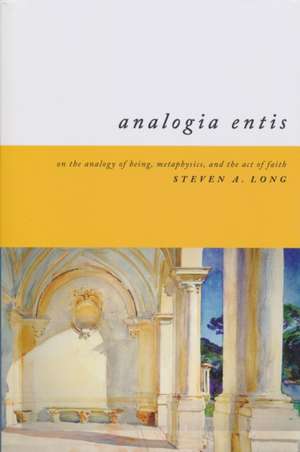
Analogia Entis
Autor Steven Longen Limba Engleză Hardback – 15 ian 2022
Analogia Entis: On the Analogy of Being, Metaphysics, and the Act of Faith is an intellectually rigorous and systematic account of Thomas’s teaching regarding the analogy of being. Steven A. Long’s work stands in contradistinction to historical-doctrinal surveys and general introductions, retrieving by way of an interpretation of Aristotle and Aquinas the indispensable role that analogy of being plays for metaphysics and, consequently, for theology.
In his later writings St. Thomas did not return to questions about the analogy of being that he had answered earlier in his career. This has led most historical-textual treatments of analogy in current scholarship to the mistaken conclusion that Thomas actually changed his answers to these questions. Scholars fail to see the continuity between his treatment in the Summa theologiae and his earlier De veritate. Long's study demonstrates the coherence of St. Thomas’s earlier and later analyses. It shows how Thomas’s later account in the Summa theologiae necessarily presupposes his earlier teaching. This is a book that invites the reader to a demanding and speculatively intense appreciation of the metaphysics of analogy. It will contribute significantly to the growing debate on the analogy of being.
“Steven A. Long’s Analogia Entis: On the Analogy of Being, Metaphysics, and the Act of Faithis a remarkable book containing a stunning speculative performance. Long speaks for a classical tradition of Thomistic thought but does so with a keen eye on precisely the ways it can help contemporary reflection. His compelling and substantive argument for the value and truth of a set of classical metaphysical understandings—for the necessity of the analogy of proper proportionality in the thought of Thomas Aquinas—will have to be taken seriously by anyone working in analogy in Aquinas as well as by a wide range of scholars within both philosophy and theology.” —John F. Boyle, University of St. Thomas
Preț: 603.98 lei
Preț vechi: 745.66 lei
-19%
Puncte Express: 906
Carte tipărită la comandă
Livrare economică 21 noiembrie-05 decembrie
Livrare prin curier în România Termenul estimat este afișat lângă disponibilitate.
Transport gratuit pentru acest produs Plată online sau ramburs, în funcție de opțiunile comenzii.
Retur gratuit în 14 zile Comandă securizată și suport în română.
Specificații
ISBN-13: 9780268204082
ISBN-10: 026820408X
Pagini: 166
Dimensiuni: 157 x 235 x 14 mm
Greutate: 0.4 kg
Editura: University of Notre Dame Press
ISBN-10: 026820408X
Pagini: 166
Dimensiuni: 157 x 235 x 14 mm
Greutate: 0.4 kg
Editura: University of Notre Dame Press
V-ar putea interesa
-
 Stones into SchoolsGreg MortensonPreț: 144.52 lei
 -
 What is a Just Peace?Pierre Allan-11%Preț: 337.46 lei380.52 lei
 -
 The International Law of OccupationEyal Benvenisti-22%Preț: 404.18 lei518.79 lei
 -
 -21%Preț: 106.17 lei134.47 lei
 -
 Fighting to the End: The Pakistan Army's Way of WarC. Christine Fair-32%Preț: 349.16 lei512.00 lei
 -
 Building Peace After WarMats BerdalPreț: 227.24 lei
 -
 Contemporary Conflict Resolution, 4eO Ramsbotham-15%Preț: 610.37 lei718.08 lei
 -
 -8%Preț: 559.44 lei608.09 lei
 -
 Preț: 176.50 lei
 -
 Beyond the Front LinesP. SeibPreț: 161.02 lei
 -
 Preț: 471.04 lei
 -
 Future WarChristopher CokerPreț: 164.84 lei
 -
 Preț: 89.74 lei
 -
 Peace and Conflict in AfricaDavid Francis-17%Preț: 214.93 lei258.33 lei
 -
 The End of WarPaul K. ChappellPreț: 69.99 lei
Notă biografică
Steven has a bachelor's degree from Emporia State University and a master's degree from New England College. He has over 20 years of experience in publishing, having worked as both an in-house and freelance editor for several publishing companies, including Gale, McGraw Hill, Random House, Kensington Publishing Corp., and The H. W. Wilson Company.
Recenzii
“Analogia Entis has a complex agenda. First the book intends to defend the theological value of the idea of ‘the analogy of being understood as the analogy of proper proportionality founded on a division of being by act and potency.’ . . . Second, the author argues that this idea is to be found not only in Aquinas’s earlier works, but also remained central to the thought of Thomas Aquinas in his later works.” —Catholic Library World
“Analogia Entis is a major strategic contribution to the practice of contemporary Thomistic thought and bears numerous crucial implications for philosophy and theology generally. Long’s chief speculative claims are well argued and penetrating. . . . [He] lays the groundwork for robustly conceptual and realist philosophy of God and theology of God.” —American Catholic Philosophical Quarterly
“With this new work, brief but incisive, ‘on the analogy of being, metaphysics, and the act of faith,’ Steven A. Long pursues his crusade in support of the restoration in Christian culture of a philosophy that is likely to help in understanding the faith, as the encyclical Fides et Ratio clearly hopes for. “ —The Thomist