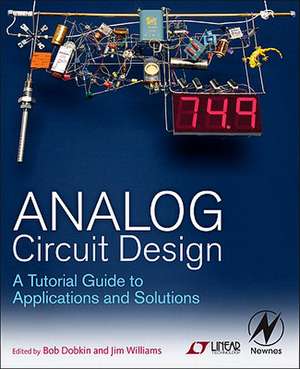
Analog Circuit Design: A Tutorial Guide to Applications and Solutions
Editat de Bob Dobkin, Jim Williamsen Limba Engleză Hardback – 11 oct 2011
Suntem de părere că ceea ce diferențiază Analog Circuit Design de documentația tehnică standard sau de manualele universitare rigide este originea sa organică: volumul este o compilație extinsă a notelor de aplicație de la Linear Technology. Spre deosebire de o fișă tehnică ce descrie parametri nominali, acest ghid tutorial, editat de Bob Dobkin și Jim Williams, oferă contextul rezolvării problemelor reale de inginerie, explicând raționamentul din spatele fiecărei decizii de design.
Notăm cu interes structura echilibrată a celor 960 de pagini. Prima parte este dedicată managementului puterii, trecând progresiv de la tutoriale fundamentale la designul regulatoarelor de comutație și liniare, culminând cu aplicații complexe pentru lasere și sisteme auto. A doua parte se concentrează pe conversia datelor și condiționarea semnalului, oferind soluții practice pentru designul de înaltă frecvență și RF. Dacă Analog Design Essentials de Willy M Sansen v-a oferit cadrul teoretic și sinteza amplificatoarelor operaționale, Analog Circuit Design oferă instrumentele practice și schemele electronice verificate necesare implementării în proiecte industriale exigente.
În contextul operei editorilor, această lucrare reprezintă piatra de temelie a seriei, fiind urmată de Analog Circuit Design Volume Three, care continuă colecția de note de design. Credem că valoarea acestui volum rezidă în capacitatea sa de a transforma concepte abstracte în soluții hardware funcționale, fiind un companion indispensabil pentru inginerul care trebuie să livreze performanță într-o eră dominată de digital, dar dependentă de precizia analogică.
Preț: 472.23 lei
Preț vechi: 604.69 lei
-22%
Carte tipărită la comandă
Livrare economică 01-15 decembrie
Specificații
ISBN-10: 0123851858
Pagini: 960
Ilustrații: black & white illustrations, figures
Dimensiuni: 216 x 276 x 33 mm
Greutate: 1.84 kg
Editura: ELSEVIER SCIENCE
V-ar putea interesa
-
 Microelectronic CircuitsAdel S. Sedra-22%Preț: 955.28 lei1222.08 lei
 -
 Electromagnetic Compatibility EngineeringHenry W. Ott-23%Preț: 881.63 lei1144.97 lei
 -
 Analog Integrated Circuit DesignTony Chan Carusone-18%Preț: 1660.27 lei2024.72 lei
 -
 Power ElectronicsNed Mohan-23%Preț: 2054.25 lei2667.86 lei
 -
 The Art of ElectronicsPaul Horowitz-9%Preț: 702.87 lei772.39 lei
 -
 -19%Preț: 439.32 lei542.37 lei
 -
 CMOSR Jacob Baker-23%Preț: 910.54 lei1182.53 lei
 -
 -26%Preț: 381.70 lei515.46 lei
 -
 Design of Analog CMOS Integrated CircuitsBehzad Razavi-24%Preț: 402.12 lei530.56 lei
 -
 -26%Preț: 277.16 lei373.40 lei
 -
 Microelectronic Circuit Design ISERichard Jaeger-24%Preț: 423.71 lei556.74 lei
 -
 Principles and Applications of Electrical Engineering ISEGiorgio Rizzoni-25%Preț: 395.45 lei527.08 lei
 -
 Microelectronics Circuit Analysis and Design ISEDonald Neamen-29%Preț: 346.41 lei489.80 lei
 -
 -9%Preț: 563.36 lei619.07 lei
 -
 -9%Preț: 623.90 lei685.60 lei
 -
 -23%Preț: 842.49 lei1094.15 lei
 -
 Foundations of Analog and Digital Electronic CircuitsAnant Agarwal-27%Preț: 551.94 lei754.30 lei
 -
 -19%Preț: 282.20 lei348.18 lei
Public țintă
Electronics engineers and designers; electronics technicians; engineering students; electronics hobbyists, circuit designers, electrical engineers, instrumentation engineers, or electrical engineering students.De ce să citești această carte
Recomandăm această carte inginerilor de design și studenților avansați care doresc să treacă dincolo de teorie. Cititorul câștigă acces la decenii de expertiză de la lideri precum Jim Williams, învățând nu doar cum să folosească un component, ci cum să gândească un întreg sistem analogic. Este o resursă esențială pentru rezolvarea provocărilor de management al puterii și condiționare a semnalului în aplicații industriale moderne.
Despre autor
Bob Dobkin este un pionier al ingineriei electrice, co-fondator al Linear Technology Corporation și creatorul multor circuite integrate de referință în industrie. Alături de el, regretatul Jim Williams a fost recunoscut ca unul dintre cei mai mari designeri de circuite analogice, faimos pentru abordarea sa intuitivă și pentru capacitatea de a explica fenomene electronice complexe prin note de aplicație legendare. Contribuția lor colectivă, alături de Carl Nelson, transformă acest volum într-o arhivă de bune practici care a definit standardele moderne în electronica analogică.
Descriere scurtă
- Covers the fundamentals of linear/analog circuit and system design to guide engineers with their design challenges
- Based on the Application Notes of Linear Technology, the foremost designer of high performance analog products, readers will gain practical insights into design techniques and practice
- Broad range of topics, including power management tutorials, switching regulator design, linear regulator design, data conversion, signal conditioning, and high frequency/RF design
- Contributors include the leading lights in analog design, Robert Dobkin, Jim Williams and Carl Nelson, among others
Cuprins
Section 1 Power Management Tutorials
Section 2 Switching Regulator Design
Section 3 Linear Regulator Design
Section 4 High Voltage and High Current Applications
Section 5 Powering Lasers and Illumination Devices
Section 6 Automotive and Industrial Power Design
Part 2: Data Conversion, Signal Conditioning and High Frequency/RF
Section 1 Data Conversion
Section 2 Signal Conditioning
Section 3 High Frequency/RF Design
Recenzii
"Subtitled 'Immersion in the black art of analog design', this huge book has over 1,200 A4 pages of joy…you will learn something from every page…delightfully readable." --ElectronicsWeekly.com, April 2013
"…this is quite an extensive work with 1250 pages. A collection of "application notes"…[it will] help you understand and solve practical problems. Here interesting questions will be answered such as ‘Why is my phone ringing,’ but also highly complex power supply circuits." --Design and Elektronik, February 2013
"For analog designers or anyone who brushes against analog design issues…Analog Circuit Design: A Tutorial Guide to Applications and Solutions...is a great place to start. Each time I look through this book, I get new insight and understanding based on the knowledge, experience, challenges, and mysteries the authors and other contributors bring…books like this can help you get your job done faster and with fewer re-spins." --Planet Analog, January 2013
"This in-depth source book of circuit design solutions supplies engineers with practical design techniques that focus on common analog challenges. The full support package includes online resources such as data sheets, design notes and LTspice design simulation software tools from Linear Technology." --EETimes.com and others, December 2012
"The 932-page book compiles 41 of Linear Tech's applications and each app note has its own chapter. The book divides information into two sections; one that covers power management (19 app notes) and a second that covers data conversion, signal conditioning, and Highfrequency & RF (22 app notes)... Anyone who works with analog electronics--and those who hope to--should own a copy of this book." --Dev-Monkey.com
"This is a handsome book that I will happily find space for on my shelf. It is extremely good value for money and is, thank heavens, a prime example of why it will be some time before e-books have a real place in the publication of technology texts. There should be a place for this latest ANALOG Circuit Design in the hands of every novice, journeyman, and experienced analog designer." --En Genius.net
"In September, three months after a stroke ended Jim’s life, the book – what may be the only coffee table book for analog engineers – came out. What’s remarkable is how easy it is to get into, how much it makes you want to browse – like a traditional coffee-table book. As my friend Paul Rako, described Jim’s writing style, ‘He never tried to impress you with his math or his intellect. He didn't make things complicated so you would think he was smart. He made things look simple. That is why he was brilliant.’" --Electronic Design.com