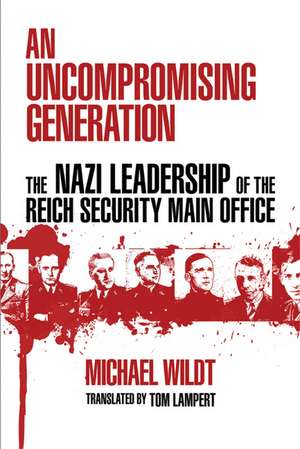
An Uncompromising Generation: The Nazi Leadership of the Reich Security Main Office: George L. Mosse Series in the History of European Culture, Sexuality, and Ideas
Autor Michael Wildt Traducere de Tom Lamperten Limba Engleză Paperback – 11 ian 2010
In An Uncompromising Generation, Michael Wildt follows the journey of a strikingly homogenous group of young academics—who came from the educated, bourgeois stratum of society—as they started to identify with the Nazi concept of Volksgemeinschaft, which labeled Jews as enemies of the people and justified their murder.
Wildt’s study traces the intellectual evolution of key members of the Reich Security Main Office (RSHA) from their days as students until the end of World War II. Established in 1939, this office fused together the Gestapo, the Criminal Police, and the Sicherheitsdienst (Security Service) of the SS. Far from being small cogs in a big bureaucratic machine, Wildt finds that the people who made up the RSHA constructed the concepts and operated the apparatus that carried out the Holocaust.
At the center of both theory and practice of persecution and genocide in Nazi-occupied Europe, these young men of the RSHA—none of whom envisioned the systematic annihilation of the European Jews—became radicalized. How this occurred is the central question of Wildt’s book. Wildt also discusses the postwar careers of the members of the RSHA. Strikingly, he shows how the leaders of the RSHA evaded the consequences of their actions under the Nazi regime and went on to have important careers in the rebuilt West Germany.
An alternate selection of the History Book Club and Military Book ClubWildt’s study traces the intellectual evolution of key members of the Reich Security Main Office (RSHA) from their days as students until the end of World War II. Established in 1939, this office fused together the Gestapo, the Criminal Police, and the Sicherheitsdienst (Security Service) of the SS. Far from being small cogs in a big bureaucratic machine, Wildt finds that the people who made up the RSHA constructed the concepts and operated the apparatus that carried out the Holocaust.
At the center of both theory and practice of persecution and genocide in Nazi-occupied Europe, these young men of the RSHA—none of whom envisioned the systematic annihilation of the European Jews—became radicalized. How this occurred is the central question of Wildt’s book. Wildt also discusses the postwar careers of the members of the RSHA. Strikingly, he shows how the leaders of the RSHA evaded the consequences of their actions under the Nazi regime and went on to have important careers in the rebuilt West Germany.
Din seria George L. Mosse Series in the History of European Culture, Sexuality, and Ideas
-
 Preț: 179.22 lei
 - 19%
 Preț: 434.85 lei
 - 19%
 Preț: 421.72 lei
 - 19%
 Preț: 454.82 lei
 -
 Preț: 126.42 lei
 - 19%
 Preț: 478.78 lei
 - 19%
 Preț: 417.69 lei
 - 19%
 Preț: 481.09 lei
 - 8%
 Preț: 516.77 lei
 - 19%
 Preț: 544.29 lei
 -
 Preț: 273.50 lei
 -
 Preț: 308.62 lei
 -
 Preț: 284.24 lei
 -
 Preț: 123.51 lei
 -
 Preț: 255.36 lei
 -
 Preț: 170.66 lei
 -
 Preț: 253.04 lei
 -
 Preț: 255.36 lei
 -
 Preț: 339.14 lei
 -
 Preț: 130.37 lei
 -
 Preț: 287.46 lei
 -
 Preț: 181.73 lei
 -
 Preț: 150.54 lei
 -
 Preț: 143.83 lei
 -
 Preț: 190.98 lei
 -
 Preț: 314.92 lei
 - 23%
 Preț: 474.65 lei
 -
 Preț: 316.07 lei
 - 23%
 Preț: 483.98 lei
 - 8%
 Preț: 479.50 lei
 - 23%
 Preț: 482.96 lei
 -
 Preț: 356.25 lei
 - 19%
 Preț: 433.09 lei
 - 11%
 Preț: 106.64 lei
 -
 Preț: 232.33 lei
 - 8%
 Preț: 506.33 lei
 - nou
 Preț: 544.89 lei
Preț: 314.50 lei
Puncte Express: 472
Carte tipărită la comandă
Livrare economică 01-15 decembrie
Livrare prin curier în România Termenul estimat este afișat lângă disponibilitate.
Transport gratuit de la 400.00 lei Plată online sau ramburs, în funcție de opțiunile comenzii.
Retur gratuit în 14 zile Comandă securizată și suport în română.
Specificații
ISBN-13: 9780299234645
ISBN-10: 0299234649
Pagini: 592
Ilustrații: 29 b-w photos
Dimensiuni: 152 x 229 x 41 mm
Greutate: 0.97 kg
Ediția:1
Editura: University of Wisconsin Press
Colecția University of Wisconsin Press
Seria George L. Mosse Series in the History of European Culture, Sexuality, and Ideas
ISBN-10: 0299234649
Pagini: 592
Ilustrații: 29 b-w photos
Dimensiuni: 152 x 229 x 41 mm
Greutate: 0.97 kg
Ediția:1
Editura: University of Wisconsin Press
Colecția University of Wisconsin Press
Seria George L. Mosse Series in the History of European Culture, Sexuality, and Ideas
V-ar putea interesa
-
 The Basque Insurgents: ETA, 1952–1980Robert P. ClarkPreț: 213.52 lei
 -
 Preț: 112.17 lei
 -
 Preț: 208.50 lei
 -
 Yugoslavism: Histories Of A Failed Idea, 1918-1992Dejan DjokićPreț: 146.55 lei
 -
 Mutiny and Rebellion in the Ottoman EmpireJane HathawayPreț: 194.55 lei
 -
 Epic Revisionism: Russian History and Literature as Stalinist PropagandaKevin M. F. PlattPreț: 171.28 lei
 -
 Times of Trouble: Violence in Russian Literature and CultureMarcus C. LevittPreț: 370.38 lei
 -
 Preț: 274.74 lei
 -
 Les derniers carolingiensRicherPreț: 200.63 lei
 -
 Preț: 79.30 lei
 -
 Le don gratuit, joyeux avénementAuguste LambertPreț: 86.37 lei
 -
 L'émigration jugée par MM. de Vaublanc et de PastoretArmand-Jacques LherbettePreț: 72.77 lei
 -
 Preț: 79.30 lei
 -
 Projet de loi sur l'indemnité des émigrésJean-Baptiste Sylvère Gaye MartignacPreț: 79.18 lei
 -
 Précis Historique Du Sacre de S. M. Charles XCharles Joseph Christophe SiretPreț: 123.95 lei
 -
 Relation des événemens qui ont précédé et suivi le licenciement de la garde nationale de ParisFrançois Mongin de MontrolPreț: 94.44 lei
 -
 Affaire de Maubreuil, jugée définitivement à la cour royale de Douai, le 6 mai 1818François Mongin De MontrolPreț: 80.19 lei
 -
 Du ministère et de la censure ... par A. JayAntoine JayPreț: 79.84 lei
 -
 Preț: 87.59 lei
 -
 Arbeit im NationalsozialismusMarc Buggeln-8%Preț: 438.55 lei476.69 lei
Recenzii
“Michael Wildt’s examination of the leadership corps of Himmler’s ‘Reich Security Main Office’ . . . is a major work in every sense.”—Richard Bessel, The Times Literary Supplement
“Wildt’s exceptionally well-written book is easily accessible.”—Alexander Arndt, Jewish Political Studies Review
“Michael Wildt has undoubtedly written an authoritative study of the RSHA, that will, for years to come, be a great aid for historical research concerning National Socialist Germany.”—Saul Friedländer, author of When Memory Comes
“An indispensable and provocative study of key members of the RSHA that focuses on their intellectual evolution from university students to practitioners of mass murder.”—Choice
Cuprins
List of Illustrations
List of Abbreviations
Introduction to the English Edition
Part 1. Generation
1. The Experience of War
2. Student Radicalism
3. A Young German Elite: The Black Hand in Leipzig
4. 1933
Part 2. Institution
5. Conceptualizing the Reich Security Main Office
6. Structure and Staff
Part 3. War
7. Poland 1939: The Experience of Racist Mass Murder
8. Expulsion 1940
9. Einsatzgruppen in the Soviet Union
10. Zenith and Decline
Part 4. Epilogue
11. Postwar: Back in Civil Society
12. Prosecution
Conclusion
Notes
Index
List of Abbreviations
Introduction to the English Edition
Part 1. Generation
1. The Experience of War
2. Student Radicalism
3. A Young German Elite: The Black Hand in Leipzig
4. 1933
Part 2. Institution
5. Conceptualizing the Reich Security Main Office
6. Structure and Staff
Part 3. War
7. Poland 1939: The Experience of Racist Mass Murder
8. Expulsion 1940
9. Einsatzgruppen in the Soviet Union
10. Zenith and Decline
Part 4. Epilogue
11. Postwar: Back in Civil Society
12. Prosecution
Conclusion
Notes
Index
Descriere
In An Uncompromising Generation, Michael Wildt follows the journey of a strikingly homogenous group of young academics—who came from the educated, bourgeois stratum of society—as they started to identify with the Nazi concept of Volksgemeinschaft, which labeled Jews as enemies of the people and justified their murder.
Wildt’s study traces the intellectual evolution of key members of the Reich Security Main Office (RSHA) from their days as students until the end of World War II. Established in 1939, this office fused together the Gestapo, the Criminal Police, and the Sicherheitsdienst (Security Service) of the SS. Far from being small cogs in a big bureaucratic machine, Wildt finds that the people who made up the RSHA constructed the concepts and operated the apparatus that carried out the Holocaust.
Wildt’s study traces the intellectual evolution of key members of the Reich Security Main Office (RSHA) from their days as students until the end of World War II. Established in 1939, this office fused together the Gestapo, the Criminal Police, and the Sicherheitsdienst (Security Service) of the SS. Far from being small cogs in a big bureaucratic machine, Wildt finds that the people who made up the RSHA constructed the concepts and operated the apparatus that carried out the Holocaust.