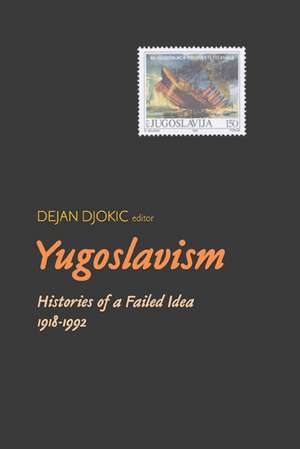
Yugoslavism: Histories Of A Failed Idea, 1918-1992
Autor Dejan Djokićen Limba Engleză Paperback – 9 iun 2003
This volume explores historical, political, social, diplomatic, and economic aspects of the Yugoslav idea—"Yugoslavism"—between the creation of the nation in 1918 and its dissolution in the early 1990s. The key theme that emerges is that Yugoslavism was a fluid concept, understood differently at different times by various leaders, social groups, and the member states that comprised Yugoslavia. There never was a single definition of who and what was (or was not) "Yugoslav," and this contributed to the ultimate failure of the Yugoslav idea and the Yugoslav state. These essays, by scholars from the former Yugoslavia and from the West, look at the interplay of the states and peoples of Yugoslavia and at the roles played by intellectuals, leaders, and institutions, both secular and religious.
Preț: 146.55 lei
Puncte Express: 220
Carte disponibilă
Livrare economică 05-19 noiembrie
Livrare prin curier în România Termenul estimat este afișat lângă disponibilitate.
Transport gratuit de la 400.00 lei Plată online sau ramburs, în funcție de opțiunile comenzii.
Retur gratuit în 14 zile Comandă securizată și suport în română.
Specificații
ISBN-13: 9780299186142
ISBN-10: 0299186148
Pagini: 368
Dimensiuni: 152 x 229 x 25 mm
Greutate: 0.43 kg
Ediția:1
Editura: University of Wisconsin Press
Colecția University of Wisconsin Press
ISBN-10: 0299186148
Pagini: 368
Dimensiuni: 152 x 229 x 25 mm
Greutate: 0.43 kg
Ediția:1
Editura: University of Wisconsin Press
Colecția University of Wisconsin Press
V-ar putea interesa
-
 -31%Preț: 530.51 lei769.65 lei
 -
 Preț: 410.44 lei
 -
 -18%Preț: 1310.47 lei1598.13 lei
 -
 New Parties in Government: In Power for the First TimeKris DeschouwerPreț: 163.87 lei
 -
 Preț: 309.27 lei
 -
 Secessionism and Separatism in Europe and Asia: To Have a State of One’s OwnJean-Pierre Cabestan-18%Preț: 1256.91 lei1532.82 lei
 -
 -18%Preț: 1257.26 lei1533.24 lei
 -
 -15%Preț: 423.54 lei498.29 lei
 -
 A Grand Illusion?Tony JudtPreț: 213.16 lei
 -
 The Future of PowerJoseph Nye, Jr.-26%Preț: 89.14 lei120.89 lei
 -
 -27%Preț: 1216.78 lei1659.05 lei
 -
 -28%Preț: 65.77 lei91.26 lei
 -
 American PoliticsJon RoperPreț: 80.43 lei
Notă biografică
Dejan Djoki´c is lecturer in contemporary history at the School of History, Classics and Archaeology, Birkbeck College, University of London. He is a frequent contributor to both scholarly and popular media in Europe, commenting on politics in the Balkans.
Descriere
This volume explores historical, political, social, diplomatic, and economic aspects of the Yugoslav idea—"Yugoslavism"—between the creation of the nation in 1918 and its dissolution in the early 1990s. The key theme that emerges is that Yugoslavism was a fluid concept, understood differently at different times by various leaders, social groups, and the member states that comprised Yugoslavia. There never was a single definition of who and what was (or was not) "Yugoslav," and this contributed to the ultimate failure of the Yugoslav idea and the Yugoslav state. These essays, by scholars from the former Yugoslavia and from the West, look at the interplay of the states and peoples of Yugoslavia and at the roles played by intellectuals, leaders, and institutions, both secular and religious.