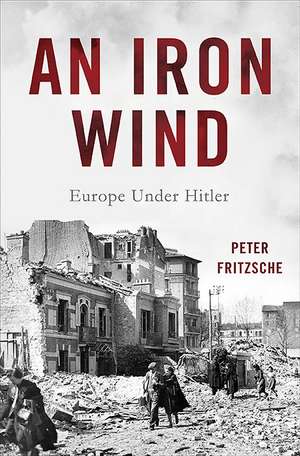
An Iron Wind: Europe Under Hitler
Autor Peter Fritzscheen Limba Engleză Hardback – 25 oct 2016
Preț: 136.11 lei
Preț vechi: 191.60 lei
-29%
Puncte Express: 204
Carte disponibilă
Livrare economică 17 noiembrie-01 decembrie
Livrare prin curier în România Termenul estimat este afișat lângă disponibilitate.
Transport gratuit de la 400.00 lei Plată online sau ramburs, în funcție de opțiunile comenzii.
Retur gratuit în 14 zile Comandă securizată și suport în română.
Specificații
ISBN-13: 9780465057740
ISBN-10: 0465057748
Pagini: 376
Ilustrații: none
Dimensiuni: 241 x 165 x 33 mm
Greutate: 0.58 kg
Ediția:1
Editura: Little Brown
Colecția Basic Books
Locul publicării:London, United Kingdom
ISBN-10: 0465057748
Pagini: 376
Ilustrații: none
Dimensiuni: 241 x 165 x 33 mm
Greutate: 0.58 kg
Ediția:1
Editura: Little Brown
Colecția Basic Books
Locul publicării:London, United Kingdom
V-ar putea interesa
-
 The Interloper: Lee Harvey Oswald Inside the Soviet UnionPeter SavodnikPreț: 296.85 lei
 -
 Life and Death in the Third ReichPeter FritzschePreț: 206.20 lei
 -
 Report Into the Loss of the SS TitanicSamuel Halpern-6%Preț: 160.42 lei171.37 lei
 -
 Stranger Than We Can ImagineJohn Higgs-25%Preț: 69.70 lei93.50 lei
 -
 -17%Preț: 159.87 lei191.87 lei
 -
 Hope in the DarkRebecca SolnitPreț: 77.89 lei
 -
 Preț: 373.71 lei
 -
 V&A Gallery of FashionClaire Wilcox-17%Preț: 107.76 lei129.53 lei
Recenzii
A profoundly significant exploration of how Europeans-both Germans and those under German occupation-struggled to make sense of the conflict by giving it some shape or meaning, or by simply accepting in the end that it made no sense... In a strikingly original chapter [Fritzsche] explores the question of where God stood in people's accounts of wartime excesses... It is difficult to do full justice to the richness and range of sources that Mr. Fritzsche has unearthed. The book is very much a history from below, providing glimpses of the reality, but it reflects the way that many ordinary people experience catastrophe then and now.
A work of deep reflection by an experienced historian rather than an attempt to capture the history of World War II from any particular angle. Still, his announced theme - the moral challenges of the war for civilians in Europe - gives way at the beginning to set pieces on other subjects: the ones, the reader suspects, that Fritzsche finds most interesting. It is a pleasure to follow along.
A work of deep reflection by an experienced historian rather than an attempt to capture the history of World War II from any particular angle. Still, his announced theme - the moral challenges of the war for civilians in Europe - gives way at the beginning to set pieces on other subjects: the ones, the reader suspects, that Fritzsche finds most interesting. It is a pleasure to follow along.