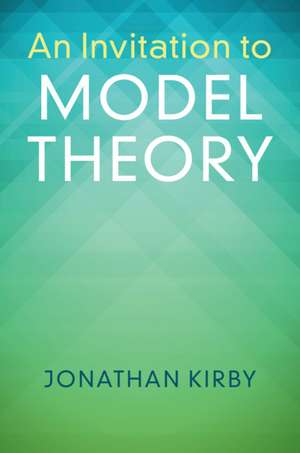
An Invitation to Model Theory
Autor Jonathan Kirbyen Limba Engleză Hardback – 18 apr 2019
Preț: 466.22 lei
Preț vechi: 575.58 lei
-19%
Puncte Express: 699
Carte tipărită la comandă
Livrare economică 05-19 decembrie
Livrare prin curier în România Termenul estimat este afișat lângă disponibilitate.
Transport gratuit pentru acest produs Plată online sau ramburs, în funcție de opțiunile comenzii.
Retur gratuit în 14 zile Comandă securizată și suport în română.
Specificații
ISBN-13: 9781107163881
ISBN-10: 1107163889
Pagini: 198
Ilustrații: 5 b/w illus.
Dimensiuni: 157 x 235 x 15 mm
Greutate: 0.4 kg
Editura: Cambridge University Press
Locul publicării:New York, United States
ISBN-10: 1107163889
Pagini: 198
Ilustrații: 5 b/w illus.
Dimensiuni: 157 x 235 x 15 mm
Greutate: 0.4 kg
Editura: Cambridge University Press
Locul publicării:New York, United States
V-ar putea interesa
-
 -27%Preț: 1035.01 lei1417.81 lei
 -
 -30%Preț: 848.26 lei1213.80 lei
 -
 Proof, Logic and FormalizationMichael Detlefsen-18%Preț: 1112.48 lei1356.68 lei
 -
 Godel's Theorem in FocusS.G. ShankerPreț: 452.95 lei
 -
 Proof and Knowledge in MathematicsMichael Detlefsen-18%Preț: 1114.04 lei1358.58 lei
 -
 -27%Preț: 977.72 lei1339.34 lei
 -
 A Course in Mathematical LogicJ.L. Bell-16%Preț: 378.64 lei449.21 lei
 -
 Logic and Algebraic Structures in Quantum ComputingJennifer Chubb-14%Preț: 981.60 lei1141.39 lei
 -
 Ordinal Definability and Recursion TheoryAlexander S. Kechris-14%Preț: 1256.23 lei1460.74 lei
 -
 A Guide to NIP TheoriesPierre Simon-14%Preț: 879.90 lei1023.13 lei
 -
 -18%Preț: 997.97 lei1217.04 lei
 -
 Mehrwertige LogikSiegfried Gottwald-9%Preț: 771.63 lei847.94 lei
 -
 Preț: 486.40 lei
 -
 Rock CoversJonathan Kirby-8%Preț: 459.77 lei499.76 lei
 -
 Rock CoversJonathan KirbyPreț: 237.56 lei
 -
 Griddlers Logic PuzzlesTeam, GriddlersPreț: 112.84 lei
 -
 Griddlers Logic PuzzlesTeam, GriddlersPreț: 95.69 lei
 -
 Preț: 107.15 lei
 -
 Griddlers Logic Puzzles - Triddlers ColorTeam, GriddlersPreț: 95.69 lei
 -
 Preț: 80.23 lei
Cuprins
Preface; Part I. Languages and Structures: 1. Structures; 2. Terms; 3. Formulas; 4. Definable sets; 5. Substructures and quantifiers; Part II. Theories and Compactness: 6. Theories and axioms; 7. The complex and real fields; 8. Compactness and new constants; 9. Axiomatisable classes; 10. Cardinality considerations; 11. Constructing models from syntax; Part III. Changing Models: 12. Elementary substructures; 13. Elementary extensions; 14. Vector spaces and categoricity; 15. Linear orders; 16. The successor structure; Part IV. Characterising Definable Sets: 17. Quantifier elimination for DLO; 18. Substructure completeness; 19. Power sets and Boolean algebras; 20. The algebras of definable sets; 21. Real vector spaces and parameters; 22. Semi-algebraic sets; Part V. Types: 23. Realising types; 24. Omitting types; 25. Countable categoricity; 26. Large and small countable models; 27. Saturated models; Part VI. Algebraically Closed Fields: 28. Fields and their extensions; 29. Algebraic closures of fields; 30. Categoricity and completeness; 31. Definable sets and varieties; 32. Hilbert's Nullstellensatz; Bibliography; Index.
Descriere
An innovative and largely self-contained textbook bringing model theory to an undergraduate audience.