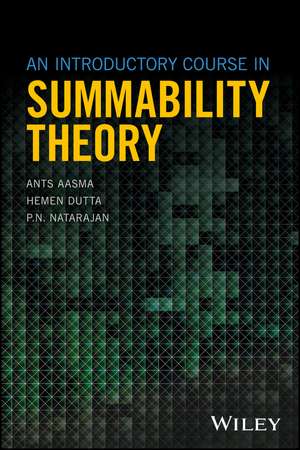
An Introductory Course in Summability Theory
Autor Ants Aasma, Hemen Dutta, P N Natarajanen Limba Engleză Hardback – 24 apr 2017
Preț: 692.38 lei
Preț vechi: 1016.42 lei
-32%
Puncte Express: 1039
Carte indisponibilă temporar
Doresc să fiu notificat când acest titlu va fi disponibil:
Se trimite...
Specificații
ISBN-13: 9781119397694
ISBN-10: 1119397693
Pagini: 224
Dimensiuni: 155 x 231 x 20 mm
Greutate: 0.48 kg
Editura: Wiley
Locul publicării:Hoboken, United States
ISBN-10: 1119397693
Pagini: 224
Dimensiuni: 155 x 231 x 20 mm
Greutate: 0.48 kg
Editura: Wiley
Locul publicării:Hoboken, United States
Public țintă
As an introductory textbook in summability theory for graduate students; as a reference for researchers; Any student, who has a good grasp of real and complex analysis will find all the chapters within his/her reach; knowledge of functional analysis will be an added asset.Notă biografică
Ants Aasma, PhD, is Associate Professor of Mathematical Economics in the Department of Economics and Finance at Tallinn University of Technology, Estonia. Hemen Dutta, PhD, is Senior Assistant Professor of Mathematics at Gauhati University, India. P.N. Natarajan, PhD, is Formerly Professor and Head of the Department of Mathematics, Ramakrishna Mission Vivekananda College, Chennai, Tamilnadu, India.
Cuprins
Preface ix
About the Authors xi
About the Book xiii
1 Introduction and General Matrix Methods 1
1.1 Brief Introduction 1
1.2 General Matrix Methods 2
1.3 Exercise 16
References 19
2 Special Summability Methods I 21
2.1 The Nörlund Method 21
2.2 The Weighted Mean Method 29
2.3 The Abel Method and the (C,1) Method 34
2.4 Exercise 44
References 45
3 Special Summability Methods II 47
3.1 The Natarajan Method and the Abel Method 47
3.2 The Euler and Borel Methods 53
3.3 The Taylor Method 59
3.4 The Hölder and Cesàro Methods 62
3.5 The Hausdorff Method 64
3.6 Exercise 73
References 74
4 Tauberian Theorems 75
4.1 Brief Introduction 75
4.2 Tauberian Theorems 75
4.3 Exercise 83
References 84
5 Matrix Transformations of Summability and Absolute Summability Domains: Inverse-Transformation Method 85
5.1 Introduction 85
5.2 Some Notions and Auxiliary Results 87
5.3 The Existence Conditions of Matrix Transform Mx 91
5.4 Matrix Transforms for Reversible Methods 95
5.5 Matrix Transforms for Normal Methods 102
5.6 Exercise 107
References 109
6 Matrix Transformations of Summability and Absolute Summability Domains: Peyerimhoff's Method 113
6.1 Introduction 113
6.2 Perfect Matrix Methods 113
6.3 The Existence Conditions of Matrix Transform Mx 117
6.4 Matrix Transforms for Regular Perfect Methods 121
6.5 Exercise 127
References 129
7 Matrix Transformations of Summability and Absolute Summability Domains: The Case of Special Matrices 131
7.1 Introduction 131
7.2 The Case of Riesz Methods 131
7.3 The Case of Cesàro Methods 139
7.4 Some Classes of Matrix Transforms 148
7.5 Exercise 151
References 154
8 On Convergence and Summability with Speed I
8.1 Introduction
8.2 The sets (m¿ , m¿ ), (c¿ , c¿ ) and (c¿ , m¿ )
8.3 Matrix transforms from mA¿ into mB¿
8.4 On orders of approximation of Fourier expansions
8.5 Exercises
References
9 On Convergence and Summability with Speed II
9.1 Introduction
9.2 Some topological properties of m¿ , c¿ , cA¿ and mA¿
9.3 Matrix transforms from cA¿ into cB¿ or mB¿
9.4 Exercises
References
About the Authors xi
About the Book xiii
1 Introduction and General Matrix Methods 1
1.1 Brief Introduction 1
1.2 General Matrix Methods 2
1.3 Exercise 16
References 19
2 Special Summability Methods I 21
2.1 The Nörlund Method 21
2.2 The Weighted Mean Method 29
2.3 The Abel Method and the (C,1) Method 34
2.4 Exercise 44
References 45
3 Special Summability Methods II 47
3.1 The Natarajan Method and the Abel Method 47
3.2 The Euler and Borel Methods 53
3.3 The Taylor Method 59
3.4 The Hölder and Cesàro Methods 62
3.5 The Hausdorff Method 64
3.6 Exercise 73
References 74
4 Tauberian Theorems 75
4.1 Brief Introduction 75
4.2 Tauberian Theorems 75
4.3 Exercise 83
References 84
5 Matrix Transformations of Summability and Absolute Summability Domains: Inverse-Transformation Method 85
5.1 Introduction 85
5.2 Some Notions and Auxiliary Results 87
5.3 The Existence Conditions of Matrix Transform Mx 91
5.4 Matrix Transforms for Reversible Methods 95
5.5 Matrix Transforms for Normal Methods 102
5.6 Exercise 107
References 109
6 Matrix Transformations of Summability and Absolute Summability Domains: Peyerimhoff's Method 113
6.1 Introduction 113
6.2 Perfect Matrix Methods 113
6.3 The Existence Conditions of Matrix Transform Mx 117
6.4 Matrix Transforms for Regular Perfect Methods 121
6.5 Exercise 127
References 129
7 Matrix Transformations of Summability and Absolute Summability Domains: The Case of Special Matrices 131
7.1 Introduction 131
7.2 The Case of Riesz Methods 131
7.3 The Case of Cesàro Methods 139
7.4 Some Classes of Matrix Transforms 148
7.5 Exercise 151
References 154
8 On Convergence and Summability with Speed I
8.1 Introduction
8.2 The sets (m¿ , m¿ ), (c¿ , c¿ ) and (c¿ , m¿ )
8.3 Matrix transforms from mA¿ into mB¿
8.4 On orders of approximation of Fourier expansions
8.5 Exercises
References
9 On Convergence and Summability with Speed II
9.1 Introduction
9.2 Some topological properties of m¿ , c¿ , cA¿ and mA¿
9.3 Matrix transforms from cA¿ into cB¿ or mB¿
9.4 Exercises
References
Descriere
An introductory course in summability theory for students, researchers, physicists, and engineers In creating this book, the authors intent was to provide graduate students, researchers, physicists, and engineers with a reasonable introduction to summability theory.