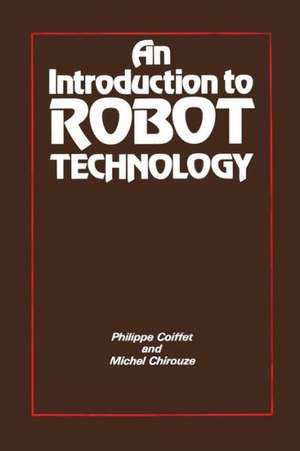
An Introduction to Robot Technology
Autor Philippe Coiffet, Michael Chirouzeen Limba Engleză Paperback – 23 feb 2012
Preț: 370.55 lei
Puncte Express: 556
Carte tipărită la comandă
Livrare economică 08-22 decembrie
Livrare prin curier în România Termenul estimat este afișat lângă disponibilitate.
Transport gratuit de la 400.00 lei Plată online sau ramburs, în funcție de opțiunile comenzii.
Retur gratuit în 14 zile Comandă securizată și suport în română.
Specificații
ISBN-13: 9789401161022
ISBN-10: 940116102X
Pagini: 200
Ilustrații: 198 p.
Dimensiuni: 155 x 235 x 12 mm
Greutate: 0.31 kg
Ediția:Softcover reprint of the original 1st ed. 1983
Editura: Springer
Locul publicării:Dordrecht, Netherlands
ISBN-10: 940116102X
Pagini: 200
Ilustrații: 198 p.
Dimensiuni: 155 x 235 x 12 mm
Greutate: 0.31 kg
Ediția:Softcover reprint of the original 1st ed. 1983
Editura: Springer
Locul publicării:Dordrecht, Netherlands
V-ar putea interesa
-
 AQA Physics: A Level Student BookJim Breithaupt-31%Preț: 388.26 lei561.07 lei
 -
 Oxford IB Diploma Programme: Physics Course CompanionMichael Bowen-Jones-23%Preț: 591.47 lei768.14 lei
 -
 Continuum Mechanics of Anisotropic MaterialsStephen C. CowinPreț: 418.25 lei
 -
 Mathematical PhysicsSadri Hassani-17%Preț: 580.99 lei699.98 lei
 -
 Towards the Mathematics of Quantum Field TheoryFrédéric Paugam-18%Preț: 1165.29 lei1421.09 lei
 -
 Quantum ChromodynamicsWalter Greiner-18%Preț: 784.06 lei956.18 lei
 -
 Advances in Meteorology, Climatology and Atmospheric PhysicsCostas G. Helmis-24%Preț: 1871.59 lei2462.62 lei
 -
 Atmospheric PhysicsUlrich Schumann-18%Preț: 1300.27 lei1585.69 lei
 -
 Atmospheric PhysicsJulio V. IribarnePreț: 374.23 lei
 -
 Atmospheric AerosolsOlivier Boucher-15%Preț: 730.11 lei858.95 lei
Public țintă
ResearchCuprins
1Robotics: an introduction.- Areas of application of robotics.- The new industrial revolution.- The aim of this book.- 2Robots and robots in use.- Origin of the word ‘robot’.- Definition of the word ‘robot’.- Characteristic properties of a robot.- General structure of a robot.- The robot environment.- Task description.- Role of the computer.- Typical industrial robot.- Classification of robots.- Robot generations.- Existing robots and the robot market.- 3Representation of a robot.- Functional representation.- Graphical representation.- Arms: structures in use.- Structure of end effectors.- 4Degrees of freedom of a robot.- Degrees of freedom of a rigid object.- Degrees of freedom of a robot.- Degrees of freedom specific to a tool.- Degrees of freedom and mobility.- 5Basic principles of control.- Variables to be handled.- The main levels of control.- 6Control based on the geometrical model.- Geometrical model: a much Simplified robot model.- Geometrical or positional control.- 7Control based on the kinematic model.- Kinematic model: a simplified robot model.- Variational control.- Characteristics of kinematic control.- Models and dynamic control.- 8Actuator servocontrol.- Principles of servocontrol.- Mathematical study of a servo-system.- Specific practical problems involved in the use of a robot servo-system.- 9Robot actuators.- Pneumatic actuators.- Hydraulic actuators.- Servocontrolled hydraulic systems.- Electrical actuators.- Servocontrolled electrical motors.- Transmission systems.- Conclusions.- 10Internal sensors.- Movement or position sensors.- Speed sensors.- Stress sensors.- Acceleration sensors.- 11External sensors.- Applications of external sensors.- Tactile sensors.- Stress sensors.- Proximity sensors.- Visual sensors.- 12Computer control.-Analog-digital, digital-analog converters.- Other types of converter used in robotics.- The program.- Conclusions.- 13Robot training and trajectory generation.- Methods of recording trajectories.- Manual control used in training.- Trajectory generation.- Trajectories in the task space and in the articulated variable space.- Control languages.- Conclusions.- References.- 14Robot performance and standards.- What is robot performance?.- Task performance.- Human performance in robot control.- Economic performance.- Performance standards.- 15Robots in use.- Examples of uses.- End effector components.- Conclusions.- Use of matrix calculations.- Handling real term matrices: a summary.- Components of a vector in an orthogonal set of coordinates.- Transformation of coordinate set.- Specific examples useful for modelling and control of robots.- Inverse transformation.- Definitions and equations.- Working principles.- Motor with induction control.- Motor with armature control.- Problems associated with dynamic control.- Dynamic control.- Effects of gravitational force.