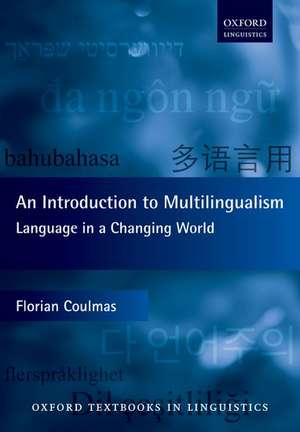
An Introduction to Multilingualism: Language in a Changing World: Oxford Textbooks in Linguistics
Autor Florian Coulmasen Limba Engleză Paperback – 14 dec 2017
Din seria Oxford Textbooks in Linguistics
- 20%
 Preț: 416.16 lei
 - 21%
 Preț: 375.58 lei
 - 27%
 Preț: 403.65 lei
 - 21%
 Preț: 430.95 lei
 - 14%
 Preț: 619.31 lei
 - 27%
 Preț: 431.78 lei
 - 13%
 Preț: 280.90 lei
 - 27%
 Preț: 440.97 lei
 - 20%
 Preț: 488.16 lei
 - 16%
 Preț: 216.87 lei
 - 25%
 Preț: 723.75 lei
 - 12%
 Preț: 367.77 lei
 - 13%
 Preț: 243.13 lei
 - 8%
 Preț: 346.36 lei
 - 20%
 Preț: 407.60 lei
 - 9%
 Preț: 405.66 lei
 - 10%
 Preț: 313.86 lei
Preț: 206.13 lei
Preț vechi: 243.11 lei
-15%
Puncte Express: 309
Carte tipărită la comandă
Livrare economică 04-09 decembrie
Livrare prin curier în România Termenul estimat este afișat lângă disponibilitate.
Transport gratuit de la 400.00 lei Plată online sau ramburs, în funcție de opțiunile comenzii.
Retur gratuit în 14 zile Comandă securizată și suport în română.
Specificații
ISBN-13: 9780198791119
ISBN-10: 0198791119
Pagini: 352
Dimensiuni: 172 x 247 x 19 mm
Greutate: 0.64 kg
Editura: OUP OXFORD
Colecția OUP Oxford
Seria Oxford Textbooks in Linguistics
Locul publicării:Oxford, United Kingdom
ISBN-10: 0198791119
Pagini: 352
Dimensiuni: 172 x 247 x 19 mm
Greutate: 0.64 kg
Editura: OUP OXFORD
Colecția OUP Oxford
Seria Oxford Textbooks in Linguistics
Locul publicării:Oxford, United Kingdom
V-ar putea interesa
-
 -19%Preț: 404.22 lei502.06 lei
 -
 -21%Preț: 301.93 lei380.19 lei
 -
 -27%Preț: 451.54 lei622.40 lei
 -
 Language in Society: An Introduction to SociolinguisticsSuzanne Romaine-14%Preț: 271.06 lei314.47 lei
 -
 Eavesdropping: An Intimate HistoryJohn L. Locke-19%Preț: 116.19 lei143.69 lei
 -
 Talking Proper: The Rise of Accent as Social SymbolLynda Mugglestone-21%Preț: 421.21 lei533.94 lei
 -
 English in EuropeManfred Görlach-28%Preț: 362.86 lei501.81 lei
 -
 Language and National Identity in AfricaAndrew Simpson-27%Preț: 437.54 lei597.76 lei
 -
 -20%Preț: 398.83 lei498.55 lei
 -
 Preț: 530.26 lei
 -
 Forensic LinguisticsGibbonsPreț: 495.17 lei
 -
 The Blackwell Encyclopedia of Writing SystemsFlorian Coulmas-8%Preț: 514.36 lei559.08 lei
 -
 Preț: 126.32 lei
 -
 Preț: 373.39 lei
 -
 Preț: 278.15 lei
 -
 Linguistic Anthropology – A Reader 2eA Duranti-23%Preț: 448.03 lei581.86 lei
Recenzii
covers multilingual phenomena with clarity and erudition. The strength of the study is the attention it pays to new concepts such as multiethnolects and subfields of linguistics, such as Internet linguistics, that should prove to be of great use and serve as implications for future research.
Diverse in research topics and approaches, overall An Introduction to Multilingualism covers multilingual phenomena with clarity and erudition. The strength of the study is the attention it pays to new concepts such as multiethnolects and subfields of linguistics, such as Internet linguistics, that should prove to be of great use and serve as implications for future research.
This book is clearly designed as a text for a course entitled multilingualism. The first eleven chapters provide the structure and focus for a semester of lectures and the final chapter, which is a guide to research in the area, gives support for assessment by coursework.
...Coulmas has given readers an exceptionally well-written, clear and coherent book. It can be fully recommended--not only to students of multilingualis... but also to researchers in the field--as both a good source of references and an inspiration for further research.
This is an important book. Timely and engagingly written, with just enough documentation and the right sprinkle of enlightening anecdotes.
This book introduces the concepts, issues, and methodologies of multilingualism; it serves as a good introductory book for undergraduate students who are new to world language systems and novice graduate students who are interested in language use and the multilingual context. It is related to many fields, including language ideology, language policy and planning, internationalization, and language education. It provides various perspectives from the micro individual level to the macro international institute level, from regional phenomenon to international issues, from offline multilingualism to online communication. The book also covers examples from various ethnicities, races, regions, countries, and languages
A tour de force. The book includes discussions of all the latest trends, such as multilingualism on the internet and urban youth language, and weaves them seamlessly into existing research traditions. It covers a whole gamut of social and individual aspects of the subject with clarity, erudition, and panache. It is a first-class teaching tool, offering relevant discussion points after each chapter. Above all, it is a pleasure to read.
Florian Coulmas offers a fresh perspective on multilingualism that sets a new standard for an introductory text on the topic. Its coverage is impressive, with fascinating examples from a wide range of spheres, demonstrating vividly the dynamic nature of the multilingual phenomena. It will attract generations of new researchers to the topic and put them on the right track.
Diverse in research topics and approaches, overall An Introduction to Multilingualism covers multilingual phenomena with clarity and erudition. The strength of the study is the attention it pays to new concepts such as multiethnolects and subfields of linguistics, such as Internet linguistics, that should prove to be of great use and serve as implications for future research.
This book is clearly designed as a text for a course entitled multilingualism. The first eleven chapters provide the structure and focus for a semester of lectures and the final chapter, which is a guide to research in the area, gives support for assessment by coursework.
...Coulmas has given readers an exceptionally well-written, clear and coherent book. It can be fully recommended--not only to students of multilingualis... but also to researchers in the field--as both a good source of references and an inspiration for further research.
This is an important book. Timely and engagingly written, with just enough documentation and the right sprinkle of enlightening anecdotes.
This book introduces the concepts, issues, and methodologies of multilingualism; it serves as a good introductory book for undergraduate students who are new to world language systems and novice graduate students who are interested in language use and the multilingual context. It is related to many fields, including language ideology, language policy and planning, internationalization, and language education. It provides various perspectives from the micro individual level to the macro international institute level, from regional phenomenon to international issues, from offline multilingualism to online communication. The book also covers examples from various ethnicities, races, regions, countries, and languages
A tour de force. The book includes discussions of all the latest trends, such as multilingualism on the internet and urban youth language, and weaves them seamlessly into existing research traditions. It covers a whole gamut of social and individual aspects of the subject with clarity, erudition, and panache. It is a first-class teaching tool, offering relevant discussion points after each chapter. Above all, it is a pleasure to read.
Florian Coulmas offers a fresh perspective on multilingualism that sets a new standard for an introductory text on the topic. Its coverage is impressive, with fascinating examples from a wide range of spheres, demonstrating vividly the dynamic nature of the multilingual phenomena. It will attract generations of new researchers to the topic and put them on the right track.
Notă biografică
Florian Coulmas is Senior Professor of the Faculty of Social Sciences at Duisberg-Essen University. He has previously held teaching and research positions at Georgetown University, Chuo University Tokyo, and the National Institute for Japanese Language and Linguistics. From 2004 to 2014 he served as Director of the German Institute for Japanese Studies in Tokyo. His publications include The Blackwell Encyclopedia of Writing Systems (Blackwell, 1999), Writing and Society (CUP, 2014), and Guardians of Language (OUP, 2016).
Cuprins
- Preface
- Introduction
- 1: The polyphonic world
- 2: Multilingualism is...: Twenty definitions - and more
- 3: Descriptive and theoretical concepts
- 4: Power, inequality, and language
- 5: The polyglot individual
- 6: Multilingual (international) institutions
- 7: Talk of the town: Language in super-diverse cities
- 8: Multilingual (multiethnic) countries
- 9: Diversity in cyberspace: The multilingual Internet
- 10: Integration and separation: Language
- 11: Integration and separation: Society
- 12: Research methods for investigating multilingualism
- References