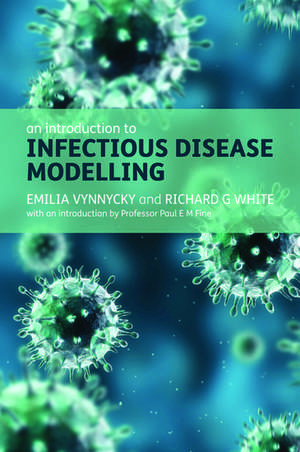
An Introduction to Infectious Disease Modelling
Autor Emilia Vynnycky, Richard Whiteen Limba Engleză Paperback – 13 mai 2010
Remarcăm contribuția autorilor Emilia Vynnycky și Richard White, profesori în cadrul prestigioasei London School of Hygiene and Tropical Medicine, care au condensat ani de experiență didactică în acest manual de referință. Structura volumului An Introduction to Infectious Disease Modelling este concepută pentru a demistifica complexitatea matematică, fiind orientată către epidemiologi, cercetători în sănătate publică și decidenți politici care au nevoie de instrumente predictive fără a deține neapărat un doctorat în matematică. Apreciem abordarea pragmatică a celor 400 de pagini, unde conceptele de bază despre transmisia infecțiilor sunt susținute vizual de 220 de diagrame și completate de resurse digitale interactive.
Suntem de părere că volumul excelează în explicarea modului în care modelele matematice pot evalua impactul strategiilor de vaccinare sau pot optimiza controlul epidemiilor de gripă pandemică și HIV. Față de alte lucrări teoretice, această ediție publicată de OUP Oxford pune accent pe aplicabilitatea imediată în politici de sănătate. În procesul de documentare, acest titlu completează excelent lucrarea Models for Infectious Human Diseases de Valerie Isham, adăugând o componentă practică și modele interactive care permit cititorului să experimenteze direct cu diferiți parametri de control. Dacă volumul lui Isham oferă o perspectivă stochastică și statistică vastă, An Introduction to Infectious Disease Modelling rafinează aceste concepte într-un format accesibil, ideal pentru implementarea rapidă în scenarii de criză epidemiologică.
Preț: 344.46 lei
Preț vechi: 490.03 lei
-30%
Carte tipărită la comandă
Livrare economică 05-16 iunie
Specificații
ISBN-10: 0198565763
Pagini: 400
Ilustrații: 220 black and white line drawings
Dimensiuni: 158 x 234 x 22 mm
Greutate: 0.59 kg
Ediția:New.
Editura: OUP OXFORD
Colecția OUP Oxford
Locul publicării:Oxford, United Kingdom
V-ar putea interesa
-
 Infectious Disease: A Very Short IntroductionMarta Wayne-25%Preț: 54.12 lei72.26 lei
 -
 -19%Preț: 246.14 lei305.56 lei
 -
 Infectious Disease EpidemiologyIbrahim Abubakar-27%Preț: 534.64 lei735.93 lei
 -
 Mathematical Biology: A Very Short IntroductionPhilip K. Maini-21%Preț: 53.36 lei67.73 lei
 -
 -26%Preț: 451.02 lei607.01 lei
 -
 Infection & ImmunityJohn Playfair-17%Preț: 427.32 lei513.81 lei
 -
 SpeedVaclav SmilPreț: 130.99 lei
 -
 Gordis EpidemiologyDavid D. Celentano-29%Preț: 295.06 lei417.44 lei
 -
 Treatise of Biological ModelsFarai Nyabadza-30%Preț: 995.96 lei1425.46 lei
 -
 Mathematical Modeling in Social Sciences & EngineeringJuan Carlos Cortes Lopez-30%Preț: 1124.33 lei1607.55 lei
 -
 Predicting & Controlling DiseaseMarcus Hutber-30%Preț: 815.66 lei1169.27 lei
 -
 Epidemiology for Field VeterinariansEvan Sergeant-5%Preț: 428.33 lei450.87 lei
 -
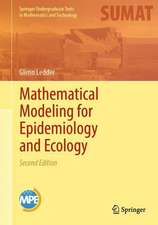 Mathematical Modeling for Epidemiology and EcologyGlenn LedderPreț: 345.17 lei
 -
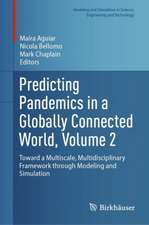 -18%Preț: 861.74 lei1050.89 lei
 -
 Surveillance, Prevention, and Control of Infectious DiseasesMuhammad E. H. Chowdhury-5%Preț: 1196.09 lei1259.04 lei
 -
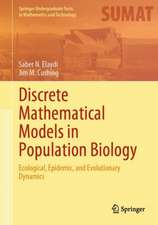 Discrete Mathematical Models in Population BiologySaber N. ElaydiPreț: 298.49 lei
 -
 -5%Preț: 753.98 lei793.66 lei
 -
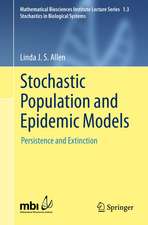 Stochastic Population and Epidemic ModelsLinda J. S. AllenPreț: 292.36 lei
 -
 Preț: 339.86 lei
De ce să citești această carte
Este resursa ideală pentru specialiștii din sănătate publică și epidemiologie care doresc să înțeleagă mecanica din spatele predicțiilor bolilor infecțioase fără a se pierde în formalism matematic extrem. Veți câștiga capacitatea de a interpreta și construi modele de bază pentru strategii de vaccinare, beneficiind de expertiza unor profesori de la London School of Hygiene and Tropical Medicine.
Despre autor
Emilia Vynnycky și Richard White sunt cercetători și cadre didactice de renume la London School of Hygiene and Tropical Medicine (LSHTM), o instituție globală de elită în domeniul sănătății publice. Specializați în epidemiologia bolilor infecțioase, aceștia au dezvoltat cursuri fundamentale de modelare matematică, adaptând rigurozitatea academică la nevoile practice ale cercetătorilor din teren și ale medicilor statisticieni.
Descriere
Recenzii
This is an excellent text book and readers can be assured that 'it does exactly what it says on the tin': provide a thorough introduction to infectious disease modelling. I will be turning to [it] for reference frequently for its clear explanations and topical worked examples.
This book has grown out of the experience of the authors teaching such a course for several years at the London School of Tropical Medicine and Hygiene. The Contents are very comprehensive, with chapters on basic terminology concerning infections and transmission, models based on difference equations, models based on differential equations, basic output from models, age patterns, stochastic modelling, contact patterns, models for sexually transmitted infections, some special topics (varicella vaccination and boosting, serotype replacement, tuberculosis control, HIV/STI co-infection) and an appendix on mathematical matters. The basic ideas are illustrated by many examples and case studies, among which several related to very up to date research and references. All relevant keywords and modern catchwords related to infectious disease modelling are mentioned and explained.