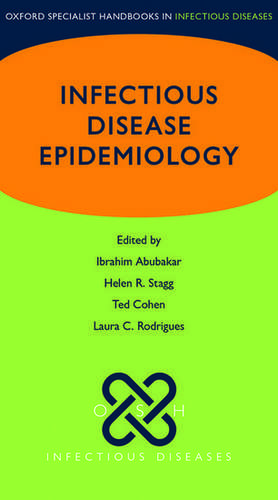
Infectious Disease Epidemiology
Editat de Ibrahim Abubakar, Helen R. Stagg, Ted Cohen, Laura C. Rodriguesen Limba Engleză Paperback – 7 apr 2016
Considerăm că abordarea metodologică propusă în Infectious Disease Epidemiology este exemplară pentru rigoarea clinică modernă, începând cu protocoalele de modelare matematică și sero-epidemiologie care fundamentează orice intervenție de sănătate publică. Structura manualului este construită progresiv: prima parte stabilește fundamentele teoretice, în timp ce a doua parte aplică aceste concepte pe grupuri de patologii clasificate strict după calea de transmitere, facilitând o identificare rapidă în practica de teren.
Ne-a atras atenția modul în care editorii, sub coordonarea lui Ibrahim Abubakar, integrează progresele recente din genomica și biologia moleculară în studiul răspândirii bolilor. Această perspectivă transformă epidemiologia dintr-o disciplină pur statistică într-una profund ancorată în realitatea biologică actuală. Pe linia clinică a lucrării Epidemiology and Disease Prevention de John Yarnell, acest manual păstrează rigoarea academică, dar pune un accent mult mai pronunțat pe complexitatea tehnică a modelării, similar cu abordările din An Introduction to Mathematical Modeling of Infectious Diseases.
În contextul operei editorului principal, această lucrare rafinează temele explorate în Handbook of Refugee Health, trecând de la cadrul administrativ și de suport al sistemelor de sănătate la mecanismele intime de transmitere și control al infecțiilor la nivel global. Textul nu se limitează la descrieri teoretice, ci oferă instrumentele necesare pentru gestionarea bolilor cu potențial letal ridicat, fiind o resursă esențială pentru cei care activează în protecția sănătății populaționale.
Preț: 534.64 lei
Preț vechi: 735.93 lei
-27%
Carte disponibilă
Livrare economică 15-26 mai
Specificații
ISBN-10: 0198719833
Pagini: 400
Dimensiuni: 101 x 180 x 13 mm
Greutate: 0.19 kg
Editura: OUP OXFORD
Colecția OUP Oxford
Locul publicării:Oxford, United Kingdom
V-ar putea interesa
-
 -19%Preț: 286.85 lei352.23 lei
 -
 EpidemiologyPetra Buettner-5%Preț: 574.21 lei604.44 lei
 -
 -19%Preț: 246.14 lei305.56 lei
 -
 -30%Preț: 319.34 lei453.57 lei
 -
 -30%Preț: 2055.18 lei2944.44 lei
 -
 Gordis EpidemiologyDavid D. Celentano-29%Preț: 295.06 lei417.44 lei
 -
 -29%Preț: 492.51 lei695.79 lei
 -
 Oh's Intensive Care ManualJonathan M. Handy-23%Preț: 742.08 lei963.74 leiRecomandat
 -
 Diagnostic Pathology: Infectious DiseasesIsaac H. Solomon-29%Preț: 1307.71 lei1851.54 lei
 -
 Kumar and Clark's Clinical MedicineDavid Randall-27%Preț: 456.34 lei627.74 leiRecomandat
 -
 Essential EpidemiologyPenny Webb-5%Preț: 441.25 lei464.47 lei
 -
 Practical Clinical Epidemiology for the VeterinarianAurora Villarroel-5%Preț: 440.04 lei463.19 lei
 -
 Nelson and Williams' Infectious Disease EpidemiologyCarolyn Masters Williams-51%Preț: 388.60 lei796.98 lei
 -
 -23%Preț: 1236.50 lei1614.36 lei
 -
 Epidemiology for Field VeterinariansEvan Sergeant-5%Preț: 428.33 lei450.87 lei
 -
 Clinical Epidemiology: The EssentialsGrant S. Fletcher MD, MPH-22%Preț: 303.59 lei388.53 lei
 -
 -5%Preț: 753.98 lei793.66 lei
 -
 Ear, Nose, and Throat DiseasesHans Behrbohm-5%Preț: 848.54 lei893.19 lei
 -
 Preț: 339.86 lei
 -
 Textbook of Clinical EpidemiologyChongjian Wang-5%Preț: 633.41 lei666.74 lei
De ce să citești această carte
Această resursă este esențială pentru epidemiologii aflați la început de drum și pentru specialiștii în sănătate publică. Cititorul câștigă o înțelegere clară a noilor tehnologii genomice aplicate în domeniu și a metodelor de modelare matematică. Este un instrument practic care simplifică navigarea prin patologii complexe prin organizarea lor în funcție de modul de transmitere, oferind soluții concrete pentru limitarea mortalității în focare.
Despre autor
Ibrahim Abubakar este un expert recunoscut în epidemiologia bolilor infecțioase și sănătate publică globală, ocupând poziții academice de prestigiu. Activitatea sa editorială reflectă o preocupare constantă pentru populațiile vulnerabile și dinamica transmiterii bolilor în contexte complexe. Printre lucrările sale de referință se numără Handbook of Refugee Health, unde analizează impactul migrației asupra sistemelor de sănătate. În volumul de față, publicat de OUP OXFORD, Abubakar aplică aceeași rigoare analitică pentru a sintetiza progresele moderne din biologia moleculară și statistică în serviciul epidemiologiei clinice.
Descriere
Recenzii
This reference text introduces major topics in epidemiology in a concise handbook. This book is a first edition from the Oxford Specialist Handbook Series and will be useful for both practitioners and students of epidemiology... Given the great breadth of topics covered in less than 400 pages, Infectious Diseases Epidemiology ambitiously serves as a valuable resource and reference.
Infectious Disease Epidemiology is a practical and concise guide which not only provides basic information and concepts used in epidemiology, but also the remarkable advances in this discipline as a result of progress in molecular biology, genomics, statistics and computing.