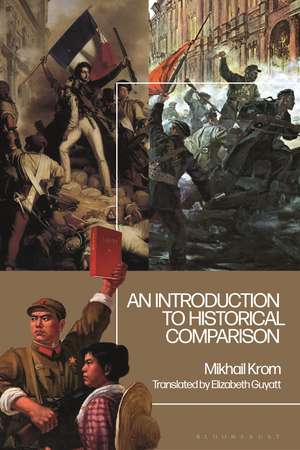
An Introduction to Historical Comparison
Autor Dr Mikhail Krom Traducere de Elizabeth Guyatten Limba Engleză Hardback – 14 ian 2021
Designed as a helpful resource for historians, An Introduction to Historical Comparison aims to teach scholars how to develop the skills needed to successfully employ a comparative methodology. It begins by tracing the intellectual history of comparative history writing and then examines the practice of historical comparison. The result is a clear and engaging analysis of historical thinking and a useful guide to main methodological techniques, successes, and pitfalls of comparative research.
An Introduction to Historical Comparison is the first comprehensive study of the theory and practice of comparative-historical research. Combining a wide range of case-studies from the best practitioners of historical comparison with an innovative interdisciplinary perspective, this book is thus a meaningful contribution to current debates on historiography. As such, this resource will be of immense value to both students reading historiography and methodology and to historians looking to apply a comparative approach to their own research.
Preț: 622.72 lei
Preț vechi: 724.10 lei
-14%
Puncte Express: 934
Carte tipărită la comandă
Livrare economică 03-17 decembrie
Livrare prin curier în România Termenul estimat este afișat lângă disponibilitate.
Transport gratuit pentru acest produs Plată online sau ramburs, în funcție de opțiunile comenzii.
Retur gratuit în 14 zile Comandă securizată și suport în română.
Specificații
ISBN-13: 9781350123328
ISBN-10: 1350123323
Pagini: 168
Dimensiuni: 156 x 234 x 18 mm
Greutate: 0.42 kg
Editura: Bloomsbury Publishing
Colecția Bloomsbury Academic
Locul publicării:London, United Kingdom
ISBN-10: 1350123323
Pagini: 168
Dimensiuni: 156 x 234 x 18 mm
Greutate: 0.42 kg
Editura: Bloomsbury Publishing
Colecția Bloomsbury Academic
Locul publicării:London, United Kingdom
Cuprins
Introduction: The Paradoxes of Historical Comparison
Part I: Historical Comparison from Herodotus to the Present
1. Historical Comparison: From Classical Antiquity to the Enlightenment
2. Historicism and Comparative Method in the 19th and early-20th Centuries
3. The Lessons of Max Weber and Marc Bloch
4. The Rise of Comparative Studies in History in the Second Half of the Twentieth Century
5. New Challenges: Cultural Transfers, Histoire Croisee, Transnational History, and Criticism of Traditional Comparative History
6. Comparative-Historical Sociology
Part II: Historical Comparison in the Search of Method
7. Does Method Exist?
8. The Functions of Comparison and its Specifics in Historical Research
9. The Choice of Objects for Comparison: Types of Historical Comparison
10. Recommendations for Newcomers to Historical Comparison
Part III: The Themes of Comparative Historical Research
11. Comparison in Economic History
12. Comparison in Political History
13. Comparison in Social History
14. Comparative Studies in the History of Nationalism, Empires, and Colonialism
Conclusion
Select Bibliography
Index
Part I: Historical Comparison from Herodotus to the Present
1. Historical Comparison: From Classical Antiquity to the Enlightenment
2. Historicism and Comparative Method in the 19th and early-20th Centuries
3. The Lessons of Max Weber and Marc Bloch
4. The Rise of Comparative Studies in History in the Second Half of the Twentieth Century
5. New Challenges: Cultural Transfers, Histoire Croisee, Transnational History, and Criticism of Traditional Comparative History
6. Comparative-Historical Sociology
Part II: Historical Comparison in the Search of Method
7. Does Method Exist?
8. The Functions of Comparison and its Specifics in Historical Research
9. The Choice of Objects for Comparison: Types of Historical Comparison
10. Recommendations for Newcomers to Historical Comparison
Part III: The Themes of Comparative Historical Research
11. Comparison in Economic History
12. Comparison in Political History
13. Comparison in Social History
14. Comparative Studies in the History of Nationalism, Empires, and Colonialism
Conclusion
Select Bibliography
Index
Recenzii
Mikhail Krom has been a pioneering thinker in historical methodology for decades in Russia, and in this book he blazes new trails in the method of historical comparison. Krom both defines the method and shows its power to analyze and explain key problems in society, economics, and politics. This book should get historians thinking about their craft in new and fruitful ways.
Mikhail Krom's crisp, accessible book introduces readers to the competing definitions, approaches, and intellectual benefits and pitfalls of historical comparison. The book's coverage is impressive. It is historically deep, but at the same time, fresh and up-to-date. It has much to teach anyone interested in historical methodologies.
Mikhail Krom's crisp, accessible book introduces readers to the competing definitions, approaches, and intellectual benefits and pitfalls of historical comparison. The book's coverage is impressive. It is historically deep, but at the same time, fresh and up-to-date. It has much to teach anyone interested in historical methodologies.