
An Introduction to Gauge Theories
Autor Nicola Cabibbo, Luciano Maiani, Omar Benharen Limba Engleză Hardback – dec 2025
Key Features:
- Contains renormalisation of QED with examples worked out in full detail alongside original derivations of Ward identities
- Discusses applications including the calculation of the β functions of QED and QCD and the electro-weak muon anomaly
- Explores fundamental constants at very high energy to introduce to theories of grand unification, the unnaturalness of scalar fields and the motivations for new physics beyond the Standard Theory
Preț: 626.06 lei
Preț vechi: 736.54 lei
-15%
Puncte Express: 939
Carte tipărită la comandă
Livrare economică 19 noiembrie-03 decembrie
Livrare prin curier în România Termenul estimat este afișat lângă disponibilitate.
Transport gratuit pentru acest produs Plată online sau ramburs, în funcție de opțiunile comenzii.
Retur gratuit în 14 zile Comandă securizată și suport în română.
Specificații
ISBN-13: 9781032883229
ISBN-10: 1032883227
Pagini: 290
Ilustrații: 120
Dimensiuni: 178 x 254 x 20 mm
Greutate: 0.75 kg
Ediția:2. Auflage
Editura: CRC Press
Colecția CRC Press
ISBN-10: 1032883227
Pagini: 290
Ilustrații: 120
Dimensiuni: 178 x 254 x 20 mm
Greutate: 0.75 kg
Ediția:2. Auflage
Editura: CRC Press
Colecția CRC Press
V-ar putea interesa
-
 A Short Introduction to Quantum Information and Quantum ComputationMichel Le Bellac-19%Preț: 640.34 lei790.54 lei
 -
 -18%Preț: 1791.87 lei2185.21 lei
 -
 -18%Preț: 920.97 lei1123.13 lei
 -
 Causal Space-TimeRichard D. BatesonPreț: 41.26 lei
 -
 -15%Preț: 562.74 lei662.04 lei
 -
 The Buddha and the QuantumSamuel AveryPreț: 98.47 lei
 -
 Quantum Mechanical Initial Conditions & Gravity (Copenhagen's Illusions)Pavel Simeonev Kamenov-27%Preț: 1352.92 lei1845.25 lei
 -
 Quantum MechanicsJonathan P Groffe-26%Preț: 1640.64 lei2232.14 lei
 -
 Preț: 303.96 lei
 -
 The UniverseJacques VanierPreț: 426.51 lei
 -
 QUANT ADVENTURE, THEMontwill AlexPreț: 255.99 lei
 -
 QUANTUM MECHANICS (2ND EDITION)Steward Edward G-15%Preț: 650.65 lei765.47 lei
 -
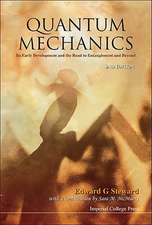 QUANTUM MECHANICS (2ND EDITION)Steward Edward GPreț: 486.15 lei
 -
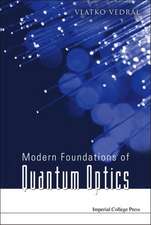 MODERN FOUNDATIONS OF QUANTUM OPTICSVedral Vlatko-15%Preț: 671.58 lei790.10 lei
 -
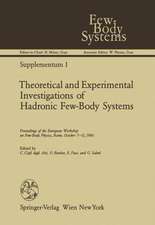 Theoretical and Experimental Investigations of Hadronic Few-Body SystemsClaudio Ciofi Degli AttiPreț: 418.29 lei
 -
 Preț: 229.58 lei
 -
 -15%Preț: 515.42 lei606.37 lei
 -
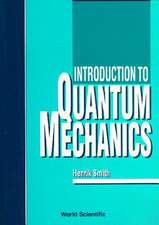 -23%Preț: 741.68 lei963.22 lei
 -
 HEISENBERG'S QUANTUM MECHANICSRazavy MohsenPreț: 487.32 lei
Public țintă
Postgraduate, Professional Reference, and Undergraduate AdvancedCuprins
Chapter 1: Introduction. Chapter 2: The Feynman Path Integral. Chapter 3: Towards a Field Theory. Chapter 4: Equations of Motion, Symmetries and Ward's Identity. Chapter 5: The Electromagnetic Field. Chapter 6: Fermion Fields. Chapter 7: Scattering Processes and the S-Matrix. Chapter 8: Perturbative Green's Functions in λϕ4. Chapter 9: S-Matrix Feynman Diagrams in λϕ4. Chapter 10: Quantum Electrodynamics. Chapter 11: Renormalisation of QED. Chapter 12: Applications of QED. Chapter 13: Renormalisation Group of QED. Chapter 14: Quantising a Non-Abelian Theory. Chapter 15: Unitarity and Ghosts. Chapter 16: The β Function in QCD. Chapter 17: Lattice QCD. Chapter 18: The ΔI = 1/2 Rule in Strange Particles Non-Leptonic Decays. Chapter 19: The Weak Muon Anomaly. Chapter 20: Effective Constants at High Energy and Ideas about Grand Unifications. Chapter 21: Limits on the Mass of the Higgs Boson. Chapter 22: Effective Potential and Naturalness. Appendix A: Transition Amplitude Calculation. Appendix B: Connected Diagrams. Appendix C: Lorentz Invariance and One-Particle States. Appendix D: Reduction Formulae. Appendix E: Integrals. Appendix F: Chiral Symmetry with Wilson Fermions: Basic Formulae. Appendix G: β(λ) and β(gt) Functions. Bibliography. Index.
Notă biografică
Luciano Maiani is emeritus professor of theoretical physics at the University of Rome, “La Sapienza”, and author of more than two hundred scientific publications on the theoretical physics of elementary particles. Together with S. Glashow and J. Iliopoulos, Maiani made the prediction of a new family of particles, those with “charm”, which form an essential part of the unified theory of the weak and electromagnetic forces. He has been president of the Italian Institute for Nuclear Physics (INFN), director-general of CERN in Geneva and president of the Italian National Council for Research (CNR). He has promoted the development of the Virgo Observatory for gravitational wave detection, the neutrino beam from CERN to Gran Sasso and at CERN has directed the crucial phases of the construction of the Large Hadron Collider (LHC). He has taught and worked in numerous foreign institutes. He was head of the theoretical physics department at the University of Rome, “La Sapienza”, from 1976 to 1984 and held the chair of theoretical physics from 1984 to 2011. He is a member of the Italian Lincean Academy and a fellow of the American Physical Society. For his scientific work, he has been awarded the J. J. Sakurai Prize, the Enrico Fermi Prize, the Dirac Medal, the High Energy and Particle Physics Prize of EPS and the Bruno Pontecorvo Prize.
Omar Benhar is an INFN research director and teaches gauge theories at the University of Rome, “La Sapienza”. He has worked extensively in the United States as a visiting professor at the University of Illinois and Old Dominion University, and was an associate scientist at the Thomas Jefferson National Accelerator Facility. Since 2013, he has served as an adjunct professor at the Centre for Neutrino Physics of Virginia Polytechnic Institute and State University. He is the author of more than one hundred scientific papers on the theory of many-particle systems, the structure of compact stars and electroweak interactions of nuclei.
Nicola Cabibbo (1935–2010) was professor of Theoretical Physics and Elementary Particle Physics at the Rome Universities La Sapienza and Tor Vergata, and held research and teaching positions in prestigious institutions such as Harvard University, the Institute for Advanced Studies, Princeton, CERN, Geneva, University of California at Berkeley and Universite Paris VI. In 1962, Cabibbo discovered the phenomenon of quark mixing, described by a new natural constant, the Cabibbo angle, measured with great accuracy in semileptonic weak decays of hadrons. According to a recent analysis, Cabibbo’s paper on quark mixing was the most influential article published in the journals of the American Physical Society during 1893–2003. In the 1980s, Cabibbo provided important momentum to the applications of numerical techniques to theoretical physics, notably the gauge theories of strong interactions, promoting and leading the development of the family of APE (Array Processor Experiment) supercomputers. He served as a member of a number of learned societies: Accademia Nazionale dei Lincei and Accademia delle Scienze di Torino, in Italy, National Academy of Science and American Association for Art and Sciences, in the United States, and Accademia Pontificia delle Scienze, which he chaired from 1993. An internationally reputed science manager, Cabibbo was president of Istituto Nazionale di Fisica Nucleare (INFN) and of Ente Nazionale per le Nuove Tecnologie per Energia e Ambiente (ENEA). He was the recipient of the J.J. Sakurai Prize (APS), the Medaglia Matteucci (Accademia Nazionale dei XL), the Dirac Medal (ICTP Trieste), and the Benjamin Franklin Medal.
Omar Benhar is an INFN research director and teaches gauge theories at the University of Rome, “La Sapienza”. He has worked extensively in the United States as a visiting professor at the University of Illinois and Old Dominion University, and was an associate scientist at the Thomas Jefferson National Accelerator Facility. Since 2013, he has served as an adjunct professor at the Centre for Neutrino Physics of Virginia Polytechnic Institute and State University. He is the author of more than one hundred scientific papers on the theory of many-particle systems, the structure of compact stars and electroweak interactions of nuclei.
Nicola Cabibbo (1935–2010) was professor of Theoretical Physics and Elementary Particle Physics at the Rome Universities La Sapienza and Tor Vergata, and held research and teaching positions in prestigious institutions such as Harvard University, the Institute for Advanced Studies, Princeton, CERN, Geneva, University of California at Berkeley and Universite Paris VI. In 1962, Cabibbo discovered the phenomenon of quark mixing, described by a new natural constant, the Cabibbo angle, measured with great accuracy in semileptonic weak decays of hadrons. According to a recent analysis, Cabibbo’s paper on quark mixing was the most influential article published in the journals of the American Physical Society during 1893–2003. In the 1980s, Cabibbo provided important momentum to the applications of numerical techniques to theoretical physics, notably the gauge theories of strong interactions, promoting and leading the development of the family of APE (Array Processor Experiment) supercomputers. He served as a member of a number of learned societies: Accademia Nazionale dei Lincei and Accademia delle Scienze di Torino, in Italy, National Academy of Science and American Association for Art and Sciences, in the United States, and Accademia Pontificia delle Scienze, which he chaired from 1993. An internationally reputed science manager, Cabibbo was president of Istituto Nazionale di Fisica Nucleare (INFN) and of Ente Nazionale per le Nuove Tecnologie per Energia e Ambiente (ENEA). He was the recipient of the J.J. Sakurai Prize (APS), the Medaglia Matteucci (Accademia Nazionale dei XL), the Dirac Medal (ICTP Trieste), and the Benjamin Franklin Medal.
Descriere
Written by world-leading experts in particle physics, this new book from Luciano Maiani and Omar Benhar, with contributions from the late Nicola Cabibbo, is based on Feynman’s path integral formulation of quantum field theory.
Recenzii
"This book on gauge theories completes a trilogy on the foundations of the Standard Theory of the fundamental interactions, but is fully self-contained. It combines the depth and conceptual accuracy expected from key contributors to the field with an effective pedagogical approach, tested over several decades of courses. The mathematical formalism is never overwhelming, and the reader is guided through the concepts and techniques of quantum gauge theories along a path always driven by physics, including recent developments on the Higgs boson. This book is a great legacy of the `Rome School’ for students, teachers and researchers in particle physics, not only theorists but also curious experimentalists."
—Fabio Zwirner, University of Padua
"Introduction to Gauge Theories is authored by leading contributors to the Standard Model of Particle Physic (SM): Nicola Cabibbo (the proponent of quark mixing angles, whose extension led to the Cabibbo-Kobayashi-Maskawa matrix); Luciano Maiani (one of the fathers of the so-called GIM mechanism which led to the prediction of the quark charm); and Omar Benhar (a well-known expert in many-body physics) and it constitutes a most welcome addition to the literature. A must-have in any physics library, this book is highly original, centring on deep problems of quantum field theory, and consistently well-motivated by experimental phenomena. The symmetries of nature are the guiding principle, illuminating the presentation of the concept of renormalisation and its applications in gauge theories, from a thorough and pedagogical analysis of Quantum Electrodynamics, to the exploration of Quantum Chromodynamics and the SM, including the role of the Higgs field, and beyond.
Everybody can find some food for thought here: from the graduate student to the most hardened researcher. This book is full of physical insights and is highly recommended."
—Belén Gavela, Professor of Theoretical Physics at
—Fabio Zwirner, University of Padua
"Introduction to Gauge Theories is authored by leading contributors to the Standard Model of Particle Physic (SM): Nicola Cabibbo (the proponent of quark mixing angles, whose extension led to the Cabibbo-Kobayashi-Maskawa matrix); Luciano Maiani (one of the fathers of the so-called GIM mechanism which led to the prediction of the quark charm); and Omar Benhar (a well-known expert in many-body physics) and it constitutes a most welcome addition to the literature. A must-have in any physics library, this book is highly original, centring on deep problems of quantum field theory, and consistently well-motivated by experimental phenomena. The symmetries of nature are the guiding principle, illuminating the presentation of the concept of renormalisation and its applications in gauge theories, from a thorough and pedagogical analysis of Quantum Electrodynamics, to the exploration of Quantum Chromodynamics and the SM, including the role of the Higgs field, and beyond.
Everybody can find some food for thought here: from the graduate student to the most hardened researcher. This book is full of physical insights and is highly recommended."
—Belén Gavela, Professor of Theoretical Physics at