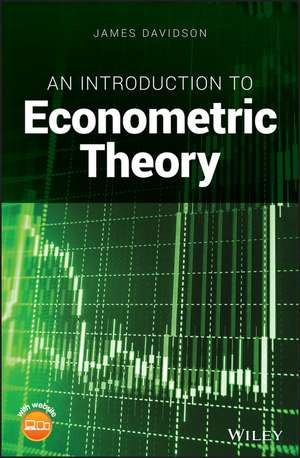
An Introduction to Econometric Theory
Autor James Davidsonen Limba Engleză Hardback – 5 oct 2018
Preț: 528.47 lei
Preț vechi: 593.78 lei
-11%
Puncte Express: 793
Carte tipărită la comandă
Livrare economică 23 noiembrie-07 decembrie
Livrare prin curier în România Termenul estimat este afișat lângă disponibilitate.
Transport gratuit pentru acest produs Plată online sau ramburs, în funcție de opțiunile comenzii.
Retur gratuit în 14 zile Comandă securizată și suport în română.
Specificații
ISBN-13: 9781119484882
ISBN-10: 111948488X
Pagini: 256
Dimensiuni: 172 x 251 x 20 mm
Greutate: 0.53 kg
Editura: Wiley
Locul publicării:Chichester, United Kingdom
ISBN-10: 111948488X
Pagini: 256
Dimensiuni: 172 x 251 x 20 mm
Greutate: 0.53 kg
Editura: Wiley
Locul publicării:Chichester, United Kingdom
V-ar putea interesa
-
 Courtesans and FishcakesJames DavidsonPreț: 98.75 lei
 -
 Fundamentals of Applied Econometrics WSER A Ashley-27%Preț: 1541.48 lei2111.61 lei
 -
 Econometric TheoryJames Davidson-23%Preț: 503.36 lei653.71 lei
 -
 New Jersey's Lindbergh Kidnapping and TrialJames DavidsonPreț: 132.32 lei
 -
 Preț: 127.04 lei
 -
 Unionizing the Armed ForcesEzra S Krendel-11%Preț: 470.37 lei528.50 lei
 -
 Navigating Life with More Than EnoughTodd DekruyterPreț: 145.73 lei
 -
 Brazil Is the New AmericaJames Dale DavidsonPreț: 172.41 lei
 -
 Essential Mathematics for Economics and Business 4eTeresa Bradley-19%Preț: 464.56 lei573.53 lei
 -
 Making Places for People: 12 Questions Every Designer Should AskChristie Johnson CoffinPreț: 321.50 lei
 -
 Around Egg Harbor City and PleasantvilleDennis M NicelerPreț: 132.80 lei
 -
 Ten Thousand Out of WorkEwan Clague-11%Preț: 643.26 lei722.77 lei
 -
 The United States of America, Volume 2Arthur P Dudden-11%Preț: 635.96 lei714.56 lei
 -
 Future Trading Upon Organized Commodity Markets in the United StatesG Wright Hoffman-11%Preț: 570.67 lei641.20 lei
 -
 Volkswirtschaft: 360 Grundbegriffe kurz erklärtHans GeldernPreț: 140.37 lei
 -
 Wirtschaftspolitik: 360 Grundbegriffe kurz erklärtHans GeldernPreț: 140.69 lei
Public țintă
Aimed at undergraduates of economics, statistics or finance, but would also find a market in MSc and PhD preliminary courses.Notă biografică
JAMES DAVIDSON is Professor of Econometrics at the University of Exeter. He has also held teaching posts at the University of Warwick, the London School of Economics, the University of Wales Aberystwyth and Cardiff University, as well as visiting positions at the University of California, Berkeley, the University of California, San Diego, and Central European University, Budapest.
Cuprins
List of Figures ix
Preface xi
About the CompanionWebsite xv
Part I Fitting 1
1 Elementary Data Analysis 3
1.1 Variables and Observations 3
1.2 Summary Statistics 4
1.3 Correlation 6
1.4 Regression 10
1.5 Computing the Regression Line 12
1.6 Multiple Regression 16
1.7 Exercises 18
2 Matrix Representation 21
2.1 Systems of Equations 21
2.2 Matrix Algebra Basics 23
2.3 Rules of Matrix Algebra 26
2.4 Partitioned Matrices 27
2.5 Exercises 28
3 Solving the Matrix Equation 31
3.1 Matrix Inversion 31
3.2 Determinant and Adjoint 34
3.3 Transposes and Products 37
3.4 Cramer's Rule 38
3.5 Partitioning and Inversion 39
3.6 A Note on Computation 41
3.7 Exercises 43
4 The Least Squares Solution 47
4.1 Linear Dependence and Rank 47
4.2 The General Linear Regression 50
4.3 Definite Matrices 52
4.4 Matrix Calculus 56
4.5 Goodness of Fit 57
4.6 Exercises 59
Part II Modelling 63
5 Probability Distributions 65
5.1 A Random Experiment 65
5.2 Properties of the Normal Distribution 68
5.3 Expected Values 72
5.4 Discrete Random Variables 75
5.5 Exercises 80
6 More on Distributions 83
6.1 Random Vectors 83
6.2 The Multivariate Normal Distribution 84
6.3 Other Continuous Distributions 87
6.4 Moments 90
6.5 Conditional Distributions 92
6.6 Exercises 94
7 The Classical RegressionModel 97
7.1 The Classical Assumptions 97
7.2 The Model 99
7.3 Properties of Least Squares 101
7.4 The Projection Matrices 103
7.5 The Trace 104
7.6 Exercises 106
8 The Gauss-Markov Theorem 109
8.1 A Simple Example 109
8.2 Efficiency in the General Model 111
8.3 Failure of the Assumptions 113
8.4 Generalized Least Squares 114
8.5 Weighted Least Squares 116
8.6 Exercises 118
Part III Testing 121
9 Eigenvalues and Eigenvectors 123
9.1 The Characteristic Equation 123
9.2 Complex Roots 124
9.3 Eigenvectors 126
9.4 Diagonalization 128
9.5 Other Properties 130
9.6 An Interesting Result 131
9.7 Exercises 133
10 The Gaussian RegressionModel 135
10.1 Testing Hypotheses 135
10.2 Idempotent Quadratic Forms 137
10.3 Confidence Regions 140
10.4 t Statistics 141
10.5 Tests of Linear Restrictions 144
10.6 Constrained Least Squares 146
10.7 Exercises 149
11 Partitioning and Specification 153
11.1 The Partitioned Regression 153
11.2 Frisch-Waugh-Lovell Theorem 155
11.3 Misspecification Analysis 156
11.4 Specification Testing 159
11.5 Stability Analysis 160
11.6 Prediction Tests 162
11.7 Exercises 163
Part IV Extensions 167
12 Random Regressors 169
12.1 Conditional Probability 169
12.2 Conditional Expectations 170
12.3 StatisticalModels Contrasted 174
12.4 The Statistical Assumptions 176
12.5 Properties of OLS 178
12.6 The Gaussian Model 182
12.7 Exercises 183
13 Introduction to Asymptotics 187
13.1 The Lawof Large Numbers 187
13.2 Consistent Estimation 192
13.3 The Central LimitTheorem 195
13.4 Asymptotic Normality 198
13.5 Multiple Regression 201
13.6 Exercises 203
14 Asymptotic Estimation Theory 207
14.1 Large Sample Efficiency 207
14.2 Instrumental Variables 208
14.3 Maximum Likelihood 210
14.4 Gaussian ML 213
14.5 Properties of ML Estimators 214
14.6 Likelihood Inference 216
14.7 Exercises 218
Part V Appendices 221
A The Binomial Coefficients 223
B The Exponential Function 225
C Essential Calculus 227
D The Generalized Inverse 229
Recommended Reading 233
Index 235
Preface xi
About the CompanionWebsite xv
Part I Fitting 1
1 Elementary Data Analysis 3
1.1 Variables and Observations 3
1.2 Summary Statistics 4
1.3 Correlation 6
1.4 Regression 10
1.5 Computing the Regression Line 12
1.6 Multiple Regression 16
1.7 Exercises 18
2 Matrix Representation 21
2.1 Systems of Equations 21
2.2 Matrix Algebra Basics 23
2.3 Rules of Matrix Algebra 26
2.4 Partitioned Matrices 27
2.5 Exercises 28
3 Solving the Matrix Equation 31
3.1 Matrix Inversion 31
3.2 Determinant and Adjoint 34
3.3 Transposes and Products 37
3.4 Cramer's Rule 38
3.5 Partitioning and Inversion 39
3.6 A Note on Computation 41
3.7 Exercises 43
4 The Least Squares Solution 47
4.1 Linear Dependence and Rank 47
4.2 The General Linear Regression 50
4.3 Definite Matrices 52
4.4 Matrix Calculus 56
4.5 Goodness of Fit 57
4.6 Exercises 59
Part II Modelling 63
5 Probability Distributions 65
5.1 A Random Experiment 65
5.2 Properties of the Normal Distribution 68
5.3 Expected Values 72
5.4 Discrete Random Variables 75
5.5 Exercises 80
6 More on Distributions 83
6.1 Random Vectors 83
6.2 The Multivariate Normal Distribution 84
6.3 Other Continuous Distributions 87
6.4 Moments 90
6.5 Conditional Distributions 92
6.6 Exercises 94
7 The Classical RegressionModel 97
7.1 The Classical Assumptions 97
7.2 The Model 99
7.3 Properties of Least Squares 101
7.4 The Projection Matrices 103
7.5 The Trace 104
7.6 Exercises 106
8 The Gauss-Markov Theorem 109
8.1 A Simple Example 109
8.2 Efficiency in the General Model 111
8.3 Failure of the Assumptions 113
8.4 Generalized Least Squares 114
8.5 Weighted Least Squares 116
8.6 Exercises 118
Part III Testing 121
9 Eigenvalues and Eigenvectors 123
9.1 The Characteristic Equation 123
9.2 Complex Roots 124
9.3 Eigenvectors 126
9.4 Diagonalization 128
9.5 Other Properties 130
9.6 An Interesting Result 131
9.7 Exercises 133
10 The Gaussian RegressionModel 135
10.1 Testing Hypotheses 135
10.2 Idempotent Quadratic Forms 137
10.3 Confidence Regions 140
10.4 t Statistics 141
10.5 Tests of Linear Restrictions 144
10.6 Constrained Least Squares 146
10.7 Exercises 149
11 Partitioning and Specification 153
11.1 The Partitioned Regression 153
11.2 Frisch-Waugh-Lovell Theorem 155
11.3 Misspecification Analysis 156
11.4 Specification Testing 159
11.5 Stability Analysis 160
11.6 Prediction Tests 162
11.7 Exercises 163
Part IV Extensions 167
12 Random Regressors 169
12.1 Conditional Probability 169
12.2 Conditional Expectations 170
12.3 StatisticalModels Contrasted 174
12.4 The Statistical Assumptions 176
12.5 Properties of OLS 178
12.6 The Gaussian Model 182
12.7 Exercises 183
13 Introduction to Asymptotics 187
13.1 The Lawof Large Numbers 187
13.2 Consistent Estimation 192
13.3 The Central LimitTheorem 195
13.4 Asymptotic Normality 198
13.5 Multiple Regression 201
13.6 Exercises 203
14 Asymptotic Estimation Theory 207
14.1 Large Sample Efficiency 207
14.2 Instrumental Variables 208
14.3 Maximum Likelihood 210
14.4 Gaussian ML 213
14.5 Properties of ML Estimators 214
14.6 Likelihood Inference 216
14.7 Exercises 218
Part V Appendices 221
A The Binomial Coefficients 223
B The Exponential Function 225
C Essential Calculus 227
D The Generalized Inverse 229
Recommended Reading 233
Index 235