An Apple A Day
Autor Joe Schwarczen Limba Engleză Paperback – 15 dec 2008
Vezi toate premiile Carte premiată
IndieFab awards (2009)
Forget your dinner jacket and put on your lab coat: you have to be a nutritional scientist these days before you sit down to eat—which is why we need Dr. Joe Schwarcz, the expert who’s famous for connecting chemistry to everyday life. In An Apple a Day, he’s taken his thorough knowledge of food chemistry, applied it to today’s top food fears, trends and questions, and leavened it with his trademark lighthearted approach. The result is both an entertaining revelation of the miracles of science happening in our bodies every time we bite into a morsel of food, and a telling exploration of the myths, claims and misconceptions surrounding our obsession with diets, nutrition and weight.
Looking first at how food affects our health, Dr. Joe examines what’s in tomatoes, soy and broccoli that can keep us healthy and how the hundreds of compounds in a single food react when they hit our bodies. Then he investigates how we manipulate our food supply, delving into the science of food additives and what benefits we might realize from adding bacteria to certain foods. He clears up the confusion about contaminants, examining everything from pesticide residues, remnants of antibiotics, the dreaded trans fats and chemicals that may leach from cookware. And he takes a studied look at the science of calories and weighs in on popular diets.
An Apple a Day is a must-read book for anyone who looks forward to digesting the truth about what we eat.
Preț: 96.06 lei
Puncte Express: 144
Carte disponibilă
Livrare economică 09-23 noiembrie
Livrare prin curier în România Termenul estimat este afișat lângă disponibilitate.
Transport gratuit de la 400.00 lei Plată online sau ramburs, în funcție de opțiunile comenzii.
Retur gratuit în 14 zile Comandă securizată și suport în română.
Specificații
ISBN-13: 9781554683994
ISBN-10: 1554683998
Pagini: 384
Dimensiuni: 135 x 203 mm
Greutate: 0.36 kg
Editura: Harper Collins Publishers
Colecția HarperCollins Publishers
ISBN-10: 1554683998
Pagini: 384
Dimensiuni: 135 x 203 mm
Greutate: 0.36 kg
Editura: Harper Collins Publishers
Colecția HarperCollins Publishers
Notă biografică
Joe Schwarcz
Joe Schwarcz is director of McGill University's Office for Science and Society in Montreal. He teaches courses on nutrition and the applications of chemistry to everyday life. His informative and entertaining public lectures range from nutritional controversies to the chemistry of love. Schwarcz has received numerous awards, including the Royal Society of Canada's McNeil Award, and is the only non-American to win the American Chemical Society's prestigious Grady-Stack Award. He is the author of six books, including Let Them Eat Flax. He was also the chief consultant for the blockbuster titles Foods That Harm, Foods That Heal and The Healing Power of Vitamins, Minerals and Herbs. A regular guest on Canadian television, and the host of weekly radio shows in Toronto and Montreal, Schwarcz also writes a weekly column for The Gazette in Montreal, where he lives. Visit him at www.joeschwarcz.ca.
Joe Schwarcz is director of McGill University's Office for Science and Society in Montreal. He teaches courses on nutrition and the applications of chemistry to everyday life. His informative and entertaining public lectures range from nutritional controversies to the chemistry of love. Schwarcz has received numerous awards, including the Royal Society of Canada's McNeil Award, and is the only non-American to win the American Chemical Society's prestigious Grady-Stack Award. He is the author of six books, including Let Them Eat Flax. He was also the chief consultant for the blockbuster titles Foods That Harm, Foods That Heal and The Healing Power of Vitamins, Minerals and Herbs. A regular guest on Canadian television, and the host of weekly radio shows in Toronto and Montreal, Schwarcz also writes a weekly column for The Gazette in Montreal, where he lives. Visit him at www.joeschwarcz.ca.
Extras
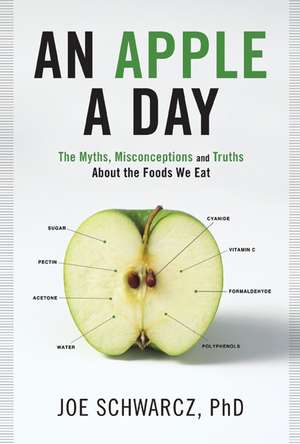
Is there a better subject with which to begin a discussion of the relationship between food and health than apples? After all, doesn’t “an apple a day keep the doctor away”? Maybe it does, if you throw it at her! There are no single foods that have magical health properties. There are good diets and there are bad diets. It is certainly possible to have a good diet and never eat apples, just as it is possible to gorge on apples and have a horrible diet. What really matters in terms of nutrition is the net effect produced by all of the chemicals that wend their way into our bodies from the food we eat. Yes, chemicals. I can practically see those eyebrows being raised. It may seem unusual to see the word “chemical” without an adjective like “poisonous,” in front of it. Actually, without appropriate context, “toxic chemical” is a meaningless term. . . . Everything in the world is made of chemicals, and if you restricted yourself to a diet free of chemicals, you would be dining in a vacuum! With that in mind, let’s investigate the chemicals in an apple. So tell me, would you like some nail polish remover in your diet? Or rubbing alcohol? Then have an apple! Yes, all apples contain acetone and isopropanol. And if these don’t sound toxic enough, you can throw in some cyanide. It’s there too. Added by nature, not by humans! Should you then be worried about eating apples? Of course not! The amounts of these chemicals are too small to be of any consequence. Apples, as already mentioned, contain over 300 naturally occurring compounds, and whatever effect the fruit has on our health is a reflection of all of these.
Recenzii
Publishers Weekly
“Readers will not need a PhD in chemistry to follow along; Schwarcz wisely limits technical terms to the minimum while adequately explaining the chemistry involved in digestion.”
Library Journal
Rachel M. Minkin
“… an entertaining guide through the tangle of conflicting research studies, advertising claims, special interest groups, age-old myths and popular opinion that make diet a cloudy subject. … leaves readers with a rational framework for evaluating the complex nature of foods and how they affect health.”
ForeWord Magazine
"An Apple a Day hashes out hype and irrational panic one chemical compound and one foodstuff at a time. Between ubiquitous cover-ups and endemic hysteria about what’s in our food and our bloodstreams, there’s nothing more helpful than a clear-speaking and apparently non-aligned food chemist who is willing to identify the real risks and defuse the rampant bad information out there. Addressing allegations that companies like Monsanto and Novartis intentionally poison consumers, Schwarcz urges skepticism, because “no company wants to undermine its existence or its profits by marketing a dangerous substance.” Discounting unfounded rumors, Schwarcz identifies a handful of foodstuffs and practices that should cause real concern. The most serious are the rampant use of antibiotics in livestock and indications that trans fats may do serious harm to people’s memories."
“Readers will not need a PhD in chemistry to follow along; Schwarcz wisely limits technical terms to the minimum while adequately explaining the chemistry involved in digestion.”
Library Journal
Rachel M. Minkin
“… an entertaining guide through the tangle of conflicting research studies, advertising claims, special interest groups, age-old myths and popular opinion that make diet a cloudy subject. … leaves readers with a rational framework for evaluating the complex nature of foods and how they affect health.”
ForeWord Magazine
"An Apple a Day hashes out hype and irrational panic one chemical compound and one foodstuff at a time. Between ubiquitous cover-ups and endemic hysteria about what’s in our food and our bloodstreams, there’s nothing more helpful than a clear-speaking and apparently non-aligned food chemist who is willing to identify the real risks and defuse the rampant bad information out there. Addressing allegations that companies like Monsanto and Novartis intentionally poison consumers, Schwarcz urges skepticism, because “no company wants to undermine its existence or its profits by marketing a dangerous substance.” Discounting unfounded rumors, Schwarcz identifies a handful of foodstuffs and practices that should cause real concern. The most serious are the rampant use of antibiotics in livestock and indications that trans fats may do serious harm to people’s memories."
Premii
- IndieFab awards Silver Medal Winner, 2009