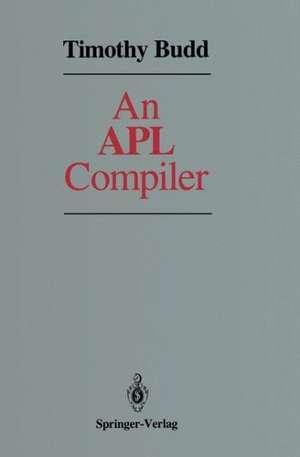
An APL Compiler
Autor Timothy Budden Limba Engleză Paperback – 8 dec 1987
Preț: 614.65 lei
Preț vechi: 768.31 lei
-20%
Puncte Express: 922
Carte tipărită la comandă
Livrare economică 30 noiembrie-14 decembrie
Livrare prin curier în România Termenul estimat este afișat lângă disponibilitate.
Transport gratuit pentru acest produs Plată online sau ramburs, în funcție de opțiunile comenzii.
Retur gratuit în 14 zile Comandă securizată și suport în română.
Specificații
ISBN-13: 9780387966434
ISBN-10: 0387966439
Pagini: 156
Ilustrații: XI, 156 p.
Dimensiuni: 155 x 235 x 9 mm
Greutate: 0.25 kg
Editura: Springer
Colecția Springer
Locul publicării:New York, NY, United States
ISBN-10: 0387966439
Pagini: 156
Ilustrații: XI, 156 p.
Dimensiuni: 155 x 235 x 9 mm
Greutate: 0.25 kg
Editura: Springer
Colecția Springer
Locul publicării:New York, NY, United States
V-ar putea interesa
-
 -23%Preț: 1174.56 lei1525.40 lei
 -
 Understanding Object-Oriented Programming with JavaTimothy Budd-20%Preț: 511.68 lei639.59 lei
 -
 The C++ Programming LanguageBjarne Stroustrup-20%Preț: 507.21 lei634.02 lei
 -
 Python Programming for BiologyTim J. Stevens-20%Preț: 460.01 lei575.01 lei
 -
 Beginning Programming with C++ For DummiesStephen R. Davis-20%Preț: 173.62 lei217.02 lei
 -
 Pro ASP.NET Web API SecurityBadrinarayanan Lakshmiraghavan-20%Preț: 525.86 lei657.33 lei
 -
 -20%Preț: 230.97 lei288.71 lei
 -
 -20%Preț: 156.43 lei195.54 lei
 -
 Sudoku Programming with CGiulio Zambon-20%Preț: 339.07 lei423.84 lei
 -
 Advanced Metaprogramming in Classic C++Davide Di Gennaro-20%Preț: 535.72 lei669.65 lei
 -
 Embedded Software Development with CKai Qian-20%Preț: 574.78 lei718.48 lei
 -
 Functional Programming in ScalaRunar Bjarnason-20%Preț: 340.60 lei425.75 lei
 -
 Python Programming for BeginnersJoseph Joyner-20%Preț: 53.61 lei67.02 lei
 -
 Murachs C# 2012Joel Murach-28%Preț: 359.74 lei496.79 lei
 -
 Software Engineering and Formal MethodsCarlos Canal-20%Preț: 342.29 lei427.86 lei
 -
 Compiler ConstructionBjörn Franke-20%Preț: 333.31 lei416.64 lei
Public țintă
ResearchCuprins
1. Why A Compiler ?.- 1.1. APL Terminology.- 1.2. The Disadvantages of a Compiler.- 1.3. The Compiler Passes.- 1.4. Compiling for a Vector Machine.- 2. The Inferencing Pass.- 2.1. A Hierarchy of Attributes.- 2.2. Expression Flow Analysis.- 2.3. Intraprocedural Dataflow Analysis.- 2.4. Interprocedural Dataflow Analysis.- 2.5. An Example - The Spiral of Primes.- 3. Code Generation Overview.- 3.1. Demand Driven Evaluation.- 3.2. Boxes.- 3.3. When Not to use Space Efficient Evaluation.- 3.4. A Note on Notation.- 4. Simple Space Efficient Functions.- 4.1. Assignment.- 4.2. Leaves.- 4.3. Primitive Scalar functions.- 4.4. Ravel, Reshape and Iota.- 4.5. Outer Product.- 4.6. Subscripting.- 4.7. Mod and Div.- 5. Further Space Efficient Functions.- 5.1. Expansion Vectors.- 5.2. Reduction.- 5.3. Scan.- 5.4. Compression and Expansion.- 5.5. Catenation.- 5.6. Dyadic Rotation.- 5.7. Inner Product and Decode.- 6. Structural Functions.- 6.1. Computing the Stepper.- 6.2. The Accessor.- 6.3. Sequential Access.- 6.4. A Nonobvious Optimization.- 7. Space Inefficient Functions.- 7.1. Semi Space Efficient Functions.- 7.2. Collectors.- 7.3. Branching.- 8. Compiling for a Vector Machine.- 8.1. Machine Model.- 8.2. Columns and Request Forms.- 8.3. Code Generation.- 9. Epilogue.- Appendix 1. The Language of the APL Compiler.- Appendix 2. A Simple Example.- A Critique.- Appendix 3. A Longer Example.- References.