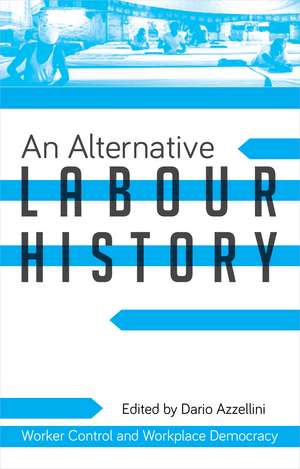
An Alternative Labour History: Worker Control and Workplace Democracy
Editat de Assistant Professor Dario Azzellinien Limba Engleză Paperback – 12 mar 2015
The dominant revolutionary left has viewed workers' control as part of a system necessary during a transition to socialism. Yet most socialist and communist parties have neglected to promote workers' control as it challenges the centrality of parties and it is in this spirit that trade unions, operating through the institutional frameworks of government, have held a monopoly over labor history.
Tracing Marx's writings on the Paris Commune through council communism, anarcho-syndicalism, Italian operaismo, and other "heretical" left currents, An Alternative Labour History uncovers the practices and intentions of historical and contemporary autonomous workers' movements that until now have been largely obscured. It shows that by bringing permanence and predictability to their workplaces, workers can stabilize their communities through expressions of participatory democracy. And, as history has repeatedly shown, workers have always had the capacity to run their enterprises on their own.
Preț: 161.67 lei
Preț vechi: 193.31 lei
-16%
Puncte Express: 243
Carte tipărită la comandă
Livrare economică 21 noiembrie-05 decembrie
Livrare prin curier în România Termenul estimat este afișat lângă disponibilitate.
Transport gratuit de la 400.00 lei Plată online sau ramburs, în funcție de opțiunile comenzii.
Retur gratuit în 14 zile Comandă securizată și suport în română.
Specificații
ISBN-13: 9781783601547
ISBN-10: 178360154X
Pagini: 352
Dimensiuni: 138 x 214 x 24 mm
Greutate: 0.5 kg
Editura: Bloomsbury Publishing
Colecția Zed Books
Locul publicării:London, United Kingdom
ISBN-10: 178360154X
Pagini: 352
Dimensiuni: 138 x 214 x 24 mm
Greutate: 0.5 kg
Editura: Bloomsbury Publishing
Colecția Zed Books
Locul publicării:London, United Kingdom
V-ar putea interesa
-
 How Football Explains The WorldFranklin FoerPreț: 113.79 lei
 -
 Mona Lisa: The People and the PaintingMartin Kemp-19%Preț: 198.68 lei244.98 lei
 -
 Heartthrobs: A History of Women and DesireCarol Dyhouse-19%Preț: 141.21 lei174.89 lei
 -
 -19%Preț: 93.60 lei115.10 lei
 -
 The Oxford Illustrated History of ScienceIwan Rhys Morus-17%Preț: 210.60 lei252.44 lei
 -
 -18%Preț: 105.59 lei128.01 lei
 -
 Delirious New YorkRem Koolhaas-20%Preț: 169.43 lei211.53 lei
 -
 Interstate: Hitch Hiking Through the State of a NationJulian Sayarer-25%Preț: 53.97 lei71.95 lei
Cuprins
Acknowledgments
Notes on Contributors
Introduction - Dario Azzellini
1. Council Democracy, or the End of the Political - Alex Demirovic´
2. Contemporary Crisis and Workers' Control - Dario Azzellini
3. Workers' Assemblies: New Formations in the Organization of Labor and the Struggle against Capitalism - Elise Danielle Thorburn
4. The Austrian Revolution of 1918-1919 and Working Class Autonomy - Peter Haumer
5. Chile: Worker Self-organization and Cordones Industriales under the Allende Government (1970-1973) - Franck Gaudichaud
6. 'Production Control' or 'Factory Soviet'? Workers' Control in Japan - Kimiyasu Irie
7. The Factory Commissions in Brazil and the 1964 Coup d'État - Henrique T. Novaes and Maurício S. de Faria
8. Self-management, Workers' Control and Resistance against Crisis and Neoliberal Counter-reforms in Mexico - Patrick Cuninghame
9. Collective Self-management and Social Classes: The Case of Enterprises Recovered by Their Workers in Uruguay - Anabel Rieiro
10. Self-managing the Commons in Contemporary Greece - Alexandros Kioupkiolis and Theodoros Karyotis Index
Notes on Contributors
Introduction - Dario Azzellini
1. Council Democracy, or the End of the Political - Alex Demirovic´
2. Contemporary Crisis and Workers' Control - Dario Azzellini
3. Workers' Assemblies: New Formations in the Organization of Labor and the Struggle against Capitalism - Elise Danielle Thorburn
4. The Austrian Revolution of 1918-1919 and Working Class Autonomy - Peter Haumer
5. Chile: Worker Self-organization and Cordones Industriales under the Allende Government (1970-1973) - Franck Gaudichaud
6. 'Production Control' or 'Factory Soviet'? Workers' Control in Japan - Kimiyasu Irie
7. The Factory Commissions in Brazil and the 1964 Coup d'État - Henrique T. Novaes and Maurício S. de Faria
8. Self-management, Workers' Control and Resistance against Crisis and Neoliberal Counter-reforms in Mexico - Patrick Cuninghame
9. Collective Self-management and Social Classes: The Case of Enterprises Recovered by Their Workers in Uruguay - Anabel Rieiro
10. Self-managing the Commons in Contemporary Greece - Alexandros Kioupkiolis and Theodoros Karyotis Index
Recenzii
Dario Azzellini has emerged as arguably the most important contemporary analyst of worker self-management. Casting a critical eye toward non-revolutionary forms of workers' control, Azzellini and the contributors to this volume enrich our understanding while pressing us ever more toward the radical and transformative experiences in workplace management that have become a resurgent hallmark of our moment.
An Alternative Labour History is a hugely important contribution to that old socialist question: how can ordinary people exercise self-government in the matters that matter most to their daily lives? The essays here update the vision of workers' councils in response to the ecological crisis and to the prospects raised by popular uprisings. Get this book!
Challenging radical fuzziness and conservative dogma, this book is a resource for comprehending the past and conceptualizing the future.
An Alternative Labour History is a must-read for those seeking fresh ways out of the current global morass. Azzellini and his contributors present a real and possible alternative to the twin corporate traps of monopoly capitalism and state socialism. There are lessons here for all who hold tight to the possibility for a future based on equality and social good.
An Alternative Labour History is a hugely important contribution to that old socialist question: how can ordinary people exercise self-government in the matters that matter most to their daily lives? The essays here update the vision of workers' councils in response to the ecological crisis and to the prospects raised by popular uprisings. Get this book!
Challenging radical fuzziness and conservative dogma, this book is a resource for comprehending the past and conceptualizing the future.
An Alternative Labour History is a must-read for those seeking fresh ways out of the current global morass. Azzellini and his contributors present a real and possible alternative to the twin corporate traps of monopoly capitalism and state socialism. There are lessons here for all who hold tight to the possibility for a future based on equality and social good.