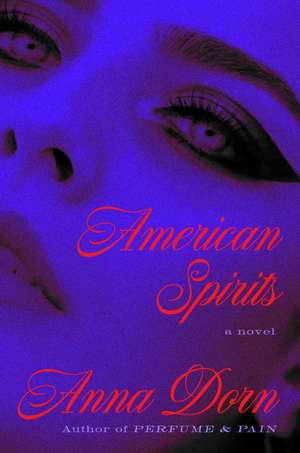
American Spirits: A Novel
Autor Anna Dornen Limba Engleză Paperback – 24 sep 2026
One of Vulture’s Most Anticipated Books of 2026
“A titillating romp!” —Booklist (starred review) • “I imagine the book as a Lynch film with a score by Lana Del Rey.” —Los Angeles Times
Thirty-eight-year-old Blue Velour has finally achieved the critical acclaim she’s long been chasing. Over the last decade, she’s released six studio albums to mixed reviews, landing her somewhere between performance artist and niche legend. But her latest album, Blue’s Beard—a cheeky reference to the subreddit fanatically dedicated to her suspected secret relationship with longtime producer Sasha Harlow—has rocket-launched her reputation. Blue hires nerdy superfan Rose Lutz as her assistant to handle the pressures of the upcoming tour.
When the pandemic shuts down the tour, however, Blue decides to hole up in the redwoods with Sasha to make another album. An aspiring singer herself, Rose is frothing at the mouth to be isolated in a cabin with these two legends, but what begins as a creative retreat spirals into a flurry of chaos and betrayal—culminating in a tragic act that changes their lives forever.
Smart, entertaining, and edgy, American Spirits is a compelling exploration of the dark side of fame.
Preț: 86.44 lei
Nou
Puncte Express: 130
Carte disponibilă
Livrare economică 13-25 noiembrie
Livrare prin curier în România Termenul estimat este afișat lângă disponibilitate.
Transport gratuit de la 400.00 lei Plată online sau ramburs, în funcție de opțiunile comenzii.
Retur gratuit în 14 zile Comandă securizată și suport în română.
Specificații
ISBN-13: 9781668247464
ISBN-10: 1668247461
Pagini: 352
Dimensiuni: 3886 x 5944 x 22 mm
Greutate: 0.33 kg
Ediția:Local Edition
Editura: Simon&Schuster
Colecția Simon & Schuster
ISBN-10: 1668247461
Pagini: 352
Dimensiuni: 3886 x 5944 x 22 mm
Greutate: 0.33 kg
Ediția:Local Edition
Editura: Simon&Schuster
Colecția Simon & Schuster
Notă biografică
Anna Dorn is the author of the novels Perfume and Pain, Exalted, Vagablonde, and American Spirits. She was a Lambda Literary Fellow and Exalted was a finalist for the Los Angeles Times Book Prize. She lives in Los Angeles.
Recenzii
"I inhaled this smoky, sinuous deep dive into the mechanics of fame and obsession. Dorn’s prose is addictive—sharp, textured, and endlessly perceptive about the ambition and resentment that often drive artists. A combustive cocktail of desire and self-destruction... I’ll read anything Anna Dorn writes."
—Kate Folk, author of Sky Daddy
“I hate pop culture and I love this book.”
—Melissa Broder, author of Death Valley
—Kate Folk, author of Sky Daddy
“I hate pop culture and I love this book.”
—Melissa Broder, author of Death Valley
Descriere
A love letter to pop music, American Spirits charts an icon’s fall—and an obsessive fangirl’s rise.
Extras
1. Blue Blue
Blue Velour sat at her vanity and dragged a thin line along her eyelid.
She’d been applying sharp wings since she was sixteen, when she’d shoplifted a liquid eyeliner pen from CVS after seeing Jean-Luc Godard’s Contempt with her much older boyfriend. She’d been mesmerized by Brigitte Bardot. For an entire year, Blue had worn a thick headband and striped T-shirt with a pencil skirt. She’d stood out among the puka-shell necklaces and Lilly Pulitzer dresses that dominated the school halls in late-’90s Wilmington, North Carolina. They still dressed like that as far as Blue knew. She hadn’t been back in nearly a decade.
Blue looked out the window, toward the rippling turquoise water. When she was younger, she’d been terrified of aging, of losing her beauty. But now that she was thirty-eight, nothing really scared her anymore. God had tortured her for many years, and now Blue had finally earned a period of peace and joy. At least that’s what she told herself whenever those old fears crept up to say hello, or, more specifically, This is all too good to be true.
Nerves danced in Blue’s stomach. She braced herself to wing the right eye. Journalists had asked about the eyeliner before. They all assumed she had a makeup artist. But Blue always did her own, even for red carpets. Ever since Sephora had made her look like a freaky pageant clown as a teen, Blue hadn’t let anyone touch her face. But now that her hand was shaking slightly as she tried to sharpen the tip of the wing, she fantasized about having someone to help her, if even to just steady her grip. She put the pen down and examined her work. It was not her best, but fine. Sufficient.
The bedroom door cracked open. Max appeared in an oversize cable knit sweater and jeans. Max was Blue’s sister, best friend, roommate, stylist, and unofficial assistant. Max had moved to LA to live with Blue as soon as she turned eighteen, less than a year after Blue left home. They were Irish twins, barely a year apart. And in the year 2000, when Max was eighteen and Blue was nineteen—although they’d been Maxine and Beatrice then—they’d shared a studio apartment in Hollywood over a Petco. They’d called it Chateau Velour after the velour couch they’d found on the street. They’d bartended and sugared for money, and on off nights, Blue had sung at open mics under the name Blue Velour, while Max had styled her. Living above the pet store had come in handy when a rich party friend had gifted them two Italian greyhound puppies. They’d named the canine sisters Bijou and Gigi.
When record label money started flowing, they’d moved to Hancock Park, a historic LA neighborhood constructed in the ’20s and former home to numerous Old Hollywood legends ranging from Clark Gable to Mae West. They’d adored their cute little bungalow with a small pool and a green lawn for Gigi and Bijou to run free. But then Blue had started gaining fans, which meant rabid paparazzi and unhinged stalkers. So Blue, Max, Gigi, and Bijou had picked up and moved to this house on Sea Level Drive, a gated subdivision in Malibu that was way out of their price range when they bought it. The Art Deco–style home had been built in the ’80s and hadn’t been renovated since, and Blue had still had to take out a thirty-year mortgage to afford it. She now had the money to renovate it, but Blue sort of liked it as it was, with its terrazzo floors and glass brick, its mirrored walls and sun-bleached teal color scheme.
“She’s hereee,” Max sang.
Blue’s heart thudded in her ears. Again, today was big. She was being interviewed for a feature in the New York Times. Her first profile in the American paper of record and one her manager believed was long overdue. Blue picked up her blue snakeskin vaporizer from the vanity and draped a blue kimono over her shoulders. She took a big drag from her vape, then followed Max through a minty cloud.
Blue had of course googled the journalist. Zoe Alexander. She appeared to be from the Midwest, had studied journalism at the University of Chicago. She’d started at Pitchfork, then wrote for Rolling Stone before moving to the Times roughly a year ago. In that year, she’d profiled Rosalía, FKA Twigs, and Phoebe Bridgers. She had nearly black hair cut in a fringe and narrow green eyes.
Sitting at Blue’s breakfast nook, Zoe Alexander mostly looked like she did on Blue’s iPhone screen—although her hair had grown out a bit, and her eyes were more intense than they were in photos. Blue didn’t like journalists. Historically, they made her sound like a dumbass. They’d make her feel comfortable, like they were friends, and then use quotes that alienated people at best, got Blue minorly canceled at worst.
And Blue had been canceled so many times—for telling Azealia Banks that her psych meds weren’t working, for telling Dr. Phil she didn’t need therapy because she “isn’t mental,” for telling a journalist he made her want to relapse, for calling Ayn Rand “the original girlboss,” for calling St. Vincent a “spooky dyke,” for writing Elizabeth Holmes letters in prison, for saying she’d rather talk to pedophiles than critics, for posting a photo of herself with a loaded gun to her head after being snubbed at the Grammys.
Shaking Zoe Alexander’s hand, Blue silently vowed not to become friends with this woman. She had to be guarded, deliberate, which was not her nature. It was frustrating, because fans liked that she was raw. But the Interscope execs liked her irreverent attitude to stay in her music and out of her conversations with the press.
“Can I get you something to drink?” Blue asked, wandering over to the wood-paneled fridge. She opened it and peered inside. “We have Diet Coke, Red Bull, Mountain Dew?” Blue was something of a caffeine addict. She was addicted to a lot of other things too—sex, love, older men, sometimes women, nicotine, music, and at one point cocaine, alcohol, and other, more serious downers, but she’d given those up.
“I’m okay,” Zoe Alexander said coolly.
Blue grabbed a can of Red Bull for herself. “Let’s go outside,” she said. “The sun is finally breaking through the fog.” Blue headed toward the balcony and Bijou followed. Gigi had become exceedingly lazy in her old age, moving only for the promise of food.
Blue rarely awoke before the marine layer disappeared around noon every day. In this sense, her sleep schedule was tailor-made for Malibu. On the rare occasions Blue did wake up early, either when she had a shoot or a meeting in LA, she enjoyed the moody, foggy vibe. The Pacific coast was infinitely more dramatic than the Atlantic beach city where she’d grown up, where the waves were small and the land was flat, where there were no mountains, no cliffs, no sound of water crashing up violently against rocks.
Outside, the sun shone bright and yellow. It was warm for November. The balcony curved with the building and hung over the water so that it almost felt like they were on a boat. There was a built-in wrap-around sofa with faded teal cushions and a white coffee table covered in cigarette butts. Blue sat on the couch.
“Wow,” Zoe said, taking in the view for a second, miles of aquamarine sprawling out before them.
“It’s something, right?” Blue lit a cigarette. She offered Zoe Alexander one, knowing she’d refuse. No one smoked anymore, it seemed, except for Blue and Max. They used to smoke cigarettes in the house but had recently stopped due to the stench that had lodged in the carpets. Vape inside, smoke outside. That was the new rule, and they mostly followed it.
Zoe shook her head no and took a seat across from Blue on a rickety metal chair with her back to the ocean.
“You don’t want the view?” Blue asked. “Come sit beside me, there’s plenty of room.” Oops, she was already trying to be the girl’s friend.
“That’s okay,” Zoe said. “I won’t be able to focus.”
Blue should channel Zoe, try to focus on the interview, not the hypnotizing stretch of blue water. Blue had always been a good mimic. She’d learned to sing by mimicking Nancy Sinatra and Julee Cruise. Maybe she could learn to behave appropriately by mimicking Zoe Alexander, who pulled an iPhone from her pocket and started punching on it.
“Cool if I record?” she asked without looking up.
“Of course,” Blue said, wishing she could say no.
Zoe put the iPhone on the table between them. Blue could see the flat line from the recording moving slightly as the surf roared beneath them. Bijou barked and the line shot up. Blue picked her up off the ground. The dog didn’t bark much, except in the presence of bad vibes. She had a refined vibe detector and had identified several of Blue’s exes as toxic far before Blue had. Now she made all her dates meet Bijou first. If she barked, it was game over. Blue was therefore now extra uneasy about Zoe Alexander.
Blue tapped her cigarette on the pink flamingo ashtray in the center of the table. She took a sip of Red Bull and prepared to think before she spoke, for maybe the first time in her entire life.
“So, you’ve been making music for roughly…” Zoe looked up, evidently thinking. Her lashes fluttered.
“My whole life,” said Blue.
“Your whole life,” Zoe repeated.
Blue wasn’t going to say her age if that’s what Zoe wanted.
“You must be thrilled with how far you’ve come,” Zoe said.
Blue took a breath. The question, or she supposed it was more of a comment, bothered her. Infuriated her even. The comment implied that Blue had been bad but had improved. That she’d redeemed herself somehow. But Blue had always been good, always been great. The public was just very late to an amazing party she’d been at her entire life. The old Blue would have snapped at Zoe, maybe even threatened her. But that was the old Blue.
“Honestly,” Blue said, “I’ve been at peace since Paz De La Huerta took out her tits at one of my shows.”
Zoe laughed, which relieved Blue. This was good. Keep it light. No aggression, no hostility. Be entertaining, elusive. She leaned back in her chair, slightly more at ease.
“Can we do a quick rapid fire?” Zoe asked.
Blue nodded. This sounded fun, but also dangerous. Just don’t get canceled again, she told herself. Funny, elusive.
“Favorite of your albums?”
“Fluorescent Gloom.” This was Blue’s least popular album.
“Least favorite?”
“Chateau Velour.” This was Blue’s most popular album.
“Biggest inspiration?”
“My sister.”
“Musical inspiration?”
“Kurt Cobain.”
“Dream collaboration?”
“Amy Winehouse.”
“Dream collaboration with someone who is alive?”
“My gardener.” Blue was lying; she didn’t have a gardener.
“Dream collaboration with a popular musician who is alive?”
“Dolly Parton.”
“Why blue?”
Blue laughed, instructed Zoe to turn around, to look at the layered hues of water and powder blue sky above it.
Zoe turned toward the water for a brief second, then turned back and wrote something down. She looked up at Blue and blinked. All business, this woman.
“Describe your music in three words.”
Blue pulled in smoke from her cigarette, exhaled.
“Love.” Drag. “Death.” Drag. “Ribbons.”
“Describe your fans in three words.”
“Sexy.” Drag. “Gay.” Laugh. “Rabid.”
“What do you want more than anything?”
“Respect.”
“How do you prepare for a live performance?”
Blue sighed. “I freak the fuck out.”
Zoe laughed. Thank God. Blue looked at the water. This was going okay. She hadn’t said anything offensive yet, she didn’t think. It seemed like the rapid fire was over. Smooth sailing from here.
“I love Blue’s Beard,” Zoe Alexander said, catching Blue off guard. “I think it’s your best record yet.”
Blue picked up her cigarette and inhaled deeply to hide her surprise, and, she supposed, joy. The album wasn’t out yet; only a few digital copies had gone to journalists. And Blue wasn’t used to journalists complimenting her. For the first ten years of her career, she’d routinely been panned by the critics. Contrived, manufactured, and alienating were the most common insults flung her way, but she’d been called worse. Blue used to take the bad reviews seriously. She thought the critics were correct that she was a fraud. After all, she’d changed her name from Beatrice Clark to Blue Velour as soon as she moved to LA. She’d dyed her hair periwinkle for years until it had started falling out in her early thirties from chemical damage. It had grown out a sort of chestnut, made darker with a quarterly gloss. She was generally more natural now, no longer starving herself or injecting massive amounts of filler into her lips. Back then, she supposed, the critics had been correct that she was fake. But she hadn’t realized then that audiences wanted pop stars to be anything but.
“Thank you,” Blue said. She pulled hard from her cigarette again to prevent herself from saying something she might regret.
“Can you tell me about the inspiration? How did it come to be?”
Blue hadn’t done an interview in a while and suddenly remembered how much she hated answering questions like these, ones in which she was expected to articulate her artistic process. She liked music because it was beyond language. She wrote her lyrics, but that was different. That was poetry. Her lyrics were meant to evoke a feeling, not to make sense.
“I can’t totally explain where my music comes from,” Blue said. “It’s between me and God.” Blue laughed and the line on Zoe Alexander’s iPhone wiggled. Blue put a hand over her mouth.
“The album title and opening song, ‘Blue’s Beard’—it’s really interesting, an apparent reference to both the French folktale and a shout-out to your LGBTQ+ fan base.”
Blue laughed again, a breathy sound that floated off toward the sea. She couldn’t take Zoe Alexander seriously. They didn’t speak the same language. Blue felt the caffeine and nicotine dancing together in her veins.
“The gays love me,” Blue said. She kissed Bijou on the nose.
“A beard,” Zoe began, “is a faux romantic partner used to conceal a person’s sexual identity.”
Blue smirked. “Thank you for that very formal definition.”
Zoe Alexander said nothing, just folded her arms. She was wearing a black blazer and must have been very hot. It was probably sixty-seven degrees, but the sun made it feel hotter. Blue was partially in the shade, but Zoe was fully exposed to the ozone.
“Actually,” Zoe said, “I’ll take a cigarette.”
Blue raised an eyebrow. This was a first. She handed Zoe an American Spirit and, for a brief second, wondered if the woman wanted to fuck her. Journalists had tried to get with her before, and on at least one occasion had succeeded. Blue had thought it would make him write about her more favorably. She’d been wrong. He’d called her a clown.
Blue leaned over and lit Zoe’s cigarette, then relit her own.
“There are legions of people online convinced that you had, or have, a romantic relationship with your producer Sasha Harlow.”
Blue took a drag to appear casual. This question—was it even a question? maybe more of a comment again—tended to irk her. It was hardly the first time an interviewer had mentioned this alleged affair with Sasha, but Blue had thought the American paper of record was classier than this.
“Is that so?” Blue played dumb. The album title was a reference to the subreddit BlueBeards, which was dedicated to piecing together clues that Blue and Sasha were romantically linked. Blue didn’t like the internet, but it was hard to avoid. And on a mushroom microdose roughly a year ago, Blue and Sasha had decided it would be hilarious and meta to directly reference the subreddit in the album’s title.
Most educated people dismissed the BlueBeards as QAnon-level delusional, but Blue had in fact slept with Sasha on and off since she was twenty-six, when the label had arranged for them to work together. Blue didn’t talk about it in the press—not because she was embarrassed or had any doubts about her sexuality, but because fans loved mysteries. Sasha and Blue played into it, leaving little Easter egg hints of their romance for careful listeners, occasionally holding hands on the red carpet. Neither Blue nor Sasha believed in marriage or monogamy, only in all-consuming, passionate, addictive, obsessive, druglike love—what they called an “Aphrodite Bender” in the song they’d written for the Fifty Shades of Grey franchise in 2015.
“You tend to be evasive when asked about Sasha,” Zoe Alexander said. She dragged and turned toward the water, as if to be polite by blowing her smoke in another direction, as if Blue minded smoke in her face.
“Evasive?” Blue said. “I’m an open book.” She inhaled, waited for Zoe to turn back to face her. “Sasha is my soulmate,” Blue said when she met Zoe’s eyes. “I’ll never make another song without her as long as I live.”
“Do you mean soulmate in a creative or a romantic sense?” Zoe asked.
Blue exhaled toward Zoe.
“Is there a difference?”
Blue Velour sat at her vanity and dragged a thin line along her eyelid.
She’d been applying sharp wings since she was sixteen, when she’d shoplifted a liquid eyeliner pen from CVS after seeing Jean-Luc Godard’s Contempt with her much older boyfriend. She’d been mesmerized by Brigitte Bardot. For an entire year, Blue had worn a thick headband and striped T-shirt with a pencil skirt. She’d stood out among the puka-shell necklaces and Lilly Pulitzer dresses that dominated the school halls in late-’90s Wilmington, North Carolina. They still dressed like that as far as Blue knew. She hadn’t been back in nearly a decade.
Blue looked out the window, toward the rippling turquoise water. When she was younger, she’d been terrified of aging, of losing her beauty. But now that she was thirty-eight, nothing really scared her anymore. God had tortured her for many years, and now Blue had finally earned a period of peace and joy. At least that’s what she told herself whenever those old fears crept up to say hello, or, more specifically, This is all too good to be true.
Nerves danced in Blue’s stomach. She braced herself to wing the right eye. Journalists had asked about the eyeliner before. They all assumed she had a makeup artist. But Blue always did her own, even for red carpets. Ever since Sephora had made her look like a freaky pageant clown as a teen, Blue hadn’t let anyone touch her face. But now that her hand was shaking slightly as she tried to sharpen the tip of the wing, she fantasized about having someone to help her, if even to just steady her grip. She put the pen down and examined her work. It was not her best, but fine. Sufficient.
The bedroom door cracked open. Max appeared in an oversize cable knit sweater and jeans. Max was Blue’s sister, best friend, roommate, stylist, and unofficial assistant. Max had moved to LA to live with Blue as soon as she turned eighteen, less than a year after Blue left home. They were Irish twins, barely a year apart. And in the year 2000, when Max was eighteen and Blue was nineteen—although they’d been Maxine and Beatrice then—they’d shared a studio apartment in Hollywood over a Petco. They’d called it Chateau Velour after the velour couch they’d found on the street. They’d bartended and sugared for money, and on off nights, Blue had sung at open mics under the name Blue Velour, while Max had styled her. Living above the pet store had come in handy when a rich party friend had gifted them two Italian greyhound puppies. They’d named the canine sisters Bijou and Gigi.
When record label money started flowing, they’d moved to Hancock Park, a historic LA neighborhood constructed in the ’20s and former home to numerous Old Hollywood legends ranging from Clark Gable to Mae West. They’d adored their cute little bungalow with a small pool and a green lawn for Gigi and Bijou to run free. But then Blue had started gaining fans, which meant rabid paparazzi and unhinged stalkers. So Blue, Max, Gigi, and Bijou had picked up and moved to this house on Sea Level Drive, a gated subdivision in Malibu that was way out of their price range when they bought it. The Art Deco–style home had been built in the ’80s and hadn’t been renovated since, and Blue had still had to take out a thirty-year mortgage to afford it. She now had the money to renovate it, but Blue sort of liked it as it was, with its terrazzo floors and glass brick, its mirrored walls and sun-bleached teal color scheme.
“She’s hereee,” Max sang.
Blue’s heart thudded in her ears. Again, today was big. She was being interviewed for a feature in the New York Times. Her first profile in the American paper of record and one her manager believed was long overdue. Blue picked up her blue snakeskin vaporizer from the vanity and draped a blue kimono over her shoulders. She took a big drag from her vape, then followed Max through a minty cloud.
Blue had of course googled the journalist. Zoe Alexander. She appeared to be from the Midwest, had studied journalism at the University of Chicago. She’d started at Pitchfork, then wrote for Rolling Stone before moving to the Times roughly a year ago. In that year, she’d profiled Rosalía, FKA Twigs, and Phoebe Bridgers. She had nearly black hair cut in a fringe and narrow green eyes.
Sitting at Blue’s breakfast nook, Zoe Alexander mostly looked like she did on Blue’s iPhone screen—although her hair had grown out a bit, and her eyes were more intense than they were in photos. Blue didn’t like journalists. Historically, they made her sound like a dumbass. They’d make her feel comfortable, like they were friends, and then use quotes that alienated people at best, got Blue minorly canceled at worst.
And Blue had been canceled so many times—for telling Azealia Banks that her psych meds weren’t working, for telling Dr. Phil she didn’t need therapy because she “isn’t mental,” for telling a journalist he made her want to relapse, for calling Ayn Rand “the original girlboss,” for calling St. Vincent a “spooky dyke,” for writing Elizabeth Holmes letters in prison, for saying she’d rather talk to pedophiles than critics, for posting a photo of herself with a loaded gun to her head after being snubbed at the Grammys.
Shaking Zoe Alexander’s hand, Blue silently vowed not to become friends with this woman. She had to be guarded, deliberate, which was not her nature. It was frustrating, because fans liked that she was raw. But the Interscope execs liked her irreverent attitude to stay in her music and out of her conversations with the press.
“Can I get you something to drink?” Blue asked, wandering over to the wood-paneled fridge. She opened it and peered inside. “We have Diet Coke, Red Bull, Mountain Dew?” Blue was something of a caffeine addict. She was addicted to a lot of other things too—sex, love, older men, sometimes women, nicotine, music, and at one point cocaine, alcohol, and other, more serious downers, but she’d given those up.
“I’m okay,” Zoe Alexander said coolly.
Blue grabbed a can of Red Bull for herself. “Let’s go outside,” she said. “The sun is finally breaking through the fog.” Blue headed toward the balcony and Bijou followed. Gigi had become exceedingly lazy in her old age, moving only for the promise of food.
Blue rarely awoke before the marine layer disappeared around noon every day. In this sense, her sleep schedule was tailor-made for Malibu. On the rare occasions Blue did wake up early, either when she had a shoot or a meeting in LA, she enjoyed the moody, foggy vibe. The Pacific coast was infinitely more dramatic than the Atlantic beach city where she’d grown up, where the waves were small and the land was flat, where there were no mountains, no cliffs, no sound of water crashing up violently against rocks.
Outside, the sun shone bright and yellow. It was warm for November. The balcony curved with the building and hung over the water so that it almost felt like they were on a boat. There was a built-in wrap-around sofa with faded teal cushions and a white coffee table covered in cigarette butts. Blue sat on the couch.
“Wow,” Zoe said, taking in the view for a second, miles of aquamarine sprawling out before them.
“It’s something, right?” Blue lit a cigarette. She offered Zoe Alexander one, knowing she’d refuse. No one smoked anymore, it seemed, except for Blue and Max. They used to smoke cigarettes in the house but had recently stopped due to the stench that had lodged in the carpets. Vape inside, smoke outside. That was the new rule, and they mostly followed it.
Zoe shook her head no and took a seat across from Blue on a rickety metal chair with her back to the ocean.
“You don’t want the view?” Blue asked. “Come sit beside me, there’s plenty of room.” Oops, she was already trying to be the girl’s friend.
“That’s okay,” Zoe said. “I won’t be able to focus.”
Blue should channel Zoe, try to focus on the interview, not the hypnotizing stretch of blue water. Blue had always been a good mimic. She’d learned to sing by mimicking Nancy Sinatra and Julee Cruise. Maybe she could learn to behave appropriately by mimicking Zoe Alexander, who pulled an iPhone from her pocket and started punching on it.
“Cool if I record?” she asked without looking up.
“Of course,” Blue said, wishing she could say no.
Zoe put the iPhone on the table between them. Blue could see the flat line from the recording moving slightly as the surf roared beneath them. Bijou barked and the line shot up. Blue picked her up off the ground. The dog didn’t bark much, except in the presence of bad vibes. She had a refined vibe detector and had identified several of Blue’s exes as toxic far before Blue had. Now she made all her dates meet Bijou first. If she barked, it was game over. Blue was therefore now extra uneasy about Zoe Alexander.
Blue tapped her cigarette on the pink flamingo ashtray in the center of the table. She took a sip of Red Bull and prepared to think before she spoke, for maybe the first time in her entire life.
“So, you’ve been making music for roughly…” Zoe looked up, evidently thinking. Her lashes fluttered.
“My whole life,” said Blue.
“Your whole life,” Zoe repeated.
Blue wasn’t going to say her age if that’s what Zoe wanted.
“You must be thrilled with how far you’ve come,” Zoe said.
Blue took a breath. The question, or she supposed it was more of a comment, bothered her. Infuriated her even. The comment implied that Blue had been bad but had improved. That she’d redeemed herself somehow. But Blue had always been good, always been great. The public was just very late to an amazing party she’d been at her entire life. The old Blue would have snapped at Zoe, maybe even threatened her. But that was the old Blue.
“Honestly,” Blue said, “I’ve been at peace since Paz De La Huerta took out her tits at one of my shows.”
Zoe laughed, which relieved Blue. This was good. Keep it light. No aggression, no hostility. Be entertaining, elusive. She leaned back in her chair, slightly more at ease.
“Can we do a quick rapid fire?” Zoe asked.
Blue nodded. This sounded fun, but also dangerous. Just don’t get canceled again, she told herself. Funny, elusive.
“Favorite of your albums?”
“Fluorescent Gloom.” This was Blue’s least popular album.
“Least favorite?”
“Chateau Velour.” This was Blue’s most popular album.
“Biggest inspiration?”
“My sister.”
“Musical inspiration?”
“Kurt Cobain.”
“Dream collaboration?”
“Amy Winehouse.”
“Dream collaboration with someone who is alive?”
“My gardener.” Blue was lying; she didn’t have a gardener.
“Dream collaboration with a popular musician who is alive?”
“Dolly Parton.”
“Why blue?”
Blue laughed, instructed Zoe to turn around, to look at the layered hues of water and powder blue sky above it.
Zoe turned toward the water for a brief second, then turned back and wrote something down. She looked up at Blue and blinked. All business, this woman.
“Describe your music in three words.”
Blue pulled in smoke from her cigarette, exhaled.
“Love.” Drag. “Death.” Drag. “Ribbons.”
“Describe your fans in three words.”
“Sexy.” Drag. “Gay.” Laugh. “Rabid.”
“What do you want more than anything?”
“Respect.”
“How do you prepare for a live performance?”
Blue sighed. “I freak the fuck out.”
Zoe laughed. Thank God. Blue looked at the water. This was going okay. She hadn’t said anything offensive yet, she didn’t think. It seemed like the rapid fire was over. Smooth sailing from here.
“I love Blue’s Beard,” Zoe Alexander said, catching Blue off guard. “I think it’s your best record yet.”
Blue picked up her cigarette and inhaled deeply to hide her surprise, and, she supposed, joy. The album wasn’t out yet; only a few digital copies had gone to journalists. And Blue wasn’t used to journalists complimenting her. For the first ten years of her career, she’d routinely been panned by the critics. Contrived, manufactured, and alienating were the most common insults flung her way, but she’d been called worse. Blue used to take the bad reviews seriously. She thought the critics were correct that she was a fraud. After all, she’d changed her name from Beatrice Clark to Blue Velour as soon as she moved to LA. She’d dyed her hair periwinkle for years until it had started falling out in her early thirties from chemical damage. It had grown out a sort of chestnut, made darker with a quarterly gloss. She was generally more natural now, no longer starving herself or injecting massive amounts of filler into her lips. Back then, she supposed, the critics had been correct that she was fake. But she hadn’t realized then that audiences wanted pop stars to be anything but.
“Thank you,” Blue said. She pulled hard from her cigarette again to prevent herself from saying something she might regret.
“Can you tell me about the inspiration? How did it come to be?”
Blue hadn’t done an interview in a while and suddenly remembered how much she hated answering questions like these, ones in which she was expected to articulate her artistic process. She liked music because it was beyond language. She wrote her lyrics, but that was different. That was poetry. Her lyrics were meant to evoke a feeling, not to make sense.
“I can’t totally explain where my music comes from,” Blue said. “It’s between me and God.” Blue laughed and the line on Zoe Alexander’s iPhone wiggled. Blue put a hand over her mouth.
“The album title and opening song, ‘Blue’s Beard’—it’s really interesting, an apparent reference to both the French folktale and a shout-out to your LGBTQ+ fan base.”
Blue laughed again, a breathy sound that floated off toward the sea. She couldn’t take Zoe Alexander seriously. They didn’t speak the same language. Blue felt the caffeine and nicotine dancing together in her veins.
“The gays love me,” Blue said. She kissed Bijou on the nose.
“A beard,” Zoe began, “is a faux romantic partner used to conceal a person’s sexual identity.”
Blue smirked. “Thank you for that very formal definition.”
Zoe Alexander said nothing, just folded her arms. She was wearing a black blazer and must have been very hot. It was probably sixty-seven degrees, but the sun made it feel hotter. Blue was partially in the shade, but Zoe was fully exposed to the ozone.
“Actually,” Zoe said, “I’ll take a cigarette.”
Blue raised an eyebrow. This was a first. She handed Zoe an American Spirit and, for a brief second, wondered if the woman wanted to fuck her. Journalists had tried to get with her before, and on at least one occasion had succeeded. Blue had thought it would make him write about her more favorably. She’d been wrong. He’d called her a clown.
Blue leaned over and lit Zoe’s cigarette, then relit her own.
“There are legions of people online convinced that you had, or have, a romantic relationship with your producer Sasha Harlow.”
Blue took a drag to appear casual. This question—was it even a question? maybe more of a comment again—tended to irk her. It was hardly the first time an interviewer had mentioned this alleged affair with Sasha, but Blue had thought the American paper of record was classier than this.
“Is that so?” Blue played dumb. The album title was a reference to the subreddit BlueBeards, which was dedicated to piecing together clues that Blue and Sasha were romantically linked. Blue didn’t like the internet, but it was hard to avoid. And on a mushroom microdose roughly a year ago, Blue and Sasha had decided it would be hilarious and meta to directly reference the subreddit in the album’s title.
Most educated people dismissed the BlueBeards as QAnon-level delusional, but Blue had in fact slept with Sasha on and off since she was twenty-six, when the label had arranged for them to work together. Blue didn’t talk about it in the press—not because she was embarrassed or had any doubts about her sexuality, but because fans loved mysteries. Sasha and Blue played into it, leaving little Easter egg hints of their romance for careful listeners, occasionally holding hands on the red carpet. Neither Blue nor Sasha believed in marriage or monogamy, only in all-consuming, passionate, addictive, obsessive, druglike love—what they called an “Aphrodite Bender” in the song they’d written for the Fifty Shades of Grey franchise in 2015.
“You tend to be evasive when asked about Sasha,” Zoe Alexander said. She dragged and turned toward the water, as if to be polite by blowing her smoke in another direction, as if Blue minded smoke in her face.
“Evasive?” Blue said. “I’m an open book.” She inhaled, waited for Zoe to turn back to face her. “Sasha is my soulmate,” Blue said when she met Zoe’s eyes. “I’ll never make another song without her as long as I live.”
“Do you mean soulmate in a creative or a romantic sense?” Zoe asked.
Blue exhaled toward Zoe.
“Is there a difference?”