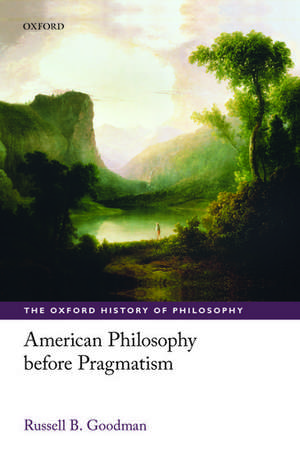
American Philosophy before Pragmatism: The Oxford History of Philosophy
Autor Russell B. Goodmanen Limba Engleză Paperback – 11 ian 2018







Preț: 252.31 lei
Preț vechi: 306.44 lei
-18%
Puncte Express: 378
Carte tipărită la comandă
Livrare economică 03-09 decembrie
Livrare prin curier în România Termenul estimat este afișat lângă disponibilitate.
Transport gratuit de la 400.00 lei Plată online sau ramburs, în funcție de opțiunile comenzii.
Retur gratuit în 14 zile Comandă securizată și suport în română.
Specificații
ISBN-13: 9780198801535
ISBN-10: 019880153X
Pagini: 292
Dimensiuni: 156 x 232 x 16 mm
Greutate: 0.45 kg
Editura: OUP OXFORD
Colecția OUP Oxford
Seria The Oxford History of Philosophy
Locul publicării:Oxford, United Kingdom
ISBN-10: 019880153X
Pagini: 292
Dimensiuni: 156 x 232 x 16 mm
Greutate: 0.45 kg
Editura: OUP OXFORD
Colecția OUP Oxford
Seria The Oxford History of Philosophy
Locul publicării:Oxford, United Kingdom
V-ar putea interesa
-
 Hegel: A Very Short IntroductionPeter Singer-19%Preț: 57.29 lei71.12 lei
 -
 Rousseau: A Very Short IntroductionRobert Wokler-19%Preț: 57.90 lei71.58 lei
 -
 Kant: A Very Short IntroductionRoger Scruton-20%Preț: 57.15 lei71.12 lei
 -
 Kant's Metaphysics of Morals: Interpretative EssaysMark Timmons-28%Preț: 501.61 lei698.43 lei
 -
 Hume's ReasonDavid Owen-18%Preț: 324.23 lei394.53 lei
 -
 Oxford Studies in Early Modern Philosophy Volume 1Daniel Garber-28%Preț: 344.71 lei481.58 lei
 -
 -28%Preț: 427.24 lei595.14 lei
 -
 Descartes's Theory of MindDesmond Clarke-19%Preț: 352.36 lei436.17 lei
 -
 Hume VariationsJerry A. Fodor-13%Preț: 365.08 lei421.06 lei
 -
 Schiller as Philosopher: A Re-ExaminationFrederick Beiser-21%Preț: 354.21 lei448.82 lei
 -
 -10%Preț: 329.04 lei366.95 lei
 -
 HegelTerry PinkardPreț: 365.99 lei
 -
 The Cambridge Companion to KantPaul GuyerPreț: 326.45 lei
 -
 Practical PhilosophyImmanuel KantPreț: 402.80 lei
 -
 Preț: 324.79 lei
 -
 Conversations With Isaiah BerlinRamin JahanbeglooPreț: 78.47 lei
Recenzii
Goodman's book is required reading. There is much to admire about this relatively short (and therefore extremely ambitious) book: its historical detail, its ability to anticipate and foreshadow later philosophical developments, its attention to the nexus of the political and the philosophical, and a gracious manner of writing that invites the reader into a very accessible story about a strain of American thought.
This fine introduction to early American philosophy features Edwards prominently . . . [Goodman's] treatment of Edwards now joins the ranks of short surveys by philosophers and historians--John Smith, Morton White, Paul Conkin, William Clebsch, Bruce Kuklick, and others--who interpret him in light of later American philosophy. It deserves a wide reading.
Goodman succeeds in linking the varied intellectual debates that occupied his principle figures to their practical implications, both of their own times and of today. His readings as a result are fresh and convincing, though given the brevity of the book, no discussion is as intense as the topics deserve. His presentations relate his figures to concurrent developments in Europe, but they do not demand more than a casual knowledge of the history of philosophy. As an account of how five prominent thinkers in British North America and the United States responded to debates over slavery, the work illuminates the twists and turns involved when ideals and practical interests are in conflict. These strengths will make this a useful book for some courses, particularly if combined with primary readings.
This fine introduction to early American philosophy features Edwards prominently . . . [Goodman's] treatment of Edwards now joins the ranks of short surveys by philosophers and historians--John Smith, Morton White, Paul Conkin, William Clebsch, Bruce Kuklick, and others--who interpret him in light of later American philosophy. It deserves a wide reading.
Goodman succeeds in linking the varied intellectual debates that occupied his principle figures to their practical implications, both of their own times and of today. His readings as a result are fresh and convincing, though given the brevity of the book, no discussion is as intense as the topics deserve. His presentations relate his figures to concurrent developments in Europe, but they do not demand more than a casual knowledge of the history of philosophy. As an account of how five prominent thinkers in British North America and the United States responded to debates over slavery, the work illuminates the twists and turns involved when ideals and practical interests are in conflict. These strengths will make this a useful book for some courses, particularly if combined with primary readings.
Notă biografică
Russell Goodman is Professor of Philosophy at the University of New Mexico, Albuquerque.