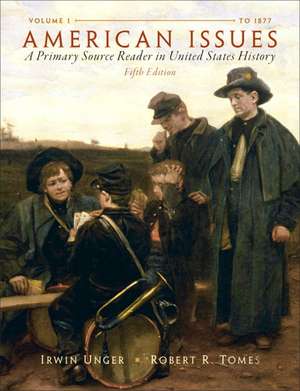
American Issues, Volume 1: A Primary Source Reader in United States History
Editat de Irwin Unger, Robert R. Tomesen Limba Engleză Paperback – 31 iul 2010
Preț: 639.90 lei
Preț vechi: 790.00 lei
-19%
Puncte Express: 960
Carte tipărită la comandă
Livrare economică 27 noiembrie-11 decembrie
Livrare prin curier în România Termenul estimat este afișat lângă disponibilitate.
Transport gratuit pentru acest produs Plată online sau ramburs, în funcție de opțiunile comenzii.
Retur gratuit în 14 zile Comandă securizată și suport în română.
Specificații
ISBN-13: 9780205803453
ISBN-10: 0205803458
Pagini: 381
Dimensiuni: 175 x 231 x 23 mm
Greutate: 0.52 kg
Ediția:5
Editura: Prentice Hall
Locul publicării:Upper Saddle River, United States
ISBN-10: 0205803458
Pagini: 381
Dimensiuni: 175 x 231 x 23 mm
Greutate: 0.52 kg
Ediția:5
Editura: Prentice Hall
Locul publicării:Upper Saddle River, United States
V-ar putea interesa
-
 Preț: 122.84 lei
 -
 Founding the Far WestDavid Alan JohnsonPreț: 524.85 lei
 -
 Riot and RemembranceJames S. HirschPreț: 117.86 lei
 -
 Apollo 13James LovellPreț: 118.17 lei
 -
 Boomtown Blues: Colorado Oil Shale, Revised EditionAndrew GullifordPreț: 245.72 lei
 -
 Living Our Language: Ojibwe Tales & Oral HistoriesAnton TreuerPreț: 121.91 lei
 -
 Preț: 152.44 lei
 -
 Preț: 259.85 lei
 -
 Preț: 102.61 lei
 -
 1864Charles Bracelen FloodPreț: 118.29 lei
 -
 Clandestine in ChileFrancisco GoldmanPreț: 97.08 lei
Descriere
The first of a two-volume anthology of primary documents, letters, and articles through which participants and contemporary observers express their opinions, make observations, and reach conclusions about events and issues that affected the nation and American society.
Cuprins
Chapter 1 The Settlement Enterprise
1.1 Richard Hakluyt on the Colonizing of North America
Richard Hakluyt,Why England Should Settle North America ((1584)
1.2 John Winthrop Advises Puritans to Emigrate
John Winthrop, Why We Should Leave England (1629)
1.3 A Cavalier Goes into Exile
Colonel Norwood, A Voyage to Virginia (1649)
1.4 The Common Folk Come to America
William Penn,Who Should Go to Pennsylvania? (1683)
1.5 Indentured Servants: Upward Mobility or Deeper Bondage
Servant’s Indenture for Transportation to Virginia (1622)
1.6 Coercion: The West African Slave
Venture Smith, An Eighteenth-Century African Describes His Enslavement (1729)
Chapter 2 The British Colonies of North America
2.1 Paradise or Hell: Economic Survival and Opportunity
John Smith, The Generall Historie of Virginia (1609)
Richard Ffrethorne, A Virginia Settler Regrets Coming
Gabriel Thomas, An Historical and Geographical Account of the Province and
Country of Pensilvania etc.
John Josselyn, An Account of Two Voyages to New England
Reverend Andrew Burnaby, New-York City
2.2 The Political Economy: Old Regime or Innovation?
Ordinance for Virginia (1621)
Massachusetts Bay Company (1629)
Charter of Freedoms and Exemptions to Patroons (1629)
The Navigation Act of 1663
2.3 Religious Toleration
John Cotton, God Did Not Ordain Democracy Fit for Church or Commonwealth (1636)
Massachusetts Proscribes Quakers (1677)
Royal Order to Send Accused Quakers to England (1661)
Roger Williams Responds to John Cotton (1644)
Hector St. John de Crèvecoeur, American Diversity: American Tolerance (1782)
2.4 Class Tensions and Slavery in Colonial America
Jaspar Danckaerts, A Traveler Disapproves of the Chesapeake Planters (1679)
William Eddis, The Wretchedness of White Servants (1770)
Reverend R. Walsh, The Inspection of a Slave Ship
MarylandStatue on Negroes and Other Slaves (1664)
Runaway Slaves (1745, 1749)
George Oglethorpe on the Stono Rebellion (1739)
The Diary of Samuel Sewall
Chapter 3 Native Americans
3.1 A British Officer Describes Native Americans
Captain Jonathan Carver, A Concise Character of the Indians (1767)
3.2 A Pennsylvanian Calls the Native Americans "Devils"
Hugh Henry Brackenridge, The Indians Have No Exclusive Claim to America (1782)
3.3 William Penn Urges Kindness Toward Native Americans
William Penn Admires the Indians (1683)
3.4 A Moravian Missionary Praises Native American Values
John Heckewelder, Indians and Nature (1777)
The Little Mohee (c. 1725)
3.5 Treaties and Alliances
Iroquois Chiefs Address the Governors of New York and Virginia (1684)
An Iroquois Chief Discusses the Treaty of Rights (1742)
3.6 The Paxton Boys and Native American Extermination
Benjamin Franklin,A Narrative of the Late Massacres, in Lancaster County, of a
Number of Indians, Friends of This Province, by Persons Unknown. With
Some Observations on the Same. (1764)
Professor Peter Kalm, Small Pox and Brandy Among the Indians (1749)
Chapter 4 Patriot versus Loyalist
4.1 The Stamp Act: Congress Denounces Taxation without Representation
The Stamp Act (1765)
Declarations of the Stamp Act Congress (1765)
Francis Bennard Describes Stamp Act Riots in Boston (1765)
4.2 A Constitutional Crisis: Virtual and Actual Representation
Benjamin Franklin, Invectives Against the Americans (1765)
4.3 The Boston Town Meeting Presents the Patriot Case
Joseph Warren, A List of Infringements and Violations of Rights (1772)
4.4 An American Radical Reevaluates the English Constitution
Thomas Paine, Common Sense (1776)
4.5 The Declaration of Independence
Thomas Jefferson, The Declaration of Independence (1776)
4.6 The Radicalism of the American Revolution
The Virginia Bill of Rights (1776)
4.7 Parliament's Official View
The Declaratory Act (1766)
4.8 A British Official Argues for Taxing Americans
Samuel Johnson, A Diatribe on the American Arguments (1766)
4.9 A British View of "No Taxation without Representation"
Soame Jenyns, “No Taxation with Representation” Is an Invalid Argument (1765)
4.9 American Loyalists Defend Britain
Josiah Quincy, Jr., The Hutchinson Riot (1775)
Samuel Seabury, Anglican Ministers Defends Britain’s Position (1774)
4.10 The American Revolution as a Social Movement
Abigail Adams on Women’s Rights (1776)
Prince Hall, a Former Slave (1777)
Chapter 5 The Constitution
5.1 Drafting the Constitution
George Washington, Letter from the Constitutional Convention to the President of
Congress (1787)
Resolutions of the Convention Concerning the Ratification and Implementation of
the Constitution (1787)
The Constitution
5.2 Patrick Henry Denounces the Constitution
Patrick Henry,Virginia Should Reject the Constitution (1788)
5.3 The Constitution as a Usurpation
Richard Henry Lee, The Constitution Will Encourage Aristocracy (1787)
5.4 "The Father of the Constitution" Defends His Offspring
James Madison, The Constitution Should Be Ratified (1787)
James Madison, Regulating the Violence of Faction Federalist Paper #10 (1788)
5.5 Alexander Hamilton on Pro- and Anti-Constitution Forces
Alexander Hamilton, On the Expediency of Adopting the Federal Constitution (1787)
Chapter 6 Federalist versus Republican
6.1 Alexander Hamilton's Economic Reports
Alexander Hamilton, The First Report on Public Credit (1790)
Alexander Hamilton, The Second Report on Public Credit (1790)
Alexander Hamilton, The Report on Manufactures (1791)
6.2 Thomas Jefferson and the American Arcadia
Thomas Jefferson, Query XIX: Manufactures (1784)
6.3 Thomas Jefferson Attacks the Hamiltonian System
Thomas Jefferson, The Vile Hamiltonian System (1790)
6.4 The Jeffersonians Embrace the French
Thomas Jefferson, In Praise of the French Jacobins (1793)
6. 5 The Federalists Denounce the French Revolution
Gouverneur Morris, Deploring the Excesses of the French Revolution (1793)
6.6 Freedom of Expression: The Press
The Alien and Sedition Acts (1798)
Edward Livingston Opposes the Alien Act (1798)
6.7 Washington and the Success of the Great Experiment
From Washington’s First Inaugural Address (1789)
James Madison Embraces Political Parties
From Washington’s Farewell Address (1796)
Chapter 7 Pioneers and Native Americans
7.1 Opening the Great American Desert: The Lewis and Clark Expedition
John Filson, The Adventures of Col. Daniel Boon (1784))
Frederick Jackson Turner, Report to the American Historical Association (1893)
7.2 The Pioneer Experience
The Diary of Elias Pym Fordham (1818)
Journal of Zerah Hawley (1821)
7.3 Indian Removal
Timothy Flint, The Indians Are Savages
The Indian Removal Act (1830)
Memorial to Congress by Inhabitants of the Territory (1832)
John C. Calhoun, Justification for “Removal”
The Indians Protest Against Removal
Chapter 8 Capital versus Labor
8.1 The Lowell System
Charles Dickens, A Positive View of the Lowell Girls (1842)
The “Factory Girls” Tell Their Own Story (1845-1846)
8.2 An Economist Defends Capitalism
Henry C. Carey, Worker Benefit from High Profits (1835)
8.3 The Workingmen's Party Indicts Capitalism
The Workingmen’s Party, Workers Are Exploited and Oppressed (1840)
8.4 Popular Songs of American Workers
LowBridge, Everybody Down
E.R.I.E.
No Irish Need Apply
Pat Works on the Railway
Chapter 9 Jacksonian Democracy
9.1 Andrew Jackson: Man of the People or Autocrat?
Mrs. Smith Observes the Inauguration of Andrew Jackson (1829)
Andrew Jackson Protests to the Senate (1834)
9.2 Andrew Jackson Vetoes the Bank Bill
Andrew Jackson, Why I Vetoed the BUS Recharter (1832)
9.3 Daniel Webster Replies to the Veto
Daniel Webster Defends the BUS (1832)
9.4 Democratic Egalitarianism
Isaac S. Smith, The Positions of the Loco Focos (1836)
9.5 A "Knickerbocker" Gentleman Flays the "Rabble"
Philip Hone, A Whig Gentleman’s View of the Working Class
Chapter 10 The Ferment of Reform
10.1 Women's Rights
The Seneca Falls Declaration of Sentiments and Resolutions (1848)
10.2 Abolitionism and Human Rights
Angelina Grimké, Human Rights Not Founded On Sex (1837)
Sojourner Truth, When Woman Gets Her Rights Man Will Be Right (1867)
10.3 Women and Divorce
Elizabeth Cady Stanton Questions the Laws of Marriage and Divorce (1861)
10.4 Sarah Josepha Hale On Women and Peace Societies
Sarah Josepha Hale,Ought Ladies To Form Peace Societies? (1840)
10.5 Dorothea L. Dix and the Plight of the Mentally Ill
Dorothea L. Dix, Memorial to the Legislature of Massachusetts (1843)
Chapter 11 The Mexican War
11.1 Manifest Destiny
John L. O’Sullivan, Manifest Destiny (1845)
11.1 James K. Polk Calls For War against Mexico
Polk’s War Message (1846)
11.3 The Mexican View
Ramon Alcaraz, The Mexican View of the War (1850)
11.4 Dissent At Home
James Russell Lowell, The Mexican War Is on Behalf of Slavery
Charles Sumner, Senator from Massachusetts (1847)
Thomas Corwin, The War With Mexico Is Morally Wrong (1847)
Frederick Douglass Opposes the War (1848)
Chapter 12 Slavery and the "Old South"
12. 1 Slavery from the Victim's Viewpoint
William Brown, My Life as a Slave
Harriet Jacobs,The Trials of Girlhood
12.2 A Southern Apologist Views Slavery
Edward A. Pollard, Happy “Darkies” (1859)
12.3 The Southern Plantation Idyll vs. Northern Experiments
John Pendleton Kennedy, The Southern Plantation Idyll
George Fitzhugh, In What Slavery Ends
12. 4 A Nonslaveholding Southerner Attacks the "Peculiar Institution"
Hinton Rowan Helper, Slavery Hurts Non-Slaveholding Whites (1857)
12.5 Abolitionism
William Lloyd Garrison, Manifesto of a New Antislavery Movement
12.6 A Northerner Describes the Old South
Frederick Law Olmstead, A Northern Traveler Views Southern Slavery (1854)
12.7 The World the Slaves Made
Go Down, Moses (c. 1850)
12.8 Resistance and Rebellion
James W. C. Pennington, The Escape of a Fugitive Slave
Rebellion: The Confessions of Nat Turner (1831)
13 The Clash of Sections.
13.1 A Southern Champion Demands Equal Rights for the South
John C. Calhoun, The South Defended (1850)
13.2 A Northern Unionist Supports the Compromise of 1850
Daniel Webster, Webster’s Seventh of March Speech Favoring the Compromise
Measures (1850)
13.3 Antislavery Leaders Respond to the Kansas-Nebraska Act
The Kansas–Nebraska Act: A Plot against the North (1854)
13.4 John Brown and the Remission of Sins by Blood
John Brown’s Last Speech (1859)
13.5 The Victory of the Republican Party
The Republican Party Platform of 1860
13.6 The South Secedes
South Carolina Secession Convention (1860)
Why South Carolina Is Leaving the Union (1860)
Chapter 14 The Civil War
14.1 The War Is About Slavery
Alexander H. Stephens, Slavery Is the Cornerstone of the Confederacy (1861)
The War Will Destroy Slavery (1861)
14.2 The War Is Over Constitutional Issues
Jefferson Davis, Inaugural Address (1861)
Abraham Lincoln, Inaugural Address (1861)
14.3 The War Is a Clash of Economic Interests
The North Opposed the South Economically (1860)
Edward Everett, The North’s Economic Grievances Against the South (1861)
14.4 The Union's Advance Undermines Slavery
Abraham Lincoln, The Emancipation Proclamation (1863)
Abraham Lincoln, The Gettysburg Address (1863)
James Henry Gooding, An African American Soldier Appeals for Equality (1863)
The New York City Draft Riots (1863)
Mrs. Burton Harrison, A Lady of the Old South Describes the Fall of Richmond (1865)
14.5 The Experience of Civil War Soldiers
Frank Wilkeson, Death in Battle (1864)
Battle Cry of Freedom
The Bonnie Blue Flag
John Brown’s Body
Dixie
Chapter 15 Reconstruction
15. 1 Harsh Versus Lenient Victors
Abraham Lincoln, Reconstruction Must Be Gradual and Careful (1865)
Andrew Johnson, Amnesty Proclamation (1865)
Thaddeus Stevens, We Must Have a Radical Reconstruction
15.2 The White South Responds
Mississippi Black Code (1865)
James W. Hunnicutt, Johnson’s Policies Criticized (1866)
White People Must Regain Control of Their States (1868)
Organization and Principles of the Ku Klux Klan (1874)
15.3 The Black Response
Frederick Douglass, What the Black Man Wants (1865)
Ex-Slaves Should Have Land (1868)
The Ex-Slaves Crave Education (1866)
An Appeal for Protection from the KKK (1871)
1.1 Richard Hakluyt on the Colonizing of North America
Richard Hakluyt,Why England Should Settle North America ((1584)
1.2 John Winthrop Advises Puritans to Emigrate
John Winthrop, Why We Should Leave England (1629)
1.3 A Cavalier Goes into Exile
Colonel Norwood, A Voyage to Virginia (1649)
1.4 The Common Folk Come to America
William Penn,Who Should Go to Pennsylvania? (1683)
1.5 Indentured Servants: Upward Mobility or Deeper Bondage
Servant’s Indenture for Transportation to Virginia (1622)
1.6 Coercion: The West African Slave
Venture Smith, An Eighteenth-Century African Describes His Enslavement (1729)
Chapter 2 The British Colonies of North America
2.1 Paradise or Hell: Economic Survival and Opportunity
John Smith, The Generall Historie of Virginia (1609)
Richard Ffrethorne, A Virginia Settler Regrets Coming
Gabriel Thomas, An Historical and Geographical Account of the Province and
Country of Pensilvania etc.
John Josselyn, An Account of Two Voyages to New England
Reverend Andrew Burnaby, New-York City
2.2 The Political Economy: Old Regime or Innovation?
Ordinance for Virginia (1621)
Massachusetts Bay Company (1629)
Charter of Freedoms and Exemptions to Patroons (1629)
The Navigation Act of 1663
2.3 Religious Toleration
John Cotton, God Did Not Ordain Democracy Fit for Church or Commonwealth (1636)
Massachusetts Proscribes Quakers (1677)
Royal Order to Send Accused Quakers to England (1661)
Roger Williams Responds to John Cotton (1644)
Hector St. John de Crèvecoeur, American Diversity: American Tolerance (1782)
2.4 Class Tensions and Slavery in Colonial America
Jaspar Danckaerts, A Traveler Disapproves of the Chesapeake Planters (1679)
William Eddis, The Wretchedness of White Servants (1770)
Reverend R. Walsh, The Inspection of a Slave Ship
MarylandStatue on Negroes and Other Slaves (1664)
Runaway Slaves (1745, 1749)
George Oglethorpe on the Stono Rebellion (1739)
The Diary of Samuel Sewall
Chapter 3 Native Americans
3.1 A British Officer Describes Native Americans
Captain Jonathan Carver, A Concise Character of the Indians (1767)
3.2 A Pennsylvanian Calls the Native Americans "Devils"
Hugh Henry Brackenridge, The Indians Have No Exclusive Claim to America (1782)
3.3 William Penn Urges Kindness Toward Native Americans
William Penn Admires the Indians (1683)
3.4 A Moravian Missionary Praises Native American Values
John Heckewelder, Indians and Nature (1777)
The Little Mohee (c. 1725)
3.5 Treaties and Alliances
Iroquois Chiefs Address the Governors of New York and Virginia (1684)
An Iroquois Chief Discusses the Treaty of Rights (1742)
3.6 The Paxton Boys and Native American Extermination
Benjamin Franklin,A Narrative of the Late Massacres, in Lancaster County, of a
Number of Indians, Friends of This Province, by Persons Unknown. With
Some Observations on the Same. (1764)
Professor Peter Kalm, Small Pox and Brandy Among the Indians (1749)
Chapter 4 Patriot versus Loyalist
4.1 The Stamp Act: Congress Denounces Taxation without Representation
The Stamp Act (1765)
Declarations of the Stamp Act Congress (1765)
Francis Bennard Describes Stamp Act Riots in Boston (1765)
4.2 A Constitutional Crisis: Virtual and Actual Representation
Benjamin Franklin, Invectives Against the Americans (1765)
4.3 The Boston Town Meeting Presents the Patriot Case
Joseph Warren, A List of Infringements and Violations of Rights (1772)
4.4 An American Radical Reevaluates the English Constitution
Thomas Paine, Common Sense (1776)
4.5 The Declaration of Independence
Thomas Jefferson, The Declaration of Independence (1776)
4.6 The Radicalism of the American Revolution
The Virginia Bill of Rights (1776)
4.7 Parliament's Official View
The Declaratory Act (1766)
4.8 A British Official Argues for Taxing Americans
Samuel Johnson, A Diatribe on the American Arguments (1766)
4.9 A British View of "No Taxation without Representation"
Soame Jenyns, “No Taxation with Representation” Is an Invalid Argument (1765)
4.9 American Loyalists Defend Britain
Josiah Quincy, Jr., The Hutchinson Riot (1775)
Samuel Seabury, Anglican Ministers Defends Britain’s Position (1774)
4.10 The American Revolution as a Social Movement
Abigail Adams on Women’s Rights (1776)
Prince Hall, a Former Slave (1777)
Chapter 5 The Constitution
5.1 Drafting the Constitution
George Washington, Letter from the Constitutional Convention to the President of
Congress (1787)
Resolutions of the Convention Concerning the Ratification and Implementation of
the Constitution (1787)
The Constitution
5.2 Patrick Henry Denounces the Constitution
Patrick Henry,Virginia Should Reject the Constitution (1788)
5.3 The Constitution as a Usurpation
Richard Henry Lee, The Constitution Will Encourage Aristocracy (1787)
5.4 "The Father of the Constitution" Defends His Offspring
James Madison, The Constitution Should Be Ratified (1787)
James Madison, Regulating the Violence of Faction Federalist Paper #10 (1788)
5.5 Alexander Hamilton on Pro- and Anti-Constitution Forces
Alexander Hamilton, On the Expediency of Adopting the Federal Constitution (1787)
Chapter 6 Federalist versus Republican
6.1 Alexander Hamilton's Economic Reports
Alexander Hamilton, The First Report on Public Credit (1790)
Alexander Hamilton, The Second Report on Public Credit (1790)
Alexander Hamilton, The Report on Manufactures (1791)
6.2 Thomas Jefferson and the American Arcadia
Thomas Jefferson, Query XIX: Manufactures (1784)
6.3 Thomas Jefferson Attacks the Hamiltonian System
Thomas Jefferson, The Vile Hamiltonian System (1790)
6.4 The Jeffersonians Embrace the French
Thomas Jefferson, In Praise of the French Jacobins (1793)
6. 5 The Federalists Denounce the French Revolution
Gouverneur Morris, Deploring the Excesses of the French Revolution (1793)
6.6 Freedom of Expression: The Press
The Alien and Sedition Acts (1798)
Edward Livingston Opposes the Alien Act (1798)
6.7 Washington and the Success of the Great Experiment
From Washington’s First Inaugural Address (1789)
James Madison Embraces Political Parties
From Washington’s Farewell Address (1796)
Chapter 7 Pioneers and Native Americans
7.1 Opening the Great American Desert: The Lewis and Clark Expedition
John Filson, The Adventures of Col. Daniel Boon (1784))
Frederick Jackson Turner, Report to the American Historical Association (1893)
7.2 The Pioneer Experience
The Diary of Elias Pym Fordham (1818)
Journal of Zerah Hawley (1821)
7.3 Indian Removal
Timothy Flint, The Indians Are Savages
The Indian Removal Act (1830)
Memorial to Congress by Inhabitants of the Territory (1832)
John C. Calhoun, Justification for “Removal”
The Indians Protest Against Removal
Chapter 8 Capital versus Labor
8.1 The Lowell System
Charles Dickens, A Positive View of the Lowell Girls (1842)
The “Factory Girls” Tell Their Own Story (1845-1846)
8.2 An Economist Defends Capitalism
Henry C. Carey, Worker Benefit from High Profits (1835)
8.3 The Workingmen's Party Indicts Capitalism
The Workingmen’s Party, Workers Are Exploited and Oppressed (1840)
8.4 Popular Songs of American Workers
LowBridge, Everybody Down
E.R.I.E.
No Irish Need Apply
Pat Works on the Railway
Chapter 9 Jacksonian Democracy
9.1 Andrew Jackson: Man of the People or Autocrat?
Mrs. Smith Observes the Inauguration of Andrew Jackson (1829)
Andrew Jackson Protests to the Senate (1834)
9.2 Andrew Jackson Vetoes the Bank Bill
Andrew Jackson, Why I Vetoed the BUS Recharter (1832)
9.3 Daniel Webster Replies to the Veto
Daniel Webster Defends the BUS (1832)
9.4 Democratic Egalitarianism
Isaac S. Smith, The Positions of the Loco Focos (1836)
9.5 A "Knickerbocker" Gentleman Flays the "Rabble"
Philip Hone, A Whig Gentleman’s View of the Working Class
Chapter 10 The Ferment of Reform
10.1 Women's Rights
The Seneca Falls Declaration of Sentiments and Resolutions (1848)
10.2 Abolitionism and Human Rights
Angelina Grimké, Human Rights Not Founded On Sex (1837)
Sojourner Truth, When Woman Gets Her Rights Man Will Be Right (1867)
10.3 Women and Divorce
Elizabeth Cady Stanton Questions the Laws of Marriage and Divorce (1861)
10.4 Sarah Josepha Hale On Women and Peace Societies
Sarah Josepha Hale,Ought Ladies To Form Peace Societies? (1840)
10.5 Dorothea L. Dix and the Plight of the Mentally Ill
Dorothea L. Dix, Memorial to the Legislature of Massachusetts (1843)
Chapter 11 The Mexican War
11.1 Manifest Destiny
John L. O’Sullivan, Manifest Destiny (1845)
11.1 James K. Polk Calls For War against Mexico
Polk’s War Message (1846)
11.3 The Mexican View
Ramon Alcaraz, The Mexican View of the War (1850)
11.4 Dissent At Home
James Russell Lowell, The Mexican War Is on Behalf of Slavery
Charles Sumner, Senator from Massachusetts (1847)
Thomas Corwin, The War With Mexico Is Morally Wrong (1847)
Frederick Douglass Opposes the War (1848)
Chapter 12 Slavery and the "Old South"
12. 1 Slavery from the Victim's Viewpoint
William Brown, My Life as a Slave
Harriet Jacobs,The Trials of Girlhood
12.2 A Southern Apologist Views Slavery
Edward A. Pollard, Happy “Darkies” (1859)
12.3 The Southern Plantation Idyll vs. Northern Experiments
John Pendleton Kennedy, The Southern Plantation Idyll
George Fitzhugh, In What Slavery Ends
12. 4 A Nonslaveholding Southerner Attacks the "Peculiar Institution"
Hinton Rowan Helper, Slavery Hurts Non-Slaveholding Whites (1857)
12.5 Abolitionism
William Lloyd Garrison, Manifesto of a New Antislavery Movement
12.6 A Northerner Describes the Old South
Frederick Law Olmstead, A Northern Traveler Views Southern Slavery (1854)
12.7 The World the Slaves Made
Go Down, Moses (c. 1850)
12.8 Resistance and Rebellion
James W. C. Pennington, The Escape of a Fugitive Slave
Rebellion: The Confessions of Nat Turner (1831)
13 The Clash of Sections.
13.1 A Southern Champion Demands Equal Rights for the South
John C. Calhoun, The South Defended (1850)
13.2 A Northern Unionist Supports the Compromise of 1850
Daniel Webster, Webster’s Seventh of March Speech Favoring the Compromise
Measures (1850)
13.3 Antislavery Leaders Respond to the Kansas-Nebraska Act
The Kansas–Nebraska Act: A Plot against the North (1854)
13.4 John Brown and the Remission of Sins by Blood
John Brown’s Last Speech (1859)
13.5 The Victory of the Republican Party
The Republican Party Platform of 1860
13.6 The South Secedes
South Carolina Secession Convention (1860)
Why South Carolina Is Leaving the Union (1860)
Chapter 14 The Civil War
14.1 The War Is About Slavery
Alexander H. Stephens, Slavery Is the Cornerstone of the Confederacy (1861)
The War Will Destroy Slavery (1861)
14.2 The War Is Over Constitutional Issues
Jefferson Davis, Inaugural Address (1861)
Abraham Lincoln, Inaugural Address (1861)
14.3 The War Is a Clash of Economic Interests
The North Opposed the South Economically (1860)
Edward Everett, The North’s Economic Grievances Against the South (1861)
14.4 The Union's Advance Undermines Slavery
Abraham Lincoln, The Emancipation Proclamation (1863)
Abraham Lincoln, The Gettysburg Address (1863)
James Henry Gooding, An African American Soldier Appeals for Equality (1863)
The New York City Draft Riots (1863)
Mrs. Burton Harrison, A Lady of the Old South Describes the Fall of Richmond (1865)
14.5 The Experience of Civil War Soldiers
Frank Wilkeson, Death in Battle (1864)
Battle Cry of Freedom
The Bonnie Blue Flag
John Brown’s Body
Dixie
Chapter 15 Reconstruction
15. 1 Harsh Versus Lenient Victors
Abraham Lincoln, Reconstruction Must Be Gradual and Careful (1865)
Andrew Johnson, Amnesty Proclamation (1865)
Thaddeus Stevens, We Must Have a Radical Reconstruction
15.2 The White South Responds
Mississippi Black Code (1865)
James W. Hunnicutt, Johnson’s Policies Criticized (1866)
White People Must Regain Control of Their States (1868)
Organization and Principles of the Ku Klux Klan (1874)
15.3 The Black Response
Frederick Douglass, What the Black Man Wants (1865)
Ex-Slaves Should Have Land (1868)
The Ex-Slaves Crave Education (1866)
An Appeal for Protection from the KKK (1871)
Notă biografică
Pulitzer Prize winning historian Irwin Unger has been teaching American history for over forty years on both coasts. Born and largely educated in New York, he has lived in California, Virginia, and Washington State. He is married to Debi Unger and they have five children, now all safely past their college years. Professor Unger formerly taught at California State University at Long Beach, the University of California at Davis, and New York University. He is now professor emeritus at NYU. Professor Unger’s professional interests have ranged widely within American history. He has written on Reconstruction, the Progressive Era, and on the 1960s. His first book, The Greenback Era, won a Pulitzer Prize in 1965. Since then he has written The Movement: The New Left and (with Debi Unger) The Vulnerable Years, Turning Point: 1968, The Best of Intentions (about the Great Society), LBJ: A Life, The Guggenheims, A Family History. He has just completed a book on the 1960s and he and Debi Unger are working on a biography of General George C. Marshall.
Caracteristici
- Contemporary spin on politics and the economy - Includes new chapters that stress recent and present issues.
- Enriches students with state-of-the-art scholarship on United States history.
Demonstrates for students the timeless nature of certain historical issues.
Shifting political trends - Offers a more in-depth and broader survey on political trendstriumph of conservatism in the last 35 years, the enduring tensions of church-state and federal-state government relations, and the importance of demographic transition.
Gives students a thorough analysis of political changes in America and the effects on the American people.
Women's issues - considers the National Organization for Women's Bill of Rights (1967), radical feminism of the late 60's, and its 1977 counterattack.
Helps students understand the great strides and setbacks for American women over history.