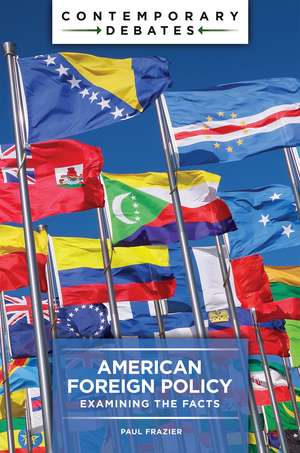
American Foreign Policy
Autor Paul Frazieren Limba Engleză Hardback – 23 ian 2025
Notăm cu interes apariția volumului American Foreign Policy, o resursă academică esențială pentru nivelul de licență și master în științe politice și relații internaționale. Publicată de BLOOMSBURY ACADEMIC, lucrarea semnată de Paul Frazier se distinge printr-o abordare bazată strict pe fapte, oferind instrumentele necesare pentru a naviga prin dezbaterile partizane complexe referitoare la securitatea națională, drepturile omului și prosperitatea economică a Statelor Unite. Structura volumului este una pragmatică, organizată sub formă de întrebări și răspunsuri care vizează pilonii diplomației americane. Găsim în această carte analize detaliate despre rolul SUA în NATO și ONU, precum și examinări ale conceptelor de „putere vacuum” sau „balanța puterii”. Această metodologie de fact-checking extinde cadrul teoretic propus de The Politics of U.S. Foreign Policy and NATO de Chris J. Dolan, aducând date concrete despre prezența militară globală și impactul alianțelor asupra stabilității europene. În timp ce Dolan se concentrează pe presiunile politice interne, Frazier oferă o bază documentară din surse primare și rapoarte guvernamentale pentru a explica motivele din spatele acțiunilor externe. Poziționată în contextul operei autorului, lucrarea completează perspectiva narativă din The Cold War on Film. Dacă în volumul anterior Paul Frazier explora modul în care cinematografia a modelat memoria colectivă a Războiului Rece, în American Foreign Policy acesta trece la o analiză factuală a realităților geopolitice actuale. Ritmul este alert, susținut de o succesiune logică de la concepte fundamentale la motivele etice ale intervențiilor, precum teoria războiului just, oferind o claritate necesară într-un domeniu marcat adesea de retorică politică.
Preț: 295.40 lei
Preț vechi: 533.73 lei
-45%
Carte disponibilă
Livrare economică 09-23 noiembrie
Specificații
ISBN-10: 1440879419
Pagini: 176
Dimensiuni: 158 x 238 x 16 mm
Greutate: 0.45 kg
Editura: BLOOMSBURY ACADEMIC
Locul publicării:New York, United States
De ce să citești această carte
Recomandăm această carte studenților și profesioniștilor care caută o sinteză rapidă și obiectivă a politicii externe americane. Spre deosebire de manualele teoretice dense, volumul lui Paul Frazier oferă răspunsuri directe la întrebări presante despre influența SUA în lume, utilizând date verificate. Este un instrument excelent pentru a înțelege mecanismele puterii americane dincolo de titlurile de știri, oferind o bază solidă pentru analize politice ulterioare.
Descriere
How much foreign aid does the United States give foreign countries? How many military bases do US forces have around the world, and for what reasons? Why are US attitudes about the North Atlantic Treaty Organization (NATO) so important to economic and political stability in Europe? Where do America's political parties stand on issues of free trade, counterterrorism, human rights, economic exploitation, and international cooperation on environmental issues such as climate change? How have US relations with China and Russia changed over the last half century?
This fact-checking resource answers all these questions and more, drawing on essential primary sources, authoritative government studies and reports, and top experts in the field. Rather than a specific ideological approach to the topic, this book presents the facts pertaining to the most consequential issues in American foreign policy and international relations today.
Cuprins
1: The United States and the World
Q1. Is it true that the United States contributes more to NATO than any other single nation?
Q2. Does membership in the United Nations enhance American foreign policy?
Q3. Does the United States maintain military bases all over the world?
Q4. Does collective security work?
Q5. Does the United States support or have alliances with non-democratic states?
2: Foreign Policy Concepts
Q6. Is the Thucydides Trap real?
Q7. Do the concepts of power vacuum and balance of power still drive foreign policy?
Q8. When is soft power most frequently used to address foreign policy challenges?
Q9. When is hard power most frequently used to address foreign policy challenges?
Q10. What are the central theories for international relations?
3: Foreign Policy Motives
Q11. Does the United States foreign policy include preemptive warfare?
Q12. What is just war theory and how does it apply to American foreign policy?
Q13. Is American foreign policy primarily concerned with national security?
Q14. Does the United States give foreign aid to other countries?
Q15. Does American foreign policy involve nation building?
4: Foreign Policy in History
Q16. Has the United States been mostly an isolationist country?
Q17. Did American foreign policy change dramatically after 9/11?
Q18. What was the Bush Doctrine, and did it achieve its objectives?
Q19. What was the Obama Doctrine, and did it achieve its objectives?
Q20. Was America's Cold War Containment Policy successful?
5: Foreign Policy in a Democratic Society
Q21. Does modern day news media influence American foreign policy?
Q22. Does public opinion play a role in America's foreign policy?
Q23. Does the American president have greater authority in foreign policy than in domestic policy?
Current and Future Issues in American Foreign Policy
Q24. Is China a threat to the United States?
Q25. Is Russia a threat to the United States?
Q26. What factors have shaped U.S. involvement in Africa's wars?
Other Factors in American Foreign Policy
Q27. Does concern for human rights drive American foreign policy?
Q28. Do environmental factors like climate change play a role in foreign policy?
Q29. Does farming and agriculture have an impact on foreign policy?
Q30. What role does economics play in foreign policy?