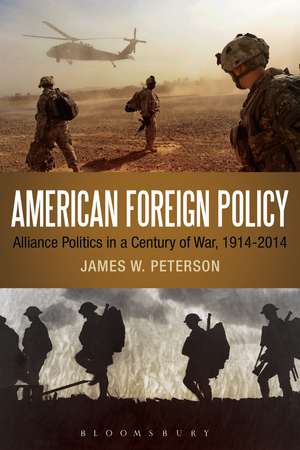
American Foreign Policy: Alliance Politics in a Century of War, 1914-2014
Autor James W. Petersonen Limba Engleză Paperback – 8 mai 2014
After a thorough discussion of the concepts of alliance building and the containment doctrine, the work then addresses such themes as the alliance networks used to confront German and Japanese powers during the early 20th century wars, the role of alliances in containing the Soviet Union during the Cold War, the creation of alliances to restrict and defeat rogue state powers, and whether they were useful when dealing with the challenges posed by terrorism in the post-9/11 world.
Each chapter features case studies, a summary, references, and web links. In addition, the book utilizes primary sources, such as U.S. Department of Defense and State documents and presidential statements. An exhaustive study of containment and alliance, this text will be an essential resource for anyone studying U.S. foreign policy, international relations, and national security.
Preț: 277.68 lei
Puncte Express: 417
Carte tipărită la comandă
Livrare economică 02-16 decembrie
Livrare prin curier în România Termenul estimat este afișat lângă disponibilitate.
Transport gratuit de la 400.00 lei Plată online sau ramburs, în funcție de opțiunile comenzii.
Retur gratuit în 14 zile Comandă securizată și suport în română.
Specificații
ISBN-13: 9781623560737
ISBN-10: 162356073X
Pagini: 216
Dimensiuni: 152 x 229 x 18 mm
Greutate: 0.34 kg
Ediția:New.
Editura: Bloomsbury Publishing
Colecția Bloomsbury Academic
Locul publicării:New York, United States
ISBN-10: 162356073X
Pagini: 216
Dimensiuni: 152 x 229 x 18 mm
Greutate: 0.34 kg
Ediția:New.
Editura: Bloomsbury Publishing
Colecția Bloomsbury Academic
Locul publicării:New York, United States
V-ar putea interesa
-
 Talking to TerroristsJonathan Powell-19%Preț: 76.51 lei93.98 lei
 -
 The Oxford Handbook of Modern DiplomacyAndrew F. Cooper-13%Preț: 324.72 lei374.33 lei
 -
 Preț: 200.77 lei
 -
 American Allies in Times of War: The Great AsymmetryStéfanie von Hlatky-31%Preț: 692.82 lei1006.59 lei
 -
 -31%Preț: 775.25 lei1124.44 lei
 -
 No Illusions: The Voices of Russia's Future LeadersEllen Mickiewicz-20%Preț: 191.45 lei239.16 lei
 -
 The New Public DiplomacyJ. Melissen-15%Preț: 718.74 lei845.58 lei
 -
 Diplomatic Theory from Machiavelli to KissingerG. Berridge-18%Preț: 1028.33 lei1254.06 lei
 -
 The Public Diplomacy ReaderJ. Michael WallerPreț: 221.36 lei
 -
 Battles to BridgesR S Zaharna-15%Preț: 637.96 lei750.55 lei
 -
 -24%Preț: 80.93 lei107.07 lei
 -
 China's Public DiplomacyIngrid D'Hooghe-23%Preț: 1263.49 lei1640.89 lei
Cuprins
Introduction: 1914: An Abrupt End to a Century and a Quarter of Isolationism
Part One: Alliance Networks and the Defeat of German and Japanese Power: Early Twentieth Century Hot Wars, 1914-1945
Chapter One: World War I, Temporary Alliance Networks, and American Leadership, 1914-1918
Chapter Two: World War II, Permanent Alliances, and American Internationalism, 1931-1945
Part Two: Role of Alliances in Containing the Power of the Soviet Union: Late Twentieth Century Cold War, 1945-1991
Chapter Three: War of Nerves with the Soviet Union: A Broad but Shaky Containment Alliance,
1945-1991
Chapter Four: Korean War: A Small Pacific-Based Containment Alliance and Stalemate, 1950-1953
Chapter Five: War in Southeast Asia: Absence of Allies, Non-Containment, and Defeat, 1964-1973
Part Three: Creation of Alliances to Restrict and Defeat Rogue State Power: Immediate Post-Cold War Period
Chapter Six: American-Led, United Nations Based Alliance to Check Saddam and Iraq, 1990-1991
Chapter Seven: American-Led, NATO-Based Alliance to Check Milosevic and Serbia, 1992-1999
Part Four: Utility and Disutility of Alliances in Dealing with Challenges from Terrorist Power, 2001-2014
Chapter Eight: America, NATO, and the War in Afghanistan, 2001-2014
Chapter Nine: America, Coalition of the Willing, and the War in Iraq, 2003-2011
Chapter Ten: Arab Spring, Discussions within Alliances, and the Potential for War, 2011-2014
Conclusion: 2014: Reflections on a Century of War and an Abrupt Transition to New Conflicts
Alliance Networks and the Defeat of Enemy European and Asian States, 1914-1945
Role of Alliances in Containing the Power of a Universalist State and its Empire, 1945-1991
Creation of Alliances to Counter Rogue States and their Regional Power, 1991-2001
Battle against Terrorism - Beneath , Above, Beyond, and Within, 2001-2014
Continuing Terrorism, Arab Resurgence, and Globalization, 2014 and after
"Mazar"
References
Part One: Alliance Networks and the Defeat of German and Japanese Power: Early Twentieth Century Hot Wars, 1914-1945
Chapter One: World War I, Temporary Alliance Networks, and American Leadership, 1914-1918
Chapter Two: World War II, Permanent Alliances, and American Internationalism, 1931-1945
Part Two: Role of Alliances in Containing the Power of the Soviet Union: Late Twentieth Century Cold War, 1945-1991
Chapter Three: War of Nerves with the Soviet Union: A Broad but Shaky Containment Alliance,
1945-1991
Chapter Four: Korean War: A Small Pacific-Based Containment Alliance and Stalemate, 1950-1953
Chapter Five: War in Southeast Asia: Absence of Allies, Non-Containment, and Defeat, 1964-1973
Part Three: Creation of Alliances to Restrict and Defeat Rogue State Power: Immediate Post-Cold War Period
Chapter Six: American-Led, United Nations Based Alliance to Check Saddam and Iraq, 1990-1991
Chapter Seven: American-Led, NATO-Based Alliance to Check Milosevic and Serbia, 1992-1999
Part Four: Utility and Disutility of Alliances in Dealing with Challenges from Terrorist Power, 2001-2014
Chapter Eight: America, NATO, and the War in Afghanistan, 2001-2014
Chapter Nine: America, Coalition of the Willing, and the War in Iraq, 2003-2011
Chapter Ten: Arab Spring, Discussions within Alliances, and the Potential for War, 2011-2014
Conclusion: 2014: Reflections on a Century of War and an Abrupt Transition to New Conflicts
Alliance Networks and the Defeat of Enemy European and Asian States, 1914-1945
Role of Alliances in Containing the Power of a Universalist State and its Empire, 1945-1991
Creation of Alliances to Counter Rogue States and their Regional Power, 1991-2001
Battle against Terrorism - Beneath , Above, Beyond, and Within, 2001-2014
Continuing Terrorism, Arab Resurgence, and Globalization, 2014 and after
"Mazar"
References
Recenzii
James Peterson has given us a coherent and informative analysis of U.S. foreign policy from a perspective often ignored. Anyone who has long studied American Foreign Policy should see things through a somewhat different lens after reading this book. It adds an important perspective to the American role in the world over the last century.
Utilizing a variety of theoretical perspectives James Peterson presents a compelling analysis of and commentary on the central role alliances have played in four distinct periods of global warfare that engaged American foreign policy from 1914-2014.
James Peterson presents an interesting and provocative account of the foreign policy of the United States. This volume provides a succinct and excellent overview of the four eras of American foreign policy, its twists and turns to accommodate an ever changing world, as well as its successes and failures over the last one hundred years that he appropriately calls a 'Century of War.'
Utilizing a variety of theoretical perspectives James Peterson presents a compelling analysis of and commentary on the central role alliances have played in four distinct periods of global warfare that engaged American foreign policy from 1914-2014.
James Peterson presents an interesting and provocative account of the foreign policy of the United States. This volume provides a succinct and excellent overview of the four eras of American foreign policy, its twists and turns to accommodate an ever changing world, as well as its successes and failures over the last one hundred years that he appropriately calls a 'Century of War.'