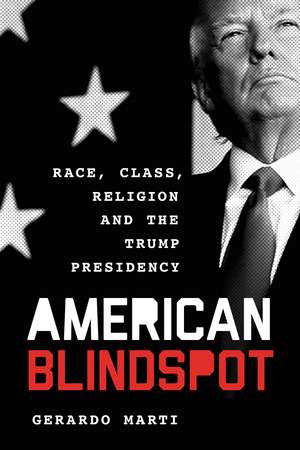
American Blindspot: Race, Class, Religion, and the Trump Presidency
Autor Gerardo Martíen Limba Engleză Paperback – 10 ian 2020
Nivel de studiu: Licență și Master. În volumul American Blindspot, sociologul Gerardo Martí propune o analiză riguroasă a forțelor sistemice care au precedat și susținut președinția lui Donald Trump. Departe de a fi un fenomen izolat sau o reacție spontană a clasei muncitoare, autorul demonstrează că victoria din 2016 este rezultatul unor sedimentări istorice profunde în care identitatea rasială, apartenența de clasă și convingerile religioase s-au întrepătruns constant. Reținem abordarea sa structurală: primele capitole reconstruiesc fundalul inegalității, de la sclavie la restricționarea cetățeniei, oferind contextul necesar pentru a înțelege de ce suportul evanghelic alb nu a fost un accident, ci o continuitate.
Subliniem modul în care Martí integrează dimensiunea economică, analizând 'turnura teologică' a creștinismului de la mijlocul secolului XX, care a fuzionat valorile religioase cu piața liberă și conservatorismul economic. Această perspectivă completează viziunea oferită de Trumpism de Carter A. Wilson, adăugând o profunzime istorică și sociologică asupra modului în care elitele economice și mișcările populiste au fost pregătite cultural timp de decenii. Dacă lucrarea lui Wilson se concentrează pe definirea mișcării ca populism de dreapta, Martí pune accent pe 'blindspot'-ul (punctul mort) național: incapacitatea de a vedea cum structurile etnoreligioase produc activ inegalitate.
În contextul operei sale, American Blindspot extinde preocupările autorului din Latino Protestants in America. În timp ce lucrarea anterioară analiza dinamica și creșterea comunităților protestante latine, noul volum investighează polul opus — naționalismul creștin alb — și modul în care acesta a devenit un pilon al puterii politice contemporane. Rezultatul este o cercetare academică echilibrată care explică mecanismele de putere din spatele retoricii politice actuale.
Preț: 186.86 lei
Preț vechi: 245.24 lei
-24%
Carte tipărită la comandă
Livrare economică 30 noiembrie-14 decembrie
Specificații
ISBN-10: 153811609X
Pagini: 272
Dimensiuni: 148 x 226 x 24 mm
Greutate: 0.49 kg
Editura: Bloomsbury Publishing
Colecția Rowman & Littlefield
Locul publicării:New York, United States
De ce să citești această carte
Recomandăm această carte studenților la științe politice și sociologie care doresc să înțeleagă rădăcinile istorice ale polarizării din SUA. Cititorul câștigă o perspectivă nuanțată asupra modului în care religia și rasa sunt utilizate pentru a justifica politici economice de elită. Este o lectură esențială pentru a descifra complexitatea naționalismului creștin și rolul său în modelarea democrației americane moderne, dincolo de analizele jurnalistice superficiale.
Descriere
Cuprins
Chapter 1: The Unexpected President: The 2016 Trump Election and White Evangelical Support
Chapter 2: Deep Cultural Background on Racial Inequality: Slavery and Territorial Expansion in Early America
Chapter 3: Racialized Power and Constraints of Freedom after Slavery: Failure of Reconstruction
Chapter 4: A "True American" Identity: Immigration and the Restriction of Citizenship
Chapter 5: Business-Friendly Evangelicalism: Theological Turn of Mid-Twentieth-Century Christianity
Chapter 6: The Establishment of Free-Market Conservatism: Religious Imperatives of Regan-Era Economics
Chapter 7: Reactionary Politics of the Tea Party: Barack Obama and His Critics
Chapter 8: Increased Concentration of Elite Wealth through Asset Growth: The 2007 Market Collapse and the Rule of Finance
Chapter 9: Identity Politics and Evangelical Support: Trump's White Christian Nationalism
Chapter 10: Conclusion: Ethnoreligious Structures of Inequality in the Trump Presidency
Notes
Bibliography
Recenzii
In American Blindspot: Race, Class, Religion and the Trump Presidency, Gerardo Martí deftly avoids facile, pop-explanations for Trump's ascendency, and instead provides a carefully crafted historical account of the interrelated racial, religious, political, and economic currents that together culminated in Trump's surprising 2016 victory. . . . given that much of the content of the book emerged from Martí's advanced seminar at Davidson, I think the book would make an ideal text for courses that touch on similar topics. I would also recommend it for the busy scholar or pastor wishing to access a one-stop text for learning about the problematic racial, religious, and economic streams feeding Trump's maddeningly resilient approval ratings.
Martí's book American Blindspot: Race, Class, Religion and the Trump Presidency is a thorough & broad-reaching scholarly analysis of evangelical Trumpism to date.He has read widely in the history and sociology of American evangelicalism, making his book a useful primer for pastors, laypeople, religion reporters and academics.
American Blindspot: Race, Class, Religion and the Trump Presidency by Gerardo Marti provides readers with an unflinching portrait of America in the hopes that clearer historical and sociological vision will produce more accurate political analysis in the future. . . . For a growing chorus of scholars, journalists, and activists, the key to overcoming this dissonance is by abandoning the easy mythology and embracing the messy complexity of the real Americanstory. American Blindspot is a fine contribution to this collective effort.
Overall, the American Blindspot tells an important history of America and provides a much needed insight on the social dynamics that led to the Trump presidency. . . this book would be a useful resource for all sociology instructors. . . . While reading the book, I found myself pausing to reflect, take notes, and have thought-provoking discussions with colleagues. Whether using it as a resource or assigning it for class, one will likely find American Blindspot to be constructive and compelling.
Writing with accessible clarity, Martí takes us through the long and deep history that has shaped the American system of white privilege, woven it into our identity and economic order, and sanctified it in the churches. Through both original historical sources and the best recent scholarship, this book shows us why we should not have been surprised by the 2016 election and its aftermath.
Examining intersecting inequalities based on race, religion, and economics, Gerardo Martí argues that Donald Trump's election revealed-rather than upended-deep histories in American culture and society. This engaging read, based on the latest scholarship, presents Trump as the embodiment of deep ethno-religious undercurrents. An unsettling, but important, message for those of us who hope for better from our nation.
In American Blindspot, Gerardo Martí makes a compelling case that the election of Donald Trump should not have come as a surprise. Drawing on expansive historical and sociological evidence, he demonstrates that support for Trump reflects longstanding patterns of behavior and deeply entrenched commitments.