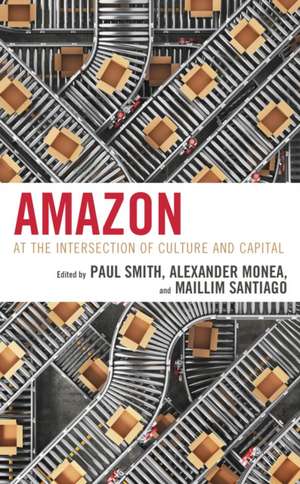
Amazon: At the Intersection of Culture and Capital
Editat de Paul Smith, Alexander Monea, Maillim Santiagoen Limba Engleză Paperback – 29 ian 2025
As Amazon changes the face of capitalist business, it is also changing global culture in multiple ways. This book brings together some of the most important analyses of Amazon's pioneering business practices and how they intersect with and affect the components of everyday culture. Its contributors examine the political economy of Amazon's platform, making the argument that it operates as an unregulated monopoly that is disruptive to the global economy and that its infrastructure and logistical operations increasingly alienate its workers and wreak many other social harms.
Our contributors outline the practices of resistance that have been employed by organizers ranging from Amazon employees to artists to digital piecemeal laborers working on Amazon's Mechanical Turk platform. They examine the broader cultural impact that Amazon has had, looking at things like Amazon Prime and the creation of unending consumption, the absorption of Whole Foods and its brand of 'conscious capitalism,' and the impact of Amazon Studios and Prime Video on everyday film and television viewing practices.
This book examines the broader environmental impacts that Amazon is having on the world, looking at the slow violence it incurs, its underwhelming Climate Pledge, and the regional impacts that its business practices have. Lastly, this book gathers together some important artistic responses to Amazon for the first time in an appendix that offers readers insight into other ways in which critics of the company are making their voices heard and attempting to move broader audiences into solidarity against Amazon.
Preț: 224.12 lei
Preț vechi: 289.89 lei
-23%
Puncte Express: 336
Carte tipărită la comandă
Livrare economică 28 noiembrie-12 decembrie
Livrare prin curier în România Termenul estimat este afișat lângă disponibilitate.
Transport gratuit de la 400.00 lei Plată online sau ramburs, în funcție de opțiunile comenzii.
Retur gratuit în 14 zile Comandă securizată și suport în română.
Specificații
ISBN-13: 9781538175583
ISBN-10: 1538175584
Pagini: 368
Ilustrații: 32 colour photos; 1 tables;
Dimensiuni: 148 x 228 x 24 mm
Greutate: 0.49 kg
Editura: Bloomsbury Publishing
Colecția Rowman & Littlefield
Locul publicării:New York, United States
ISBN-10: 1538175584
Pagini: 368
Ilustrații: 32 colour photos; 1 tables;
Dimensiuni: 148 x 228 x 24 mm
Greutate: 0.49 kg
Editura: Bloomsbury Publishing
Colecția Rowman & Littlefield
Locul publicării:New York, United States
Cuprins
Acknowledgements
Introduction
I.The Political Economy of Amazon
1.Lina Khan, "Amazon's Anti-Trust Paradox" [Reprint]
2.Ulysses Pascal, "Amazon 1-Click and the Value of Broken Infrastructure"
3.Nikolaus Poechhacker and Eva-Maria Nyckel, "The Logistics of Probability: Anticipatory Shipping and the Production of Markets" [Reprint]
4.Alessandro Delfanti, "Amazonian Fulfillment: Machinic Dispossession and Augmented Despotism"
II.Practices of Resistance
5.Jamie Woodcock and Callum Cant, "Platforms, Resistance, Organizing"
6.xtine burrough, "Disrupting Work with Play on Mturk.com: A Visual Essay"
7.Lilly Irani, "Difference and Dependence among Digital Workers: The Case of Amazon Mechanical Turk" [Reprint]
III.Amazon and Culture
8.David Arditi, "Unending Consumption: A Prime Example"
9.Lisa Daily, "Amazon Eats Whole Foods"
10.Maillim Santiago, "Virtuous Viewing and Amazon Studios"
IV.Environmental Impact
11.Brett Hutchins, Libby Lester, Richard Maxwell, Toby Miller, and Whitney Monaghan, "Quick and Sl
Introduction
I.The Political Economy of Amazon
1.Lina Khan, "Amazon's Anti-Trust Paradox" [Reprint]
2.Ulysses Pascal, "Amazon 1-Click and the Value of Broken Infrastructure"
3.Nikolaus Poechhacker and Eva-Maria Nyckel, "The Logistics of Probability: Anticipatory Shipping and the Production of Markets" [Reprint]
4.Alessandro Delfanti, "Amazonian Fulfillment: Machinic Dispossession and Augmented Despotism"
II.Practices of Resistance
5.Jamie Woodcock and Callum Cant, "Platforms, Resistance, Organizing"
6.xtine burrough, "Disrupting Work with Play on Mturk.com: A Visual Essay"
7.Lilly Irani, "Difference and Dependence among Digital Workers: The Case of Amazon Mechanical Turk" [Reprint]
III.Amazon and Culture
8.David Arditi, "Unending Consumption: A Prime Example"
9.Lisa Daily, "Amazon Eats Whole Foods"
10.Maillim Santiago, "Virtuous Viewing and Amazon Studios"
IV.Environmental Impact
11.Brett Hutchins, Libby Lester, Richard Maxwell, Toby Miller, and Whitney Monaghan, "Quick and Sl
Recenzii
An essential contribution to critical scholarship on platform capitalism, and on Amazon as its titan. Through its transdisciplinary approach, the book offers a comprehensive analysis of Amazon's apparatus, exposing the ways in which the company consolidates power through technological innovation, labour exploitation, and environmental degradation.
Technology-driven web development led to the creation of e-commerce and platform-based businesses, which occupy these new spaces and serve largely virtual markets. Amazon specifically developed multiple products, services, and technologies for a wide array of consumers, and the Amazon family of products evolved into its own culture. Fueled by social media and the pandemic, Amazon's culture now links its various product platforms, giving rise to new business opportunities in the spaces between platforms. This integrated culture has rewritten many of the rules for a "traditional" business. The editors of this volume assembled a series of related essays spotlighting various aspects of this culture and outlining exactly what Amazon has built, acquired, and accumulated. The authors examine Amazon's functionality as an "unregulated monopoly," its labor and safety practices, and its social good and harm. This volume is one of the few places where readers can view Amazon both as a whole and through its parts. It will facilitate fact-based discussion of Amazon's benefits and liabilities and new mechanisms and regulations to deal with the various impacts of this multifaceted, global company. Recommended. Undergraduates through faculty and professionals
Amazon: At the Intersection of Culture and Capital is a highly readable, provocative, and insightful collection of perspectives on Amazon's digital dominance. Featuring work ranging from antitrust analysis to artistic interventions, the book is impressively well-curated, critiquing undue concentration of platform power while sketching paths toward more equitable and democratic commerce.
Amazon: At the Intersection of Culture and Capital offers a set of investigations ingeniously put together to depict Amazon's multifaceted history, from its (intellectual) monopolistic behaviors, its performative effects on consumption and how it deepens ecological crises to its workers' struggles and social and artistic activism to raise awareness and fightback. This is a must-read book for those willing to know more about how digital technologies and big data underlie every single corner of Amazon's business, from its e-commerce marketplace to its black-box digital services on the cloud to its digital technologies that organize logistics and control its workers.
In recent years, no single institution has become more ubiquitous, more central to the material culture and everyday commercial life of people across much of the globe, than Amazon. Nobody studying contemporary economics, culture, society, or politics can avoid the need to say something about it. The diverse and rigorous contributions to this indispensable volume do exactly that, from a wide range of disciplinary and critical perspectives. As such, this book offers a tremendously impressive set of insights into the nature of contemporary capitalism and power.
Technology-driven web development led to the creation of e-commerce and platform-based businesses, which occupy these new spaces and serve largely virtual markets. Amazon specifically developed multiple products, services, and technologies for a wide array of consumers, and the Amazon family of products evolved into its own culture. Fueled by social media and the pandemic, Amazon's culture now links its various product platforms, giving rise to new business opportunities in the spaces between platforms. This integrated culture has rewritten many of the rules for a "traditional" business. The editors of this volume assembled a series of related essays spotlighting various aspects of this culture and outlining exactly what Amazon has built, acquired, and accumulated. The authors examine Amazon's functionality as an "unregulated monopoly," its labor and safety practices, and its social good and harm. This volume is one of the few places where readers can view Amazon both as a whole and through its parts. It will facilitate fact-based discussion of Amazon's benefits and liabilities and new mechanisms and regulations to deal with the various impacts of this multifaceted, global company. Recommended. Undergraduates through faculty and professionals
Amazon: At the Intersection of Culture and Capital is a highly readable, provocative, and insightful collection of perspectives on Amazon's digital dominance. Featuring work ranging from antitrust analysis to artistic interventions, the book is impressively well-curated, critiquing undue concentration of platform power while sketching paths toward more equitable and democratic commerce.
Amazon: At the Intersection of Culture and Capital offers a set of investigations ingeniously put together to depict Amazon's multifaceted history, from its (intellectual) monopolistic behaviors, its performative effects on consumption and how it deepens ecological crises to its workers' struggles and social and artistic activism to raise awareness and fightback. This is a must-read book for those willing to know more about how digital technologies and big data underlie every single corner of Amazon's business, from its e-commerce marketplace to its black-box digital services on the cloud to its digital technologies that organize logistics and control its workers.
In recent years, no single institution has become more ubiquitous, more central to the material culture and everyday commercial life of people across much of the globe, than Amazon. Nobody studying contemporary economics, culture, society, or politics can avoid the need to say something about it. The diverse and rigorous contributions to this indispensable volume do exactly that, from a wide range of disciplinary and critical perspectives. As such, this book offers a tremendously impressive set of insights into the nature of contemporary capitalism and power.