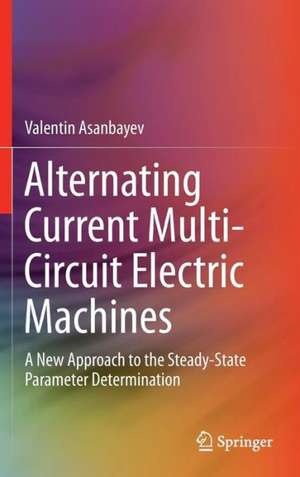
Alternating Current Multi-Circuit Electric Machines
Autor Valentin Asanbayeven Limba Engleză Hardback – 19 mar 2015
Preț: 1300.91 lei
Preț vechi: 1586.48 lei
-18%
Puncte Express: 1951
Carte tipărită la comandă
Livrare economică 07-21 decembrie
Livrare prin curier în România Termenul estimat este afișat lângă disponibilitate.
Transport gratuit pentru acest produs Plată online sau ramburs, în funcție de opțiunile comenzii.
Retur gratuit în 14 zile Comandă securizată și suport în română.
Specificații
ISBN-13: 9783319101088
ISBN-10: 3319101080
Pagini: 932
Ilustrații: XVI, 914 p. 328 illus.
Dimensiuni: 160 x 241 x 55 mm
Greutate: 1.49 kg
Ediția:2015
Editura: Springer International Publishing
Locul publicării:Cham, Switzerland
ISBN-10: 3319101080
Pagini: 932
Ilustrații: XVI, 914 p. 328 illus.
Dimensiuni: 160 x 241 x 55 mm
Greutate: 1.49 kg
Ediția:2015
Editura: Springer International Publishing
Locul publicării:Cham, Switzerland
V-ar putea interesa
-
 Reliability of MicrotechnologyJohan Liu-18%Preț: 912.50 lei1112.81 lei
-
 Microelectronic Test Structures for CMOS TechnologyManjul Bhushan-18%Preț: 765.29 lei933.28 lei
-
 Lead Free SolderJohn Hock Lye Pang-18%Preț: 697.19 lei850.23 lei
-
 Life-Cycle Assessment of SemiconductorsSarah B. Boyd-15%Preț: 617.26 lei726.18 lei
-
 Wafer-Level Chip-Scale PackagingYong Liu-18%Preț: 1038.07 lei1265.94 lei
-
 Coriolis Vibratory GyroscopesVladislav Apostolyuk-31%Preț: 462.83 lei670.78 lei
-
 -15%Preț: 610.82 lei718.61 lei
-
 Control of Grid Connected PV Systems with Grid Support FunctionsElena Anamaria ManPreț: 333.18 lei
-
 Teoreticheskie osnowy oceniwaniq neopredelennosti izmerenijVladimir Kucheruk-8%Preț: 487.39 lei529.77 lei
-
 Automatic Speaker Recognition using Phase based FeaturesTharmarajah Thiruvaran-8%Preț: 486.92 lei529.26 lei
-
 Preț: 373.53 lei
-
 -18%Preț: 953.97 lei1163.38 lei
-
 Micro System Technologies 90Herbert Reichl-15%Preț: 671.72 lei790.25 lei
-
 ESD - The Scourge of ElectronicsSten HellströmPreț: 384.08 lei
-
 -15%Preț: 392.16 lei461.37 lei
-
 -15%Preț: 390.88 lei459.85 lei
-
 Supervision et diagnotic des proce¿de¿s de production d'eau potableHector HernandezPreț: 417.47 lei
-
 Conception et Caractérisation d'Antennes MillimétriquesRami Alkhatib-15%Preț: 535.51 lei630.01 lei
-
 La Prédiction des Séries TemporellesRaihane Mechgoug-19%Preț: 434.07 lei535.89 lei
-
 La réception des images satellitairesWassila Leila RahalPreț: 346.39 lei
-
 Compression progressive d¿images par une transformation hybrideAbdennour Boukaache-15%Preț: 444.28 lei522.68 lei
-
 Variateur de vitesse pour moteur asynchrone 2,2KgNesrine FerjaniPreț: 342.61 lei
-
 Preț: 324.52 lei
-
 Caractérisation des supraconducteursJulien Leclerc-19%Preț: 433.85 lei535.62 lei
-
 Etude Du Couplage Entre Antennes Imprimees: Quel Test Choisir?Mohammed Fawzi Bendahmane-15%Preț: 420.20 lei494.35 lei
-
 La Vision Dans L'Industrie de L'Automobile: Quel Test Choisir?Fayçal HamdaouiPreț: 421.23 lei
-
 -15%Preț: 472.93 lei556.39 lei
-
 Preț: 329.78 lei
-
 -15%Preț: 663.90 lei781.06 lei
Public țintă
ResearchCuprins
Preface.- Chapter 1. Introduction.- Chapter 2. Fundamentals of the Field Decomposition Principle.- Chapter 3. The Specific System of Units: The EMF, Currents and Circuit-Loop Elements.- Chapter 4. The Magnetic Circuit Regions: The Magnetizing Reactances.- Chapter 5. The Cylindrical Magnetic Circuit Regions: The Magnetizing Reactances.- Chapter 6. The Magnetic Circuit Regions: The Magnetizing Reactances in Terms of the Curvature.- Chapter 7. The Passive and Active Conducting Layers: The Circuit-Loops.- Chapter 8. The Single -Winding Rotor Induction Machine Circuit-Loops: Weak Skin Effect.- Chapter 9. The Single-Cage Rotor: The Slot Leakage Circuit-Loops.- Chapter 10. The Single-Cage Rotor Ladder Networks: The Multi-Circuit-Loops.- Chapter 11. The Single-Cage Rotor Ladder Networks: The Single-and Double-Circuit-Loops.- Chapter 12. The Double-Cage Rotor Circuit-Loops: Weak Skin Effect.- Chapter 13. The Double-Cage Rotor: The Slot Leakage Circuit-Loops.- Chapter 14. The Triple-Cage Rotor Circuit-Loops: Weak Skin Effect.- Chapter 15. The Triple-Cage Rotor: The Slot Leakage Circuit-Loops.- Chapter 16. The Slotted Solid Rotor Circuit-Loops: Weak Skin Effect.- Chapter 17. The Slotted Solid Rotor: The Leakage Circuit-Loops.- Chapter 18. The Squirrel-Cage Solid Rotor Circuit-Loops: Weak Skin Effect.- Chapter 19. The Squirrel-Cage Solid Rotor: The Leakage Circuit-Loops.- Chapter 20. The Solid Rotor with the Conducting Slot Wedges: The Circuit-Loops at the Weak Skin Effect.- Chapter 21. The Solid Rotor with the Conducting Slot Wedges: The Leakage Circuit-Loops.- Chapter 22. The Wound Solid Rotor Circuit-Loops: Weak Skin Effect.- Chapter 23. The Wound Solid Rotor: The Leakage Circuit-Loops.
Textul de pe ultima copertă
This book details an approach for realization of the field decomposition concept. The book presents the methods as well as techniques and procedures for establishing electric machine circuit-loops and determining their parameters. The methods developed have been realized using the models of machines with laminated and solid rotor having classical structure. The use of such models are well recognized and simplifies practical implementation of the obtained results.
This book also:
· Includes methods for a construction of electric machine equivalent circuits that allows the replacement of the field models of the machine with simple circuit models
· Demonstrates the practical implementation of the proposed techniques and procedures
· Presents parameters of the circuit-loops in the form most convenient for practical implementation
· Uses methods based on machine models widely used in practice
Notă biografică
Dr. Valentin Asanbayev was born in Russia in 1939. He graduated from Kiev Polytechnic Institute (Ukraine) in 1966. From 1966 to 1995, he worked at the National Academy of Science of Ukraine (Institute of Electrodynamics), dealing with problems related to the research and development of powerful turbine generators. The last position he held was the leading research fellow. In 1995, he immigrated to the United States.